

You just took a pregnancy test and got a result you weren’t expecting. Maybe the line was faint. Maybe you dropped the stick in the sink. Or maybe you simply want to double-check before telling anyone. So you look at the plastic stick sitting on the counter and wonder: can you use it again?
No. A pregnancy test cannot be reused. Once the test strip has absorbed urine and the chemical reaction has happened, that reaction is finished. The result you see is the only result that test will ever give you. Re-dipping it in urine, waiting longer, or putting it under a different light will not produce new or more accurate information. In fact, trying to reuse a test is one of the most common reasons people get confusing or false readings.
Here is what is actually happening inside that little stick, why reuse fails, and what to do instead if you need a clearer answer.
How Does a Pregnancy Test Actually Work?
A pregnancy test detects a hormone called human chorionic gonadotropin, or hCG. This hormone is produced by the cells that form the placenta after a fertilized egg implants in the uterus. hCG shows up in urine and blood shortly after implantation.
Inside the test stick is a strip of treated paper. As urine moves up the strip, it carries any hCG with it. If hCG is present, it binds to special antibodies on the strip. That binding creates a visible line, or in the case of digital tests, triggers the electronics to display a result.
The key point: this is a one-time chemical reaction. The antibodies on the strip are designed to grab hCG once as the urine flows past. After that first pass, the strip is saturated. There is no fresh antibody left to react with a second sample. The test has done its job and it is spent.
This is why every manufacturer instructs you to read the result within a specific window, usually a few minutes. Before that window, the reaction may not be finished. After it, the strip can dry out and develop what is called an evaporation line, which can look like a faint positive but is not one.
Why Can’t You Just Dip It Again?
People try to reuse tests for understandable reasons. Tests cost money. Waiting feels unbearable. And if the first result was faint, it is tempting to think a second dip will make things clearer.
It will not. Here is why.
- The antibodies on the strip are already bound. They cannot capture new hCG.
- The strip is already wet with the first sample. Adding more urine does not restart the reaction.
- Drying and re-wetting the strip can create false lines that have nothing to do with hCG.
- Bacteria and contaminants from handling can change how the strip looks.
Any line that appears after you reuse a test is unreliable. It could be an evaporation line, a dye run, or leftover reaction from the first use. It cannot be trusted to tell you whether you are pregnant.
There is one narrow exception worth mentioning, and it is not really “reuse.” Some midstream tests are designed so the result window is read once, but the absorbent tip can technically be dipped in urine instead of held in the stream. This is still a single use. You are choosing one method of exposure, not getting two tests out of one stick.
What About Reading the Test Later?
Reading a test after the recommended window is not reuse, but it causes the same kind of confusion. A test that looked negative at three minutes might show a faint line at thirty minutes. That line is almost always an evaporation line, not a positive result.
The instructions that come with your test tell you exactly how long to wait and when to stop reading. Those windows exist because the test makers know how the strip behaves over time. A result read outside the window is not valid, whether it is positive or negative.
If you truly cannot tell what your test shows within the window, the answer is not to stare at it longer. The answer is to take a new test.


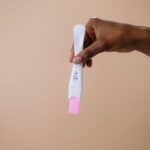


Can You Reuse a Pregnancy Test if It Was Negative?
No. A negative test is just as used up as a positive one. The strip has already been exposed to urine and the reaction has run its course.
A negative result means hCG was not detected at the level the test can measure. That could be because you are not pregnant, or because you tested too early. The test itself cannot tell you which. Reusing it will not clarify anything.
If your period is late and your test is negative, the standard advice is to wait a few days and test again with a new stick. hCG levels roughly double every couple of days in early pregnancy, so a test taken too early can miss a pregnancy that a test taken a few days later would catch.
Does a Faint Line Mean You Should Test Again?
A faint line within the reading window usually counts as a positive result. The test is designed to show a line whenever hCG is present above its detection threshold. A faint line generally means hCG is present, just at a lower level.
That said, faint lines are genuinely hard to interpret, and test instructions vary. Some brands are more sensitive than others. Lighting, camera flash, and the angle you view the strip from can all change how a line looks.
If you see a faint line and you are unsure, the right move is to wait a day or two and take a fresh test. Do not reuse the old one. Do not dig it out of the trash to compare. Take a new test and read it within the window.
What If You Need a Clearer Answer?
Home urine tests are quite accurate when used correctly and read on time. But they are not perfect, and timing matters a lot in early pregnancy.
If you keep getting results you cannot interpret, or if your results do not match what your body seems to be telling you, a blood test can measure hCG directly. Blood tests can detect hCG earlier and give a numeric value rather than a line. A healthcare provider can order one and help you interpret it.
This is also the right step if you have symptoms that concern you, such as pain, heavy bleeding, or dizziness. Those symptoms deserve medical attention regardless of what a home test shows.
How to Get an Accurate Result the First Time
Getting a clear answer comes down to a few basics that are well established.
- Test with first-morning urine when possible. It is more concentrated, which makes hCG easier to detect early on.
- Follow the timing instructions on your specific test exactly.
- Read the result only within the window the manufacturer gives you.
- Use a new test for every attempt.
- If you test early and get a negative result, wait a few days before testing again.
One detail people often miss: how much water you drink before testing can dilute your urine and lower the hCG concentration. If you drank a lot of fluids right before testing, that alone can turn a would-be positive into a negative. First-morning urine avoids this problem.
Why This Matters More Than It Seems
Reusing a pregnancy test is not just a waste of effort. It can lead to a wrong conclusion at a moment when accuracy matters.
A false positive from a reused or expired test can cause unnecessary worry. A false negative can delay a conversation with a doctor or a partner. Neither outcome is worth the few dollars saved by trying to stretch one test into two.
Pregnancy tests are single-use medical devices. That is not a marketing choice. It is how the chemistry works. The strip is built to react once, and once that reaction is done, the test has no more information to give.
Frequently Asked Questions
Can you reuse a pregnancy test to confirm a result?
No. A used test cannot produce a new result because the chemical reaction on the strip is already complete. To confirm a result, take a brand-new test.
What happens if you dip a pregnancy test twice?
The strip has no fresh antibodies left to react with new hCG, so any line that appears is unreliable. It is most likely an evaporation line or leftover dye, not a true result.
Can a pregnancy test show positive after sitting for hours?
A line that appears after the reading window is usually an evaporation line and does not mean you are pregnant. Only results read within the manufacturer’s stated window are valid.
How long should you wait before taking another pregnancy test?
If you tested early and got a negative result, waiting a few days before testing again with a new stick improves your chances of an accurate reading. hCG levels rise quickly in early pregnancy, so timing matters.
