
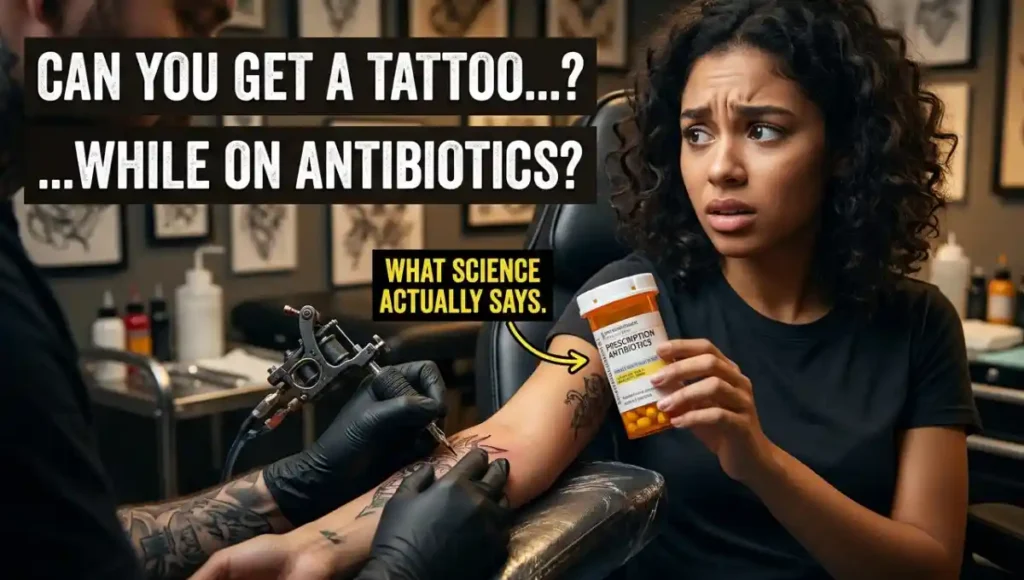
You’ve got a tattoo booked. You’re also on antibiotics. Now you’re wondering if you should go ahead.
Maybe it’s a sinus infection that hit right before your appointment. Maybe your dentist put you on a short course last week. Either way, the appointment is close, and you need an answer, not a guess.
Here’s the real answer: it depends on why you’re taking them, not just that you’re taking them. A few minutes of reading this will tell you exactly where you stand.
Get this call wrong, and you’re not just risking a bad healing process — you’re risking a deposit you won’t get back and a slot you’ll have to rebook anyway. Worth getting right the first time.
Why This Isn’t a Simple Yes or No
A tattoo is thousands of tiny puncture wounds. Your immune system has to close them up and keep bacteria out while that happens.
Antibiotics usually mean one of two things: you’re fighting an infection right now, or you’re preventing one before a procedure. Both situations keep your immune system busy. Add a fresh tattoo wound, and it now has two jobs instead of one.
That split attention is the whole reason this question matters. It’s not about the pill. It’s about what your body is already handling.
A tattoo normally takes about two to three weeks to fully heal on its own, with a healthy immune system running at full strength the entire time. Ask that same system to also fight off an infection, and you’re stretching the same resources across two repair jobs at once — like asking one crew to finish two work sites on the same deadline.
Does It Depend on Which Antibiotic?
A little, yes. Here’s what’s worth knowing:
- Doxycycline and similar drugs can make your skin more sun-sensitive.1Skin Hypersensitivity to Sun Light Due to Doxycycline Ingestion Causing Hand Partial-Thickness Burn, PubMed Central.↓ Fresh tattoos already need to stay out of the sun, so this adds two reasons to be careful.
- Antibiotics for a skin infection mean you should avoid tattooing anywhere near that area. A new wound next to an active infection is asking for trouble.
- Short preventive courses, like before a dental cleaning, carry lower risk if you feel completely normal otherwise.
But the drug name matters less than the next question.
What Matters More: Why You’re Taking It
You’re fighting an active infection
Your immune system is already at work. This is the clearest case to wait. Clearing the infection should get your body’s full attention, not a shared one.
You’re taking it as a precaution
Some antibiotics get prescribed before a procedure, even when you feel fine. Risk is lower here, but still ask your doctor directly. They know your history. A guess from a search engine doesn’t.
You just finished the course
Symptoms gone and medication finished is a good sign. It’s not an automatic green light. Your immune system can take a bit longer to fully bounce back, even after you feel normal again.
You’re on a long-term, low-dose antibiotic
This is a different case entirely. If you’re taking something like doxycycline for acne or rosacea over months, you’re not fighting an active infection, and your body has likely adjusted to the medication. This group usually faces the lowest risk of the four, but the sun-sensitivity issue still applies, so aftercare sun protection matters even more here.
What Can Actually Go Wrong
Knowing the real risk makes this easier to judge for yourself, instead of just following a rule blindly.
- Slower healing — skin takes longer to close, staying open to bacteria for longer.
- Higher infection risk — a distracted immune system fights off bacteria less effectively, even with good aftercare.
- Uneven ink retention — poor healing can cause patchy color or faded lines once the tattoo settles.
- Feeling worse overall — tattooing is a mild stress on the body on its own. Combined with an infection, it adds up.
People with weakened immunity — from illness, certain medications, or conditions like diabetes — face a measurably higher risk of tattoo-related infection, according to emergency medicine researchers who’ve studied tattoo complications directly.2Unusual complication of a tattoo in an immunosuppressed patient, https://doi.org/10.1136/bcr-2018-224968↓
What Tattoo Artists Usually Ask
A responsible studio will ask about your health before you sit down. Expect questions like these, and expect a good artist to turn you away if the answer is concerning:
- Have you finished your antibiotics and recovered fully?
- Any ongoing health conditions beyond the current prescription?
- How do you feel right now, not just on paper?
If a studio skips these questions entirely, that says something about how carefully they operate overall.
After You Finish the Course
Many artists and clinics suggest a short buffer, several symptom-free days, after your last dose before booking. It’s a small window that gives your immune system room to fully reset instead of jumping straight from “last pill” to “under the needle.” If your infection was more serious, check timing with your doctor instead of guessing.
Don’t go by the calendar alone. Check how you actually feel — normal energy, normal appetite, normal sleep. If you’re still dragging a few days after your last dose, your body is telling you it needs more time, prescription label or not.
And if you were on something like doxycycline, give your skin a few extra days past that buffer too, since sun-sensitivity from the medication can linger slightly after you stop taking it.
Already Have a Tattoo Infection?
Different question, different answer. Watch for increasing redness, swelling, warmth, pus, or fever. That calls for a doctor visit, not a leftover prescription from your medicine cabinet. Treating a tattoo infection without actually identifying the specific bacteria involved often means picking the wrong antibiotic entirely.
Timing is a useful clue here. Normal healing redness and mild swelling usually ease up within the first few days. True infection typically does the opposite — it gets worse over two to three days instead of better, according to CDC guidance on tattoo safety. If your tattoo is trending in the wrong direction instead of settling down, that’s the signal to stop waiting it out and get it checked.
The Bottom Line
Being on antibiotics doesn’t shut the door on tattoos forever. It’s a reason to pause and check, not panic and cancel automatically. Fighting an active infection? Wait it out. Short preventive course and feeling genuinely fine? A quick call to your doctor settles it. A few days of patience protects both your health and the tattoo you’re planning to carry for life.
Frequently Asked Questions
Can you get a tattoo while on antibiotics?
Yes, but it's usually better to wait. If the antibiotics are treating an active infection, your immune system is already busy, and a fresh tattoo wound adds more work. If it's a short preventive course and you feel fine, ask your doctor first.
What are the risks of getting a tattoo while on antibiotics?
Slower healing, higher infection risk, and uneven ink retention are the main risks. Your immune system has to split its attention between whatever the antibiotics are treating and the new tattoo wound, which can leave both healing less smoothly.
How long should you wait to get a tattoo after antibiotic treatment?
A few symptom-free days after your last dose is a reasonable buffer for most minor infections. For anything more serious, check the exact timing with your doctor instead of guessing based on the calendar alone.
Does taking antibiotics affect your immune system during tattoo healing?
Indirectly, yes. The antibiotics themselves aren't the issue — it's whatever your body is fighting off that keeps your immune system occupied. A tattoo heals best when your immune system can focus fully on the new wound, not split between two jobs.
Can doxycycline be used for an infected tattoo?
Doxycycline is sometimes prescribed for skin infections, but the right antibiotic depends on the specific bacteria causing the infection. A doctor needs to examine the tattoo before prescribing anything — self-treating with leftover medication isn't safe.
What is the best antibiotic for a tattoo infection?
There isn't one universal answer — it depends on the bacteria involved and how severe the infection is. A healthcare provider will typically examine the area, sometimes test it, and prescribe the antibiotic that matches what they find.
When do you need antibiotics for an infected tattoo?
If you notice increasing redness, swelling, warmth, pus, or fever around a new tattoo, see a doctor. These are signs of infection that typically need antibiotics, not just extra aftercare at home.
Scientific References
- 1Skin Hypersensitivity to Sun Light Due to Doxycycline Ingestion Causing Hand Partial-Thickness Burn, PubMed Central. ↩︎
- 2Unusual complication of a tattoo in an immunosuppressed patient, https://doi.org/10.1136/bcr-2018-224968 ↩︎
