

Can you digest chewing gum? No. Your body cannot break down the gum base at the center of chewing gum, and that part passes through your digestive tract largely unchanged. It does not sit in your stomach for seven years, though — that widely repeated claim is false. The gum base moves through your system at roughly the same pace as other indigestible material and leaves your body in your stool.
What your body does handle is everything around the base: the sweeteners, the flavorings, and the softeners. Those dissolve or get absorbed the same way other food components do. The confusion comes from treating gum as one substance. It is really two — a digestible outer layer and an indigestible core.
What Happens to Chewing Gum in Your Digestive System?
Chewing gum splits into two streams the moment you swallow it. The sugars, sugar alcohols, and flavor compounds are broken down and absorbed. The gum base is not.
That base is a blend of synthetic polymers — materials engineered to be elastic, water-insoluble, and resistant to enzymes. Your digestive tract runs on enzymes and acid that evolved to break down proteins, fats, and carbohydrates. Gum base is none of those things in a form your enzymes can act on. So it travels.
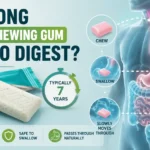
The journey looks like this:
- Mouth: Chewing releases sweeteners and flavor. Saliva begins breaking down any starch or sugar present. The base stays intact.
- Stomach: Acid and churning mix the gum with food. The base does not dissolve. It may soften slightly.
- Small intestine: Most nutrient absorption happens here. The base is not absorbed because it cannot be broken into absorbable pieces.
- Large intestine: The base continues moving with waste. Gut bacteria cannot ferment it.
- Exit: It leaves in stool, typically within a few days.
That timeline is not special to gum. Any indigestible material you swallow — corn kernels, seeds, cellulose from plants — follows a similar path. Transit time through the whole digestive tract in healthy adults is generally in the range of a day or several days, and it varies a lot from person to person.
Does Swallowed Gum Really Stay in Your Stomach for Seven Years?
The seven-year claim is a myth. No evidence supports it, and the physiology does not allow it.
Your stomach does not hold onto objects based on how hard they are to digest. It empties its contents into the small intestine as a matter of routine, whether or not those contents have been fully broken down. The stomach is a mixing chamber, not a sorting facility. Anything small enough to pass through the pylorus — the valve at the stomach’s exit — moves on.
There is one important exception. The stomach and intestines can only move material forward if it is small enough to pass. A single piece of gum is soft, pliable, and small. It passes. A large mass of gum, or gum combined with other indigestible material, is a different situation entirely — and that is where the real (though rare) medical cases come from.
The seven-year figure appears to be an old piece of folklore that spread because it is memorable. It has been repeated in classrooms, parenting advice, and casual conversation for decades. Repetition is not evidence.
Can Swallowing Gum Cause a Blockage?
Swallowing gum occasionally is not a known cause of blockage in healthy adults. Swallowing it repeatedly, or swallowing large amounts, is a different story.
There is a documented pattern in the medical literature of gum causing intestinal obstruction in specific groups. The cases cluster around:
- Young children who swallow gum often and in quantity
- People with a history of swallowing non-food items (a behavior called pica)
- People who have had certain types of gastrointestinal surgery
- People with existing narrowing or motility problems in the gut
In these cases, gum does not cause a blockage because it is sticky in some magical way. It causes one because multiple pieces can clump together into a mass — sometimes called a bezoar — that grows too large to move through a narrowed section of intestine. This is uncommon, and the cases reported in journals are individual case reports rather than large studies. That means the true frequency is not well established.
What this means practically: the danger is not one piece of gum. It is accumulation, and it is more relevant for small children than for adults. If a child swallows gum regularly, it is worth mentioning to a pediatrician — not because harm is likely, but because repeated swallowing is the behavior that shows up in the case reports.
-
 Does Chewing Gum Take 7 Years to Digest? What the Research Says
 -
How Long Does a Chewing Gum Take to Digest? What to Know
-
Does Chewing Gum Digest? What You Should Know
-
How Long Does it to Digest Gum? What the Research Says
-
ProDentim Reviews 2026 – Does This Oral Probiotic Really Improve Teeth and Gum Health?




Why Is Gum Base So Hard to Break Down?
Gum base is designed to resist your digestive system. That is not an accident — it is the point.
Modern gum base is typically made from a mix of synthetic polymers, often including materials in the same broad family as food-grade plastics and rubbers. Earlier gum bases used natural chicle, a latex from the sapodilla tree, which is also indigestible. Either way, the base is built to hold its shape under chewing, stay flexible, and not dissolve in saliva.
Those same properties make it resistant to stomach acid and digestive enzymes. It is worth being precise here: “resistant” does not mean “permanent.” It means your body has no tools to chemically dismantle it. Mechanical movement is what carries it through.
This is a useful distinction for understanding a lot of digestion questions. Being indigestible and being dangerous are not the same thing. Fiber is largely indigestible. So are many plant cell walls. Your gut handles indigestible material constantly. Gum base is simply a less familiar example.
What Actually Happens If You Swallow Gum by Accident?
Nothing unusual, in most cases. It passes through and comes out in your stool.
You will not feel it moving. You will not see it unless you look for it, and even then it may be hard to spot because it can be broken into smaller pieces by the time it exits. There is no need to monitor your stool, induce vomiting, or take anything to speed it along.
The one thing not to do is swallow more. That is the whole of the practical advice. A single accidental swallow is a non-event.
If a young child swallows a large amount of gum at once — several pieces or more — it is reasonable to call a pediatrician or a poison control center for guidance. Not because harm is likely, but because quantity is the variable that matters, and a clinician can assess it properly. For anything involving choking rather than swallowing, treat it as an emergency.
Is There Any Nutritional Value in Chewing Gum?
Almost none, and that is largely by design.
The sweeteners in gum do provide a small number of calories if they are sugar-based, but the amounts are tiny. Sugar-free gums use sugar alcohols or other low-calorie sweeteners, which contribute very few or no calories. The gum base, flavorings, and softeners contribute nothing your body can use.
One point worth separating from nutrition: chewing sugar-free gum after meals is sometimes recommended by dental professionals because chewing stimulates saliva, and saliva helps clear food particles and neutralize acids. That is a dental effect, not a nutritional one. It does not make gum a food, and it does not mean gum replaces brushing or flossing.
Some gums are marketed with added vitamins or other ingredients. The amounts are generally small, and there is no strong evidence that gum is an effective delivery method for them compared with simply eating those nutrients in food. Treat added-ingredient claims with skepticism.
Does Gum Affect Digestion in Other Ways?
Chewing gum can affect your gut in ways that have nothing to do with swallowing it.
Chewing stimulates saliva and swallowing. When you chew gum, you swallow more air and more saliva than usual. For some people, that leads to bloating or a feeling of fullness. Swallowing air — aerophagia — is a well-recognized cause of belching and abdominal discomfort.
Some sugar alcohols used in sugar-free gum, particularly sorbitol and mannitol, can cause gas, bloating, or loose stools when consumed in larger amounts. This is a known effect of these compounds and is dose-dependent. A piece or two is unlikely to matter for most people. Chewing a lot of sugar-free gum daily is a different situation, and some people are more sensitive than others.
None of this is about the gum base. It is about the other ingredients and the act of chewing. That distinction matters if you are trying to figure out why your stomach feels off after chewing gum.
Frequently Asked Questions
Can you digest chewing gum?
No. Your body cannot break down the gum base, which is the indigestible core of chewing gum. The sweeteners and flavorings are digested normally, but the base passes through and leaves in your stool.
How long does swallowed gum stay in your body?
It typically passes within a few days, similar to other indigestible material. The claim that it stays in your stomach for seven years is a myth with no supporting evidence.
Is swallowing gum dangerous?
Swallowing a piece by accident is not known to cause harm in healthy adults. Problems are rare and are associated with swallowing gum repeatedly or in large amounts, especially in young children or people with certain gut conditions.
Should I worry if my child swallows gum?
An occasional swallowed piece is generally not a concern. If a child swallows gum often or in large amounts, mention it to a pediatrician, since repeated swallowing is the pattern that appears in reported cases of blockage.
