
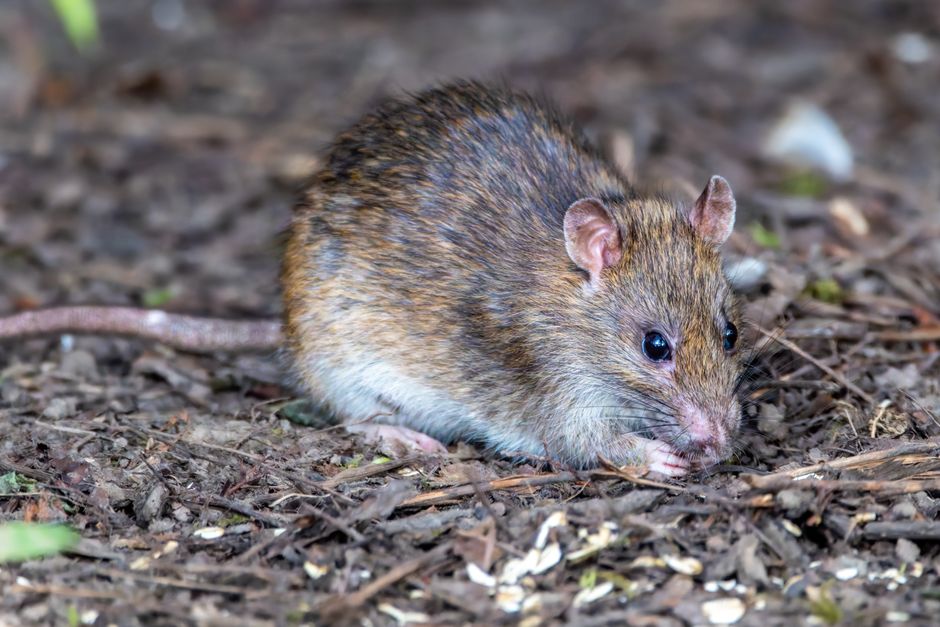
Rats are famously active at night, so it is natural to wonder if they can see in the dark. The short answer is yes, but not the way you might think. Rats do not have night vision like a cat or an owl, but their eyes are specially adapted for low-light conditions. They can navigate, find food, and avoid predators in near-total darkness using a combination of specialized vision, whiskers, and an excellent sense of smell.
How Do Rats See in Low Light?
Rat eyes are built differently from human eyes. The most important difference is the presence of a structure called the tapetum lucidum. This is a reflective layer behind the retina. It acts like a mirror, bouncing light back through the retina a second time. This gives the light-sensitive cells another chance to absorb it, which dramatically improves vision in dim settings.
This is the same structure that makes a cat’s eyes glow green or yellow in the dark. If you shine a flashlight at a rat at night, its eyes will reflect light back at you for the same reason. The tapetum lucidum is a major reason rats can see in conditions where a human would see almost nothing.
Rats also have a higher density of rod cells in their retinas. Rods are the photoreceptor cells responsible for detecting light and motion, but they do not detect color. Humans have more cone cells, which handle color and fine detail. This trade-off means rats sacrifice sharpness and color for sensitivity. They see a blurry, mostly monochrome world, but they can detect movement and shapes in very dim light.
Can Rats See in Complete Darkness?
No animal can see in total darkness. Vision requires at least some light to enter the eye. If a room has absolutely no light source, a rat is functionally blind, just like a human would be. The difference is that rats do not rely on vision alone when light is absent.
In complete darkness, rats switch to other systems. Their whiskers, or vibrissae, are highly sensitive tactile organs. They use them to detect air currents, vibrations, and physical contact with surfaces. This allows them to build a mental map of their surroundings without seeing anything. Their sense of smell is also far more developed than a human’s, helping them locate food and recognize familiar territory.
So while a rat cannot see in absolute blackness, it can still move around effectively. The combination of whisker input, smell, and spatial memory means a rat in a dark room is not helpless. It is simply using different tools than vision.
Are Rats Color Blind?
Rats are not completely color blind, but their color vision is very limited compared to humans. Research indicates that rats have two types of cone cells, making them dichromatic. Humans have three, which is why we see a full spectrum of color.
Rats can detect ultraviolet light, which humans cannot see. They are sensitive to blues and greens but have difficulty distinguishing reds from other dark colors. This is why red light is often used in animal research facilities. Researchers can observe rats under red light, and the rats behave as if they are in darkness.
For practical purposes, a rat’s world is dominated by shades of gray, blue, and green. Bright colors like red or orange likely appear as dark or muted tones. This has little impact on their survival because color is less important than motion detection and light sensitivity in their natural habitat.





How Does Rat Vision Compare to Human Vision?
Comparing rat vision to human vision highlights how different their visual priorities are. Humans are diurnal, meaning we are active during the day. Our eyes are optimized for bright light, color discrimination, and sharp focus. Rat eyes are optimized for low light, wide field of view, and motion detection.
Rats have a wider field of view than humans because their eyes are positioned on the sides of their heads. This gives them nearly 360-degree awareness, which is essential for spotting predators. However, this comes at a cost. They have a significant blind spot directly in front of their nose and poor depth perception because their eyes do not overlap as much as human eyes do.
Human vision is far sharper. A human with normal vision has 20/20 acuity. A rat’s visual acuity is estimated to be around 20/600. This means an object a human can clearly see at 600 feet, a rat would need to be within 20 feet to see with the same clarity. Rats see the world as a blurry, grainy image, but they do not need fine detail. They need to detect a hawk overhead or a fox in the grass, and their motion detection handles that well.
Do Rats Use Other Senses to Compensate?
Vision is only one part of how a rat perceives the world. In fact, for a nocturnal animal, relying on vision alone would be a serious disadvantage. Rats have evolved a suite of senses that work together in low-light environments.
Their sense of smell is exceptional. Rats have a much larger olfactory bulb relative to their brain size than humans do. They use scent to identify other rats, locate food, detect predators, and mark territory. In darkness, smell becomes a primary navigation tool.
Their hearing is also superior to human hearing in many ways. Rats can hear ultrasound frequencies above the range of human hearing. They use these high-frequency sounds to communicate with each other, and their hearing helps them detect the movement of insects and other small prey.
Whiskers provide tactile feedback that is constantly updated as the rat moves. This system is so refined that rats can navigate complex mazes in the dark using only their whiskers. The information from whiskers, smell, and hearing is integrated in the brain to form a complete picture of the environment, even when visual input is minimal.
Why Do Rats Prefer the Dark?
Rats are nocturnal, which means they are most active during the night. This is not a random preference. Being active in the dark is an evolutionary survival strategy. Many of the predators that threaten rats, such as hawks and some snakes, are diurnal. By moving at night, rats avoid these daytime hunters.
The dark also provides cover. Rats are prey animals, and their survival depends on avoiding detection. Darkness makes it harder for predators to see them, while their own low-light vision and other senses allow them to function effectively. This combination of reduced predation risk and maintained mobility makes nighttime the safest window for foraging and exploring.
This behavior has practical implications for pest control. If you see a rat during the day, it may indicate a large infestation or a sick animal. Healthy rats usually stay hidden during daylight hours and emerge only when light levels drop. Understanding this behavior helps explain why rat activity in homes often goes unnoticed until the infestation is well established.
Do All Rats Have the Same Vision?
There are many species of rats, but the most common is the Norway rat, also called the brown rat. This is the species that lives in cities and is often kept as a pet. The vision described in this article applies primarily to this species.
Other species, such as the black rat or the pack rat, have similar visual adaptations because they share the same nocturnal lifestyle. However, there is some variation in eye size and retinal structure between species that live in different environments. Rats that live in darker habitats, such as underground burrows, may have slightly larger eyes or more rod cells than those that live in brighter environments.
Pet rats have the same visual capabilities as wild rats. Owners sometimes notice that their pet rat seems to stare at nothing or bumps into objects. This is not a vision problem. It is simply the rat using its limited visual acuity and relying on whiskers to navigate. A pet rat recognizes its owner by smell and sound, not by facial features.
Frequently Asked Questions
Can rats see in the dark better than humans?
Yes, rats can see significantly better than humans in dim light because their eyes contain a reflective layer called the tapetum lucidum and a higher density of rod cells. However, neither rats nor humans can see in complete darkness.
Are rats afraid of light?
Rats are not afraid of light itself, but they avoid well-lit areas because bright light makes them more visible to predators. Their natural instinct is to stay in dark, sheltered places during the day.
Do rats have good eyesight?
Rats have poor visual acuity compared to humans, estimated at around 20/600, meaning they see the world as blurry. Their eyesight is specialized for detecting motion and light levels, not for seeing fine details.
Can pet rats see in the dark?
Pet rats have the same visual capabilities as wild rats and can see well in low light. They also rely on their whiskers and sense of smell to navigate, especially in unfamiliar or completely dark spaces.
