
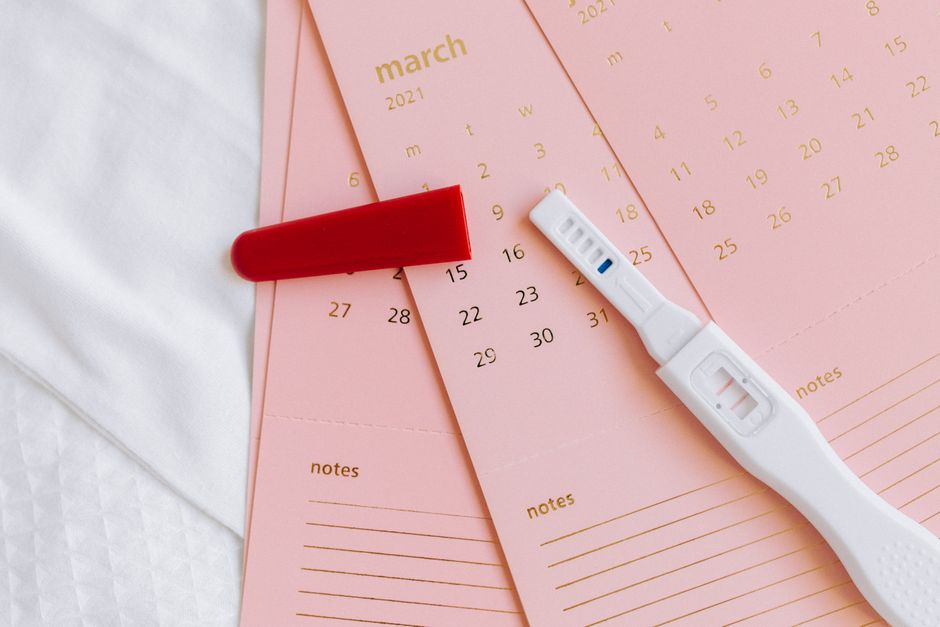
Ovulation tests are designed to detect one specific hormone, and that hormone is not the one pregnancy tests look for. So when someone pees on an ovulation stick a few days before a missed period and sees a positive result, the test is not confirming a pregnancy. It is doing exactly what it was built to do, which is detect luteinizing hormone. The confusion comes from the fact that luteinizing hormone and human chorionic gonadotropin are built from some of the same molecular parts. An ovulation test can sometimes react to hCG, but it was never made or validated for that purpose, and a positive result on one tells you very little about whether you are pregnant.
What Are Ovulation Tests Actually Measuring?
Ovulation predictor kits detect luteinizing hormone, usually called LH, in urine. LH is the hormone that surges roughly a day or two before an ovary releases an egg. That surge is the signal these tests are built to catch.
The physiology is well established. As a follicle in the ovary matures, rising estrogen eventually triggers a sharp spike in LH from the pituitary gland. That spike is what causes the follicle to rupture and release the egg. Most ovulation kits are designed to turn positive when LH rises above a certain threshold, which is why users are told to test around the same time each day and to watch for the line getting darker.
Here is the part that matters for this question. LH is not hCG. They are two different hormones with two different jobs. LH runs the menstrual cycle. hCG is produced by the cells that form the placenta after an embryo implants. A standard ovulation test is calibrated to detect LH. It has no instructions, no labeling, and no clinical validation for detecting pregnancy.
Can Ovulation Tests Pick Up Pregnancy?
An ovulation test can sometimes turn positive because of pregnancy, but this is an unreliable side effect of how the tests are built, not a feature you can count on. The reason has to do with molecular structure.
LH and hCG are both glycoprotein hormones, and they share an identical alpha subunit. They differ in their beta subunit, which is what gives each hormone its specific action. Because the two hormones are so similar in shape, the antibodies used in some ovulation tests can cross-react with hCG, especially when hCG levels are high. This is a known laboratory phenomenon.
That cross-reaction is exactly why the results are not trustworthy for pregnancy. Consider what happens in practice:
- If the test turns positive, you cannot tell whether it detected an LH surge, hCG from a pregnancy, or both.
- If the test turns negative, it proves nothing. Many ovulation tests simply are not sensitive enough to catch the lower hCG levels present in early pregnancy.
- Different brands use different antibodies, so one ovulation test may cross-react with hCG while another does not.
So the honest answer is that a positive ovulation test is a possible hint and nothing more. It is not a diagnosis. It is not a substitute for a pregnancy test. And a negative one should never be used to rule pregnancy out.
Why Do Ovulation Tests and Pregnancy Tests Look So Similar?
They look alike because they work the same way. Both are lateral flow immunoassays. A sample of urine wicks up a strip and meets antibodies that are designed to grab a specific hormone. If that hormone is present above a certain level, a colored line appears.
The difference is entirely in which antibodies are used and what concentration of hormone triggers a visible line. A pregnancy test uses antibodies that target the beta subunit of hCG, which is unique to that hormone. That design makes it far more specific. An ovulation test uses antibodies aimed at LH, and because of the shared alpha subunit, some of those antibodies can occasionally bind hCG too.
This is also why pregnancy tests are generally more sensitive for their intended purpose. A test built and validated to detect hCG will pick up pregnancy earlier and more reliably than a test built for a different hormone that happens to cross-react by accident.
Should You Use an Ovulation Test to Check for Pregnancy?
No. Using an ovulation test as a pregnancy test is not recommended by any clinical guidance, and it can lead you to the wrong conclusion in either direction. If you think you might be pregnant, use a test designed for that purpose.
Home pregnancy tests detect hCG in urine and are designed to be used from the first day of a missed period, though some are marketed as usable a few days earlier. Testing too early raises the chance of a false negative, because hCG may not have risen high enough yet to be detected. If a pregnancy test is negative but your period still does not come, waiting a few days and testing again is the standard approach.
If you get a positive pregnancy test, contact a healthcare provider. If you are trying to conceive and tracking ovulation, keep using ovulation tests for that job and pregnancy tests for the other. Mixing the two tools creates confusion that neither was designed to resolve.
What About a Positive Ovulation Test After a Missed Period?
A strongly positive ovulation test that shows up after your period is late is a reasonable reason to take a pregnancy test, but it is not proof of anything on its own. Some people notice this pattern and assume it means pregnancy. Sometimes they are right. Sometimes the test is picking up a late or unusual LH surge, which can happen for a range of reasons including irregular cycles, polycystic ovary syndrome, or perimenopause.
There is no way to tell from the ovulation test alone which situation you are in. The test does not distinguish between the two hormones. The only way to know is to use a test that measures hCG specifically.
How Do the Two Tests Compare?
The table below lays out the core differences. These are design facts about how the tests are made, not claims about any particular brand.
| Feature | Ovulation Test | Pregnancy Test |
|---|---|---|
| Hormone targeted | Luteinizing hormone (LH) | Human chorionic gonadotropin (hCG) |
| Purpose | Predict ovulation | Detect pregnancy |
| Validated for pregnancy | No | Yes |
| Can cross-react with the other hormone | Sometimes, with hCG | Designed to be specific to hCG |
| Reliable for ruling pregnancy in or out | No | Yes, when used at the right time |
What Should You Do If You Get a Surprising Result?
If an ovulation test gives you a result that does not match your cycle, the practical step is simple. Take a pregnancy test. It is the right tool for the question you are actually asking.
If you are tracking ovulation to conceive and your cycles are irregular, or if you are getting repeated positive ovulation tests across many days, that pattern is worth mentioning to a healthcare provider. Persistent elevated LH can be associated with certain conditions, and a clinician can help sort out what is going on. This is not something to self-diagnose from test strips.
One more point that trips people up. Ovulation tests and pregnancy tests are not interchangeable in either direction. A pregnancy test will not detect an LH surge, because it is built to target hCG only. So you cannot use a pregnancy test to track ovulation either. Each test answers one question.
Frequently Asked Questions
Can an ovulation test show positive if you are pregnant?
It can, because the antibodies in some ovulation tests cross-react with hCG, the pregnancy hormone. But a positive result is unreliable and cannot confirm pregnancy, so use a pregnancy test instead.
Can a negative ovulation test mean you are not pregnant?
No. A negative ovulation test says nothing about pregnancy, because many of these tests are not sensitive enough to detect early hCG. Only a pregnancy test can rule pregnancy in or out.
Why do ovulation tests sometimes detect pregnancy?
LH and hCG share an identical alpha subunit, so the antibodies in some ovulation tests can bind hCG by accident. This cross-reaction is a known laboratory effect, not a designed feature.
How early can a pregnancy test detect pregnancy?
Most home pregnancy tests are designed to be used from the first day of a missed period, and some are marketed for a few days earlier. Testing too early raises the chance of a false negative because hCG may not be high enough yet.
