
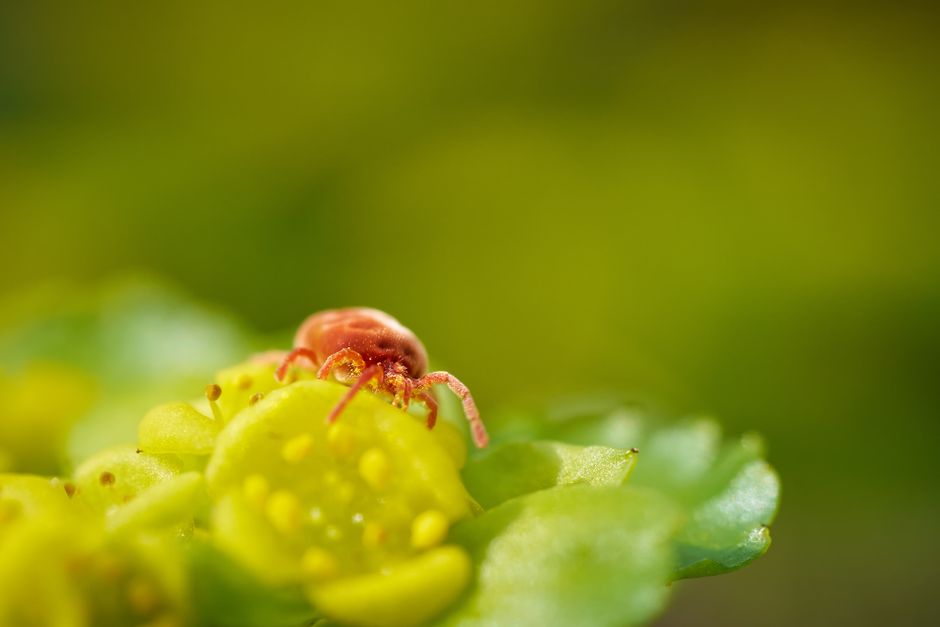
Dust mites do not eat hair, burrow into follicles, or directly cause baldness. What they can do is trigger allergic inflammation on the scalp, and that inflammation can worsen certain scalp conditions that lead to hair shedding. The connection is indirect, and it runs through your immune system, not through the mites themselves.
If you are losing hair and you also wake up congested, sneeze around bedding, or itch more at night, the two problems may share a common thread. Understanding where that thread starts — and where it does not — matters more than most online explanations admit.
What Are Dust Mites and Where Do They Live?
Dust mites are microscopic arachnids, closely related to spiders and ticks. They are not insects, and they do not bite. Two species dominate indoor environments: Dermatophagoides pteronyssinus and Dermatophagoides farinae. Both feed on shed human skin cells and thrive in warm, humid conditions.
They concentrate in bedding, pillows, mattresses, upholstered furniture, and carpet. A mattress can hold a large population, and their waste particles are small enough to become airborne when you move in bed. That airborne waste is what people actually react to.
This matters for the scalp question because your head rests on a pillow for roughly a third of your life. If you are allergic to dust mites, your scalp gets prolonged nightly exposure to the allergen.
Can Dust Mites Cause Hair Loss The Scalp Connection?
Dust mites cannot physically damage hair follicles. They are far too large to enter a follicle, and they have no interest in hair. So the short answer to whether they directly cause hair loss is no.
The longer answer involves what an allergic reaction does to skin. When someone sensitized to dust mites contacts the allergen, immune cells release histamine and other inflammatory mediators. This produces itching, redness, and swelling. On the scalp, that means persistent itch and a disturbed skin barrier.
Chronic scratching is where damage becomes possible. Repeated scratching and rubbing can traumatize hair shafts and, over time, irritate follicles. This is called traction or frictional damage, and it is a recognized contributor to hair breakage. The hair loss in this scenario is a consequence of the scratching, not the mite.
There is also a separate and more important pathway: dust mite allergy is strongly associated with atopic dermatitis, and atopic dermatitis frequently affects the scalp. Scalp inflammation from eczema can disrupt the hair growth cycle and cause shedding. So the chain runs mite allergen, then allergic inflammation, then scalp disease, then hair loss.
How Does Scalp Inflammation Lead to Shedding?
Hair grows in cycles: anagen (growth), catagen (transition), and telogen (rest). Most of your hair is in anagen at any given time. When the scalp is inflamed or stressed, more follicles than usual can shift into telogen prematurely. Weeks to a few months later, those hairs shed.
This pattern is called telogen effluvium. It is diffuse, meaning it spreads across the scalp rather than forming distinct bald patches. It is also usually reversible once the trigger resolves, though regrowth takes time because hair grows slowly.
Inflammation can also worsen androgenetic alopecia, the common inherited pattern of hair thinning. Inflammatory signals around the follicle appear to accelerate miniaturization in people who are genetically predisposed. This does not mean dust mites cause pattern baldness. It means ongoing scalp inflammation is not helpful for anyone losing hair.
One clarification worth making: itch alone does not cause hair loss. Many people itch without shedding. The damage comes from what the itch makes you do, and from the underlying inflammatory condition driving it.
Is Dust Mite Allergy Linked to Scalp Conditions?
Dust mite allergy is one of the most common indoor allergies worldwide, and it is a well-established trigger for atopic dermatitis flares. Atopic dermatitis is a chronic inflammatory skin condition. It commonly involves the scalp, especially in infants and children, and can persist or reappear in adults.
Seborrheic dermatitis is a different condition, but it also affects the scalp and causes flaking and itch. Its relationship to dust mites is less clear. Some research suggests house dust mite exposure may aggravate seborrheic dermatitis in certain people, but the evidence is not consistent enough to call it a cause.
What is well established is that scalp inflammation from any source — eczema, seborrheic dermatitis, psoriasis — can be associated with increased hair shedding. If you have both a dust mite allergy and an inflammatory scalp condition, treating the scalp condition is the priority. Reducing mite exposure is supportive, not curative.
How Can You Tell If Dust Mites Are Involved?
You cannot diagnose this by looking at your scalp. Dust mite allergy is identified through history and, when needed, allergy testing such as skin prick testing or specific IgE blood tests. A clinician interprets those results alongside your symptoms.
Patterns that point toward a dust mite connection include:
- Itching that is worse at night or after lying in bed
- Nasal congestion, sneezing, or watery eyes that improve when you are away from home
- Scalp itch without obvious flaking or a rash
- A personal or family history of eczema, asthma, or allergic rhinitis
Patterns that point away from dust mites include distinct bald patches, a receding hairline, or shedding that started abruptly after illness, surgery, or major stress. Those have different causes and need different evaluation.
If you are losing hair, a dermatologist can examine the scalp and, in some cases, perform a scalp biopsy or trichoscopy. This distinguishes inflammatory conditions from pattern hair loss and from other causes.
What Actually Helps With Scalp Itch and Shedding?
There is no treatment that targets dust mites as a cause of hair loss, because mites are not the cause. What helps is addressing the two separate problems: the allergy and the scalp condition.
For dust mite exposure, established measures include allergen-impermeable mattress and pillow covers, washing bedding in hot water, reducing indoor humidity, and removing carpet where feasible. These reduce allergen levels. Whether they meaningfully improve scalp symptoms specifically has not been well studied.
For scalp inflammation, treatment depends on the diagnosis. Medicated shampoos containing ketoconazole, zinc pyrithione, or coal tar are commonly used for seborrheic dermatitis. Topical corticosteroids are commonly prescribed for scalp eczema. These are clinical decisions, not self-treatment choices, and a clinician should guide them.
For hair shedding itself, the most useful step is identifying the trigger. If inflammation is driving it, controlling the inflammation is the goal. If it is telogen effluvium from another cause, the hair typically recovers on its own over months once that cause resolves.
One honest caution: no supplement, shampoo, or device has been shown in large human trials to reverse hair loss caused by dust mite allergy, because that specific causal pathway has not been demonstrated. Be skeptical of products claiming otherwise.
When Should You See a Doctor About Hair Loss?
Hair loss has many causes, and some are treatable only if caught early. See a clinician if you notice sudden or rapid shedding, patchy bald spots, a widening part, or a receding hairline. Also seek care if the scalp is red, scaly, painful, or shows signs of infection.
Dust mites are worth investigating if you have allergic symptoms alongside scalp itch. But they should not be assumed to be the cause of your hair loss without evaluation. Assuming the wrong cause delays treatment for the real one.
Frequently Asked Questions
Can dust mites live on your scalp?
No. Dust mites live in bedding, carpet, and upholstered furniture, not on human skin. A different organism, the Demodex mite, does live in hair follicles, but it is unrelated to dust mites.
Can dust mite allergy cause hair loss?
Not directly. Dust mites cannot damage hair follicles, but the allergic inflammation they trigger can worsen scalp conditions like eczema, and scalp inflammation is associated with increased shedding.
Does washing your hair get rid of dust mites?
Washing your hair does not reduce dust mites in your environment, because they do not live on your hair. Reducing mites requires addressing bedding, humidity, and carpet in your home.
What does hair loss from scalp inflammation look like?
It usually appears as diffuse thinning across the scalp rather than distinct bald patches. A dermatologist can confirm the cause with a scalp exam and sometimes a biopsy.
