
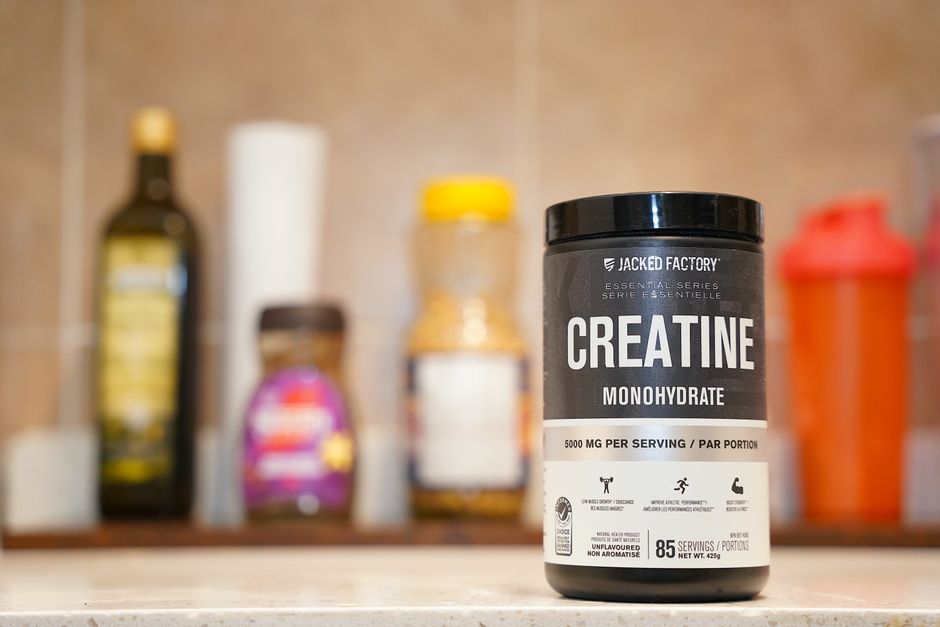
Creatine is one of the most studied sports supplements in the world, and the short answer is yes: it can help build muscle. It does this mainly by increasing the energy available to your muscles during short, hard efforts, which lets you train with more intensity and volume over time. That extra training stimulus is what drives muscle growth, not the powder itself.
It is not a drug and it is not a shortcut that works while you sit still. Creatine supports the work you put in. If you train hard and eat enough protein, it can add to your results. If you do not train, it will not build anything.
What Is Creatine and What Does It Do in the Body?
Creatine is a compound your body makes and stores, mostly in skeletal muscle. You also get it from food, mainly red meat and fish. About 95 percent of the body’s creatine sits in muscle tissue, where it plays a direct role in how your cells produce energy.
When you do something explosive — a heavy squat, a sprint, a set of push-ups to failure — your muscles need energy fast. They get it through a system called the phosphagen system. Creatine is the key molecule in that system. It helps regenerate ATP, the basic energy currency of every cell, within seconds.
More creatine in the muscle means more capacity to repeat short, intense efforts. That is the core mechanism. It is well established and not seriously debated in exercise science.
Why the Energy System Matters for Muscle
Muscle growth comes from mechanical tension and metabolic stress during training, plus enough protein and calories to rebuild tissue. Creatine does not directly trigger growth. It improves your ability to produce those training signals.
One clarification worth making: the muscle fullness many people notice in the first week or two is mostly water drawn into muscle cells, not new contractile tissue. Real muscle protein takes weeks to months to accumulate. The early weight gain on the scale is not the same as muscle growth.
Can Creatine Build Muscle on Its Own?
No. Creatine does not build meaningful muscle without resistance training. This is one of the clearest findings in the research.
Studies that give creatine to people who do not train generally show little to no muscle gain. Studies that combine creatine with a structured resistance program show more gains than training alone in many cases. The supplement amplifies the training, it does not replace it.
This is why the question “does creatine build muscle” is really two questions: does it help, and does it work by itself. The answer to the first is yes. The answer to the second is no.
How Much Muscle Can Creatine Help You Gain?
The honest answer is that the effect is real but modest, and it varies a lot between people. Creatine is not a transformation in a jar.
Research generally shows that adding creatine to a resistance training program can increase gains in muscle mass and strength compared with training alone, but the size of that advantage differs widely across studies and individuals. Some people respond strongly. Others respond very little. There is no reliable way to predict which group you fall into.
Several factors shape the outcome:
- Whether you actually train hard and progressively
- How much protein and total calories you eat
- Your training experience — beginners often gain faster than advanced lifters
- Your baseline creatine levels, which are higher if you eat a lot of meat and fish
- Genetics and individual biology
People who already eat a lot of red meat may have less room to improve, because their muscles are already fairly saturated with creatine. Vegetarians and vegans often start with lower levels and sometimes see a larger response.

How Does Creatine Compare to Other Approaches?
Creatine is not the only lever for muscle growth, and it is not the most important one. Training and nutrition come first. The table below puts it in context.
| Factor | Role in Muscle Growth | Evidence Strength |
|---|---|---|
| Resistance training | Primary driver of muscle growth | Strong, consistent |
| Adequate protein intake | Provides building blocks for repair | Strong, consistent |
| Enough total calories | Supports tissue building | Strong, consistent |
| Creatine | Increases training capacity; adds a modest boost | Strong for performance, moderate for added muscle |
| Sleep and recovery | Affects hormone environment and repair | Moderate |
Notice the pattern. Creatine sits near the top of the supplement list, but below the basics. No supplement outperforms consistent training and eating enough.
Is Creatine Safe, and What About the Kidneys?
For healthy adults, creatine has a strong safety record in the research, including studies lasting several years. The kidney concern is one of the most common myths, and it deserves a clear answer.
Creatine does raise a blood marker called creatinine, which is used to estimate kidney function. This can make kidney function look slightly worse on a standard blood test even when the kidneys are working normally. That is a measurement issue, not kidney damage. If you take creatine and get bloodwork, tell your doctor so the result is interpreted correctly.
People with pre-existing kidney disease, or those taking medications that affect the kidneys, should talk to a doctor before using creatine. The evidence in those groups is more limited, and it is not a situation for guessing.
Some people report stomach discomfort, especially with large single doses. Taking it with food or splitting the dose can reduce this. The evidence on other reported effects is mixed and generally does not show consistent harm in healthy adults.
How Do People Typically Use Creatine?
Creatine monohydrate is the form with the most research behind it. Other forms are sold, often at higher prices, but the evidence that they work better is weak. If you are choosing, monohydrate is the well-studied option.
There are two common approaches. One is a loading phase, where you take a higher amount for about a week to saturate muscles faster. The other is a steady lower amount taken daily, which reaches the same saturation over a few weeks. Both work. Loading just gets you there sooner.
Timing matters less than consistency. What matters most is taking it regularly so muscle stores stay topped up. Muscle saturation tends to fade over weeks if you stop.
No clinical guidelines currently exist for creatine dosing in pregnant women, breastfeeding women, or children. Anyone in those groups should treat it as a medical question, not a supplement question.
What Creatine Cannot Do
Creatine will not burn fat, and it is not a weight-loss product. Some people gain a few pounds of water weight when they start, which can be discouraging if the goal is the scale. That water sits inside muscle cells and is not fat.
It also will not build muscle if you are in a large calorie deficit, doing only cardio, or not training hard enough to create a growth signal. In those situations the supplement has little to work with.
And it will not replace protein, sleep, or progressive overload. It is one input among several, not the foundation.
The Bottom Line
Creatine can help build muscle, but only as a support to real training. It works by improving your capacity for short, intense efforts, which lets you do more quality work over time. The muscle itself comes from that work plus enough food and protein to rebuild tissue.
The effect is genuine and among the better-supported in sports nutrition, but it is modest and varies by person. Treat it as a useful addition to a solid program, not a replacement for one.
Frequently Asked Questions
Can creatine build muscle without working out?
No. Creatine does not build meaningful muscle without resistance training, because it works by improving your training capacity rather than directly growing tissue. People who take it without training generally see little to no muscle gain.
How long does creatine take to work?
Muscle creatine stores can rise within about a week of loading, or over a few weeks with a steady daily amount. Noticeable changes in strength and muscle size typically take several weeks of consistent training to appear.
Does creatine damage your kidneys?
In healthy adults, research does not show that creatine causes kidney damage. It can raise a blood marker called creatinine, which may make kidney function look slightly worse on a test even when the kidneys are normal.
Is creatine better than protein for building muscle?
No. Protein provides the building blocks for muscle repair and is more fundamental, while creatine supports training capacity. They do different jobs, and protein intake matters more for actually building tissue.
