
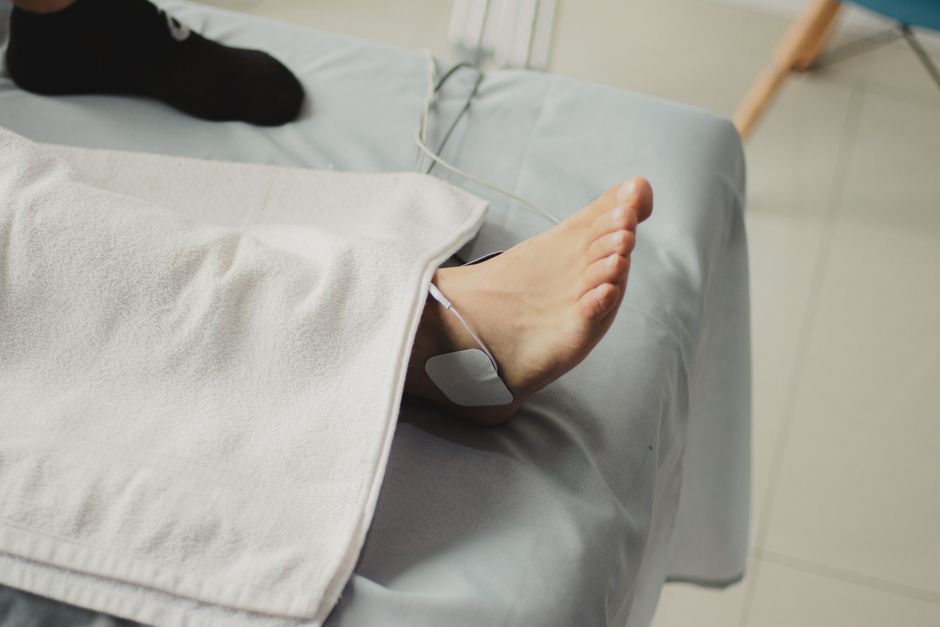
A torn Achilles tendon sometimes heals without surgery, but it depends heavily on how badly it is torn. Small partial tears can often heal with immobilization and a structured rehab program. A complete rupture is a different situation, and while nonsurgical treatment is a real option for some people, it comes with a higher chance of re-rupture and requires a committed, months-long rehabilitation process. The honest answer is that “heal on its own” is misleading — tendons need the right conditions and a lot of time to repair.
What Actually Happens When the Achilles Tendon Tears
The Achilles is the thickest and strongest tendon in the body. It connects the calf muscles to the heel bone and transmits the force that lets you push off the ground when you walk, run, or jump.
A tear happens when that force overwhelms the tendon’s tensile strength. This can be a sudden event — a sharp push-off, a fall, a rapid direction change — or the result of years of microscopic wear that weakens the tendon until it fails. Most complete ruptures occur during recreational sports, particularly in people who play intermittently rather than train consistently.
When the tendon ruptures completely, the two ends separate. The gap between them is the central problem. Tendons heal by forming scar tissue, and scar tissue only bridges a gap if the two ends are close enough together and kept relatively still while the repair matures. If the ends stay apart, the body fills the space with weak, disorganized tissue that cannot handle load.
This is why “healing on its own” is not really what happens. What happens is that the body attempts a repair, and whether that repair is functional depends on how close the torn ends are and how well they are held in position during the healing window.
Can a Partial Tear Heal Without Surgery?
Partial tears often can. When the tendon is stretched or partially torn but still continuous, the fibers that remain intact can carry load while the damaged area repairs. The tendon does not need to bridge a gap because there is no gap.
Treatment for partial tears typically involves:
- Immobilization in a walking boot or cast with the foot pointed downward, which takes tension off the tendon
- Gradual return to weight-bearing as pain allows, guided by a clinician
- Physical therapy focused on progressive loading, calf strengthening, and balance work
- Several months before return to demanding activity, sometimes longer
The timeline matters. Tendons heal slowly because they have limited blood supply compared to muscle. Even a partial tear can take months to become functionally strong. Pushing back into running or jumping too early is one of the most common reasons people re-injure.
It is worth noting that imaging does not always match symptoms. Some people with partial tears on MRI have relatively little pain, and some with minimal imaging findings have significant pain. Clinical examination and functional testing guide treatment more than imaging alone.
Can a Complete Rupture Heal Without Surgery?
Yes, in some cases — but the evidence shows nonsurgical treatment of a complete rupture carries a meaningfully higher risk of re-rupture compared to surgery. This is one of the more consistent findings in orthopedic research, and it has held up across multiple studies over several decades.
Nonsurgical treatment of a complete rupture usually means a period of immobilization in a cast or boot with the foot in a pointed position, followed by a carefully staged rehabilitation program. The idea is to bring the torn ends close together by positioning the foot so the calf muscles relax and the tendon ends approximate.
This approach can work. Some patients — particularly those who are older, less active, or have medical conditions that make surgery risky — do well with nonsurgical treatment. But it requires strict adherence to immobilization and a long, disciplined rehab process. It is not a matter of resting and waiting.
The trade-off is real. Surgery generally lowers the re-rupture rate but carries its own risks: infection, wound healing problems, nerve injury, and blood clots. Nonsurgical treatment avoids those surgical risks but accepts a higher chance the tendon tears again.



How Do You Decide Between Surgery and Nonsurgical Treatment?
The decision is not one-size-fits-all, and it should involve an orthopedic specialist. Several factors shift the balance:
- Activity level and goals. People who want to return to running, jumping, or competitive sports often lean toward surgery because of the lower re-rupture risk.
- Age and overall health. Older adults or those with diabetes, vascular disease, or poor wound healing may face higher surgical risks, making nonsurgical treatment more attractive.
- Time since injury. A rupture that is treated promptly is easier to manage than one that has been neglected for weeks.
- Whether the tear is complete or partial. Partial tears are far more likely to be treated without surgery.
- Patient commitment. Nonsurgical treatment demands strict compliance with immobilization and rehab. Someone who cannot or will not follow that regimen is a poor candidate.
Some clinicians use a functional rehabilitation protocol after surgery that allows early controlled movement rather than prolonged casting. This has become more common because controlled early motion can improve outcomes compared to complete immobilization. The specifics vary by surgeon and institution.
What Does the Healing Process Actually Look Like?
Tendon healing happens in overlapping phases. In the first days after injury, inflammation brings cells to the site. Over the following weeks, those cells lay down collagen — the protein that gives tendon its strength. Early collagen is weak and disorganized. Over months, it remodels into a stronger, more aligned structure.
This process is slow. Even under ideal conditions, a healing tendon takes many weeks to reach a point where it can handle moderate load, and months before it approaches normal strength. The exact timeline varies widely based on the severity of the tear, the treatment approach, and individual factors like age and overall health.
Rehabilitation is not optional. Immobilization protects the repair early on, but without progressive loading afterward, the tendon will not regain strength. Physical therapy typically starts with gentle range-of-motion work and advances to strengthening exercises and eventually sport-specific training. Trying to skip steps usually backfires.
What Are the Risks of Letting It Heal on Its Own?
The main risk is re-rupture. If the tendon heals in a lengthened position or with weak scar tissue, it may not tolerate the forces of daily activity, let alone sports. A re-rupture often requires surgery anyway, and outcomes after a second rupture tend to be worse than after the first.
Other risks include:
- Persistent weakness in pushing off or standing on tiptoe
- Reduced calf muscle strength and size that may not fully return
- Chronic pain or stiffness
- A longer overall recovery if the initial healing fails and surgery becomes necessary later
These risks do not mean nonsurgical treatment is wrong. They mean it is a genuine trade-off that should be made with clear information and realistic expectations.
When Should You See a Doctor?
Any suspected Achilles tear warrants prompt medical evaluation. Signs include a sudden pop or snap in the back of the leg, immediate pain, difficulty walking or pushing off, and a gap you can feel in the tendon. Some people describe it as being kicked in the back of the ankle.
Delaying evaluation can complicate treatment. A rupture that is diagnosed early gives you more options. One that has been ignored for weeks may have retracted tendon ends that are harder to bring together, whether surgically or nonsurgically.
If you cannot bear weight, cannot push off, or feel a defect in the tendon, treat it as urgent. Do not try to walk it off.
Frequently Asked Questions
Can a fully torn Achilles heal without surgery?
Yes, in some cases, but nonsurgical treatment of a complete rupture carries a higher risk of re-rupture compared to surgery. It requires strict immobilization and a long rehabilitation program.
How long does a torn Achilles take to heal without surgery?
Healing typically takes several months, and full return to demanding activity often takes longer. The exact timeline depends on the severity of the tear and how well the rehabilitation program is followed.
What happens if a torn Achilles is not treated?
An untreated complete rupture can leave you unable to push off properly, with persistent weakness and a higher chance of further injury. Some people eventually need surgery, and outcomes after delayed treatment tend to be worse.
Is surgery always better than letting an Achilles tear heal on its own?
No. Surgery lowers the re-rupture risk but carries its own complications, including infection and wound healing problems. The best choice depends on your age, health, activity goals, and the type of tear.
