
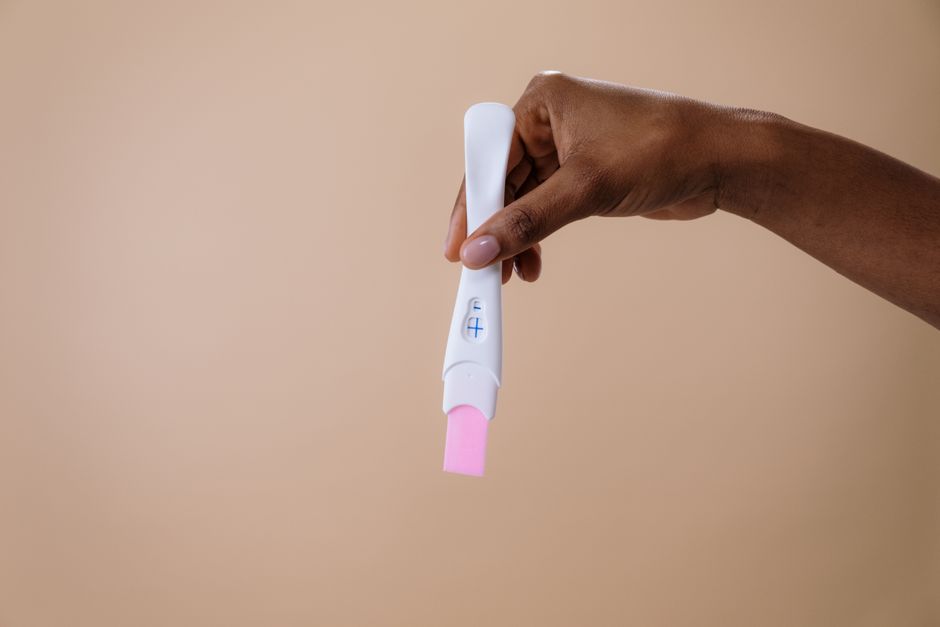
A pregnancy test can turn positive hours later, but that result is not reliable. Home pregnancy tests are designed to be read within a specific window — usually a few minutes — and any line that appears after that window is considered invalid. The timing matters because the test’s chemical reaction changes as the strip dries, which can create a faint line that looks like a positive result but is not one.
How Do Home Pregnancy Tests Actually Work?
Home pregnancy tests detect a hormone called human chorionic gonadotropin, or hCG. This hormone is produced by the developing placenta after a fertilized egg implants in the uterine lining. hCG can be detected in urine and blood.
The test strip contains antibodies that bind to hCG. When urine flows across the strip, it carries any hCG with it. If hCG is present, it binds to these antibodies and triggers a color change — usually a line or a plus sign. The control line appears regardless of whether hCG is present, confirming the test worked properly.
The key detail is that this chemical reaction takes time to complete. Manufacturers calibrate the test to be read within a specific window, typically 3 to 5 minutes depending on the brand. The instructions that come with the test specify exactly how long to wait. Reading the test too early can miss a positive result. Reading it too late can create a false positive.
This is not a flaw in the test. It is how the chemistry works.
Why Does a Pregnancy Test Turn Positive Hours Later?
A test that shows a positive result hours after the reading window has passed is showing what is commonly called an evaporation line. This is not a true positive result.
As the urine on the test strip dries, the concentration of dissolved substances in the remaining moisture changes. This can cause a faint line to appear in the test area, even when no hCG was present in the sample. The line may look gray, colorless, or faintly pink. It can be easy to mistake for a real positive result, especially if you are anxious about the outcome.
Evaporation lines are a well-documented limitation of lateral flow test strips, which is the technology used in most home pregnancy tests. The same principle applies to other types of rapid tests that use this format.
There is another possibility. If the test was truly negative when read within the proper window but showed a line hours later, that line is almost certainly an evaporation line. If the test showed a faint positive within the window and the line became darker over time, that could potentially be a real positive — but the result should still be confirmed with a new test.
What Is the Difference Between an Evaporation Line and a Real Positive?
A real positive line contains colored dye. It typically appears within the designated reading time and has a pink or blue tint, depending on the brand. The line usually becomes visible within minutes if hCG is present at a detectable level.
An evaporation line typically has no color. It looks gray or colorless. It appears after the reading window has passed, often much later. It may be very faint and hard to see unless you hold the test under bright light.
Here is a comparison of the key differences:
| Feature | Real Positive Line | Evaporation Line |
|---|---|---|
| When it appears | Within the reading window (usually 3-5 minutes) | After the reading window, often hours later |
| Color | Pink or blue, depending on brand | Gray or colorless |
| Visibility | Visible under normal lighting | Often faint, may need bright light to see |
| Reliability | Reliable if read within the window | Not a valid result |
The color difference is the most useful clue. A line with no color that appears long after the test was taken is almost certainly an evaporation line.





Can a Negative Test Become Positive If You Are Actually Pregnant?
A negative test read within the proper window does not turn into a true positive hours later. If you are pregnant but tested too early, the test may not detect hCG at that time. Taking another test a few days later — when hCG levels have had time to rise — is the appropriate next step.
hCG levels roughly double every 48 to 72 hours in early pregnancy. This is a well-established pattern in reproductive medicine. A test taken too soon after implantation may show a negative result because hCG has not yet reached the detectable threshold for that specific test. Most home pregnancy tests can detect hCG at concentrations of 20 to 25 milli-international units per milliliter (mIU/mL), though some sensitive tests claim lower thresholds.
If you suspect you are pregnant and get a negative result, waiting a few days and testing again with first-morning urine is the standard approach. First-morning urine is more concentrated, which makes hCG easier to detect.
What Should You Do If Your Test Turns Positive Hours Later?
Do not trust that result. Take a new test and follow the instructions exactly. Read the result only within the time window specified by the manufacturer. If the new test is positive within the proper window, that is a reliable result.
If you continue to get unclear or inconsistent results, consider these options:
- Wait 48 to 72 hours and test again with first-morning urine.
- Use a different brand of test, as sensitivity varies between products.
- See a healthcare provider for a blood test, which can detect hCG earlier and more precisely than a urine test.
A blood test measures the exact amount of hCG in your bloodstream. This is more sensitive than a urine test and can detect pregnancy earlier. A healthcare provider can also track hCG levels over time to see if they are rising appropriately, which can provide information about the pregnancy’s progress.
If you are experiencing symptoms such as cramping, bleeding, or pain alongside an unclear test result, contact a healthcare provider. These symptoms can have several possible causes, and only a medical evaluation can determine what is happening.
Can Medications or Medical Conditions Affect Pregnancy Test Results?
Most medications do not interfere with home pregnancy tests. However, certain fertility medications that contain hCG — such as those used for ovulation induction — can cause a false positive result. This is because the medication itself contains the hormone the test is designed to detect.
Other medications, including some diuretics and antipsychotics, may rarely affect test results, but this is not common. If you are taking fertility medications or have a medical condition that could affect hormone levels, tell your healthcare provider. They can advise you on the most reliable way to test.
Blood tests performed in a clinical setting are less likely to be affected by medications. They also provide a numerical value rather than just a positive or negative result, which gives more information.
How Accurate Are Home Pregnancy Tests When Used Correctly?
When used correctly — meaning you follow the instructions and read the result within the proper window — home pregnancy tests are generally accurate. Research indicates that most home pregnancy tests can detect pregnancy about 99% of the time when used on the day of a missed period. Accuracy is lower if you test earlier than that.
The critical factor is timing. Testing too early, before hCG has risen to detectable levels, produces a false negative. Reading the test too late produces a false positive from an evaporation line. Both errors are avoidable by following the instructions.
If you test on the first day of a missed period and read the result within the specified window, you can generally trust the result. If you test earlier or read the result later, the result is less reliable.
What Else Can Cause a False Positive on a Pregnancy Test?
Evaporation lines are the most common cause of a false positive when a test is read late. But there are other causes.
Certain medical conditions can produce hCG or hCG-like substances in the body. These include some types of tumors, though this is rare. A recent miscarriage or termination can also cause hCG to remain in the body for a period of time. The hormone does not disappear immediately after a pregnancy ends.
If you have recently been pregnant and are testing again, hCG levels may still be detectable. How long they remain detectable varies depending on how far along the pregnancy was. A healthcare provider can help you understand what to expect in your specific situation.
If you get a positive result but are unsure whether it is accurate, the best course of action is to see a healthcare provider. They can perform a blood test and, if needed, an ultrasound to confirm what is happening.
Why Following Test Instructions Matters
The instructions that come with a pregnancy test are not suggestions. They are based on how the test’s chemistry works and how the manufacturer calibrated it to produce accurate results. The reading window is specific to each brand and each test design.
Reading a test outside that window introduces variables the test was not designed to account for. Evaporation, changes in pH as the strip dries, and other factors can all create misleading lines. This is true for every brand of home pregnancy test.
If you are unsure whether a line is a true positive or an evaporation line, the safest approach is to take another test. If you are still unsure, a healthcare provider can give you a definitive answer.
Frequently Asked Questions
Can a pregnancy test turn positive after 10 minutes?
Yes, but the result is not reliable. Most tests specify a reading window of 3 to 5 minutes, and any line appearing after that window is considered invalid.
What does an evaporation line look like?
An evaporation line is typically gray or colorless and appears after the reading window has passed. It may be very faint and often requires bright light to see.
Can a pregnancy test be positive and then negative?
A true positive result should remain positive if you take another test. If a test shows positive and a later test shows negative, it may indicate a very early pregnancy loss or a problem with the first test.
How long should I wait to take another pregnancy test?
Waiting 48 to 72 hours is generally recommended if you tested early and got a negative result. hCG levels rise over time, so a test taken later is more likely to detect a pregnancy.
