
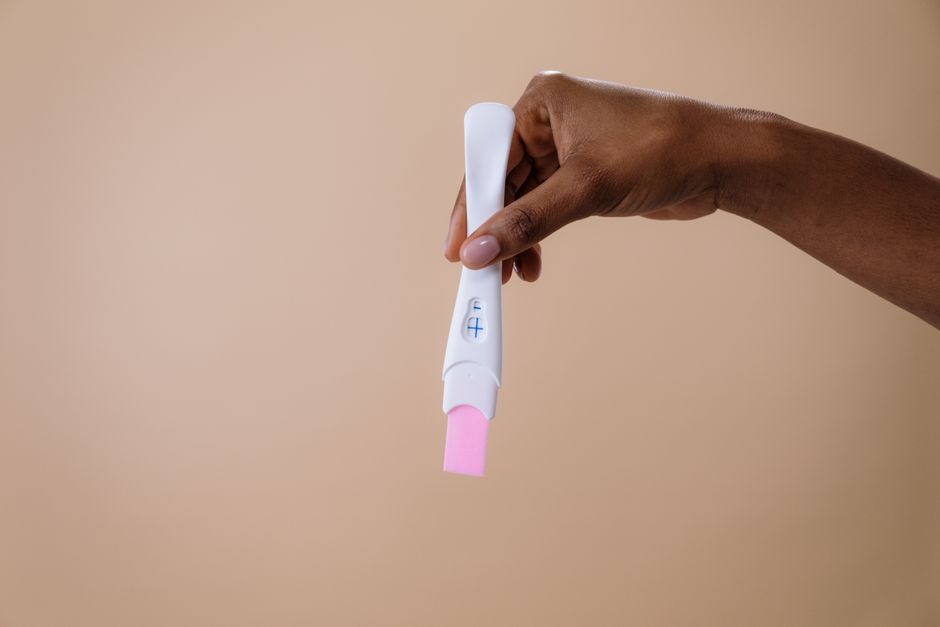
A pregnancy test can turn positive after a few hours, but that result is not reliable. Home pregnancy tests are designed to be read within a specific window, usually about 5 to 15 minutes depending on the brand, and any line that appears after that window is considered invalid. What looks like a positive result hours later is almost always an evaporation line or a dye run, not a true positive.
Can A Pregnancy Test Turn Positive After A Few Hours?
No, not in a way you should trust. A test that is negative during the proper reading window but shows a line hours later is showing an invalid result, not a positive one.
The confusion comes from how these tests actually work. Most home pregnancy tests use a strip inside a plastic casing. When you apply urine, it wicks up the strip and reacts with a dye. If hCG (human chorionic gonadotropin, the hormone produced during pregnancy) is present, it binds to antibodies on the strip and creates a visible line.
The chemistry does not stop the moment you finish reading. As the strip dries, the liquid moves and the dye can settle in ways that create faint marks. This is the source of most “it turned positive later” stories.
Why Does A Faint Line Appear Hours Later?
That late line is usually an evaporation line. It forms when urine dries on the test strip and leaves behind a faint, colorless or grayish mark where the test line would be.
An evaporation line is not a reaction to hCG. It is simply the physical result of liquid drying and dye or proteins settling. It can appear on any test, whether you are pregnant or not.
There is also something called a dye run. This happens when the colored dye in the test does not settle properly and streaks across the result window. A dye run can look like a faint line, especially in poor lighting.
Both of these are read errors, not pregnancy signals. The test’s instructions exist specifically to prevent this confusion.
How Do You Tell A True Positive From An Evaporation Line?
Timing is the single most important factor. A true positive appears within the reading window stated on the package, and it usually gets darker or stays consistent as the test develops.
An evaporation line behaves differently. Here is how they tend to compare:
- Timing: A true positive shows up during the reading window. An evaporation line shows up after it, often 30 minutes to several hours later.
- Color: A true positive line has color, usually pink or blue depending on the dye. An evaporation line is often colorless, gray, or very faint.
- Consistency: A true positive line is usually solid and even. An evaporation line can look thin, uneven, or like a shadow.
These differences are not perfectly reliable on their own. A very faint true positive early in pregnancy can be hard to distinguish from an evaporation line by appearance alone. If you are unsure, the answer is not to squint harder at an old test. It is to take a new one.


What Does The Test Window On The Instructions Mean?
The reading window is the time range when the test result is valid. It is printed on every package and typically runs from about 5 minutes to 15 minutes after you apply the urine.
Before the window opens, the reaction may not be complete, so a negative reading too early can be wrong. After the window closes, drying and dye settling can create false marks, so a reading too late can also be wrong.
This is why the instructions matter more than most people realize. The test is only telling you the truth during that specific window. Reading it an hour or a day later tells you nothing about your hCG level.
If you have kept an old test and are now staring at a faint line, that line has no diagnostic meaning. It cannot confirm pregnancy, and it cannot rule it out either.
When Should You Take A New Test?
Take a new test if your first result was unclear or if you read it outside the valid window. Wait at least until your missed period, and ideally a day or two after, because hCG levels rise quickly in early pregnancy.
Testing too early is a common reason for a false negative. hCG roughly doubles every 48 to 72 hours in early pregnancy, so a test taken a few days later can detect what an earlier test missed.
For the most reliable result, test first thing in the morning. Urine is more concentrated after you have not urinated overnight, which can make hCG easier to detect, especially very early on.
Follow the instructions exactly. Read the result only during the stated window. Then stop looking at it.
Can A Test Be Positive And Then Turn Negative?
Yes, this can happen, and it means something different from a late-appearing line. If a test is clearly positive during the valid window and then fades, that is usually just the dye settling or the test drying out, not a change in your hCG level.
A test cannot measure a changing hormone level over hours. It captures a single moment. Once the reaction has happened and the strip dries, the result is frozen in time.
If you had a positive result within the window and then a later test is negative, that is a separate situation. A very early pregnancy can be lost, or a test can vary in sensitivity. This is a case where talking to a healthcare provider is the right step.
What Causes A False Positive In The First Place?
True false positives do exist, but they are uncommon and usually have a real explanation. They are different from evaporation lines.
Some medications that contain hCG, such as certain fertility treatments, can cause a positive test. Rare medical conditions, including some tumors, can also raise hCG levels. A very early pregnancy loss can leave hCG in your system briefly after the pregnancy has ended.
Most of these are not things you can identify from a test strip alone. If you get a positive result that does not match your situation, a healthcare provider can sort out the cause with a blood test, which measures hCG directly and is more sensitive than a urine test.
The key point is this: a line that only shows up hours after you took the test is not in this category. It is not a false positive. It is an invalid result, and it should not be read as anything at all.
What Should You Do If You Are Unsure?
Take another test and read it strictly within the time window. This is the simplest and most reliable next step.
If you keep getting unclear results, or if you get a positive result and want confirmation, a blood test from a healthcare provider can measure hCG directly. Blood tests can detect pregnancy earlier and give a clearer answer than a home urine test.
Do not rely on a test you read hours later, and do not try to interpret a line that was not there during the valid window. That result is not telling you anything about whether you are pregnant.
Frequently Asked Questions
Can a pregnancy test turn positive after a few hours if I am pregnant?
No, a late line does not mean you are pregnant. If you were pregnant, the test would typically show a positive result within the reading window stated on the package, not hours later.
What does a faint line on a pregnancy test after an hour mean?
It most often means an evaporation line or dye run, which forms as the test dries. This is an invalid result and does not indicate pregnancy.
How long should I wait before reading a pregnancy test?
Read the result only during the window printed on the package, which is usually about 5 to 15 minutes. Any line appearing after that window should be ignored.
Can a pregnancy test be positive and then negative the next day?
A test result does not change based on drying, but a new test the next day can differ. If results are inconsistent, a blood test from a healthcare provider can give a clearer answer.
