
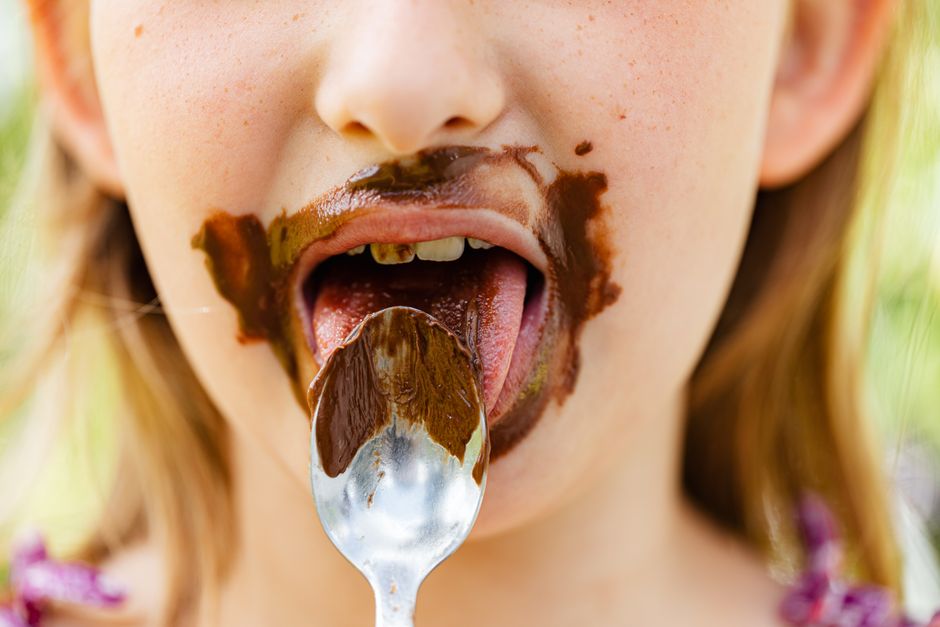
The tongue does not have separate zones for sweet, sour, salty, bitter, and umami. That idea came from a mistranslation of a German textbook published in 1901, and it has been repeated in classrooms ever since. Taste buds for every basic taste are spread across the tongue and the rest of the mouth.
What you can taste varies somewhat across the tongue’s surface, but not in the clean map most people picture. The real story involves how taste buds are distributed, how they connect to nerves, and what else is happening in your mouth besides taste.
Where did the tongue taste map come from?
The tongue map was a mistake that got copied forward for over a century. A German researcher named D.P. Hänig published a study in 1901 suggesting that sensitivity to different tastes varied slightly across the tongue’s edges. A Harvard psychologist, Edwin Boring, translated the work into English in 1942 and drew it as a map with distinct zones.
The original data showed small differences in sensitivity thresholds, not separate regions. Boring’s drawing turned those subtle variations into a picture of hard boundaries. Later textbooks reproduced the image without checking the source.
Modern research has tested the map directly. When scientists measured taste sensitivity across the tongue’s surface, they found that all five basic tastes can be detected in every region that has taste buds. The differences between areas are minor and vary from person to person.
Some areas do show slightly higher sensitivity to certain tastes. The back of the tongue tends to be a bit more sensitive to bitter. But the “sweet zone” at the tip and the “sour zone” at the sides do not exist as separate functional regions.
How are taste buds actually spread across the tongue?
Taste buds sit inside small bumps called papillae, and these are distributed across most of the tongue’s upper surface. There are four main types, and only some of them carry taste buds.
- Fungiform papillae look like small pink mushrooms and are scattered across the front two-thirds of the tongue. Each one holds a few taste buds.
- Foliate papillae are folds along the sides toward the back of the tongue and contain many taste buds.
- Circumvallate papillae are large circular structures at the very back, arranged in a V shape. Each contains hundreds of taste buds.
- Filiform papillae are the tiny rough bumps that give the tongue its texture. They do not contain taste buds at all — they sense touch and temperature.
Taste buds also exist outside the tongue. You have them on the roof of your mouth, the soft palate, and the back of your throat. That is part of why food still tastes like something after you swallow.
Each taste bud contains dozens of receptor cells. These cells detect taste molecules and send signals through nerve fibers to the brain. The cells themselves turn over roughly every 10 to 14 days, which is one reason taste can shift after illness or injury.
What can affect how you taste across different areas of the tongue?
Taste perception is not fixed. It changes with age, health, medications, and even the temperature of your food. Some changes affect the whole tongue. Others show up unevenly.
Age
Taste bud numbers and sensitivity tend to decline with age, though the change is usually gradual. Older adults often notice less intensity in taste rather than a complete loss. Smell declines faster than taste in most people, and because flavor depends heavily on smell, food can seem bland even when taste buds are working.
Medications and dry mouth
Many common medications cause dry mouth, and saliva is essential for taste molecules to reach receptors. Some drugs also directly alter taste perception, producing a metallic or bitter background taste. This is a known side effect of certain antibiotics, blood pressure medications, and chemotherapy drugs. Anyone noticing a persistent taste change should mention it to their doctor rather than assume it is harmless.
Nerve damage and injury
Different parts of the tongue are wired to different nerves. The front two-thirds connect to the chorda tympani branch of the facial nerve. The back third connects to the glossopharyngeal nerve. Damage to one nerve can reduce taste on part of the tongue while leaving the rest intact. This is one of the rare situations where a genuine regional difference in taste can occur — but it is caused by nerve injury, not by normal anatomy.
Infections and inflammation
Viral infections, including COVID-19, can disrupt taste and smell. The mechanism is still being studied. Some evidence points to effects on supporting cells rather than the taste receptor cells themselves. Taste changes from COVID-19 usually improve over weeks, but recovery time varies widely and some people report lingering changes.





Is umami detected everywhere on the tongue?
Umami is detected across the same areas as the other basic tastes. It was identified as a distinct taste in the early 1900s by Japanese chemist Kikunae Ikeda, who isolated glutamate from kombu seaweed. Western science was slower to accept it, and it was not widely recognized as a basic taste until the 1980s and 1990s.
Umami receptors respond to glutamate and nucleotides found in foods like meat, aged cheese, mushrooms, tomatoes, and soy sauce. The receptors are present in taste buds throughout the mouth, not in a specific zone.
Some people are more sensitive to umami than others, and this varies by individual. It is not tied to tongue location.
Does the tongue map still appear in textbooks?
Yes, and that is a problem. The map has been removed from many modern textbooks and curricula, but it persists in others and in popular science writing. Teachers sometimes still present it because it is simple and memorable.
The persistence of the tongue map is a useful example of how errors spread. A single translation choice, made decades ago, became a fact that took generations to correct. The correction has been slow partly because the map is easy to draw and easy to remember.
If you come across the tongue map in a school setting or online, the accurate version is this: all five basic tastes can be detected across the tongue wherever taste buds exist, with only minor variations in sensitivity between regions.
How does taste actually work beyond the tongue?
Taste is only one part of flavor. What most people call “taste” is a combination of signals from taste buds, smell receptors, and the trigeminal nerve, which senses texture, temperature, and chemical irritation like the burn of chili peppers.
Smell contributes the largest share of what we perceive as flavor. Pinch your nose while eating something and you will notice how little you can identify. This is why food seems bland when you have a cold.
Texture matters too. Creamy, crunchy, and chewy foods register differently even when their taste molecules are identical. The trigeminal nerve also detects sensations like the cooling of menthol or the fizz of carbonation, which are not tastes in the strict sense.
The brain combines all of these signals into a single experience. That is why damage to smell can make food taste wrong even when the tongue’s taste buds are fully functional.
When should a change in taste be checked by a doctor?
A sudden loss of taste or smell, especially after a respiratory illness, is common and often temporary. A taste change that persists for weeks without a clear cause deserves medical attention.
See a doctor if you notice taste changes along with unexplained weight loss, difficulty swallowing, persistent mouth sores, or a metallic taste that does not go away. These can be signs of conditions that need evaluation, including nutritional deficiencies, nerve problems, or in rare cases, neurological issues.
There is no home test that reliably identifies the cause of a taste change. A clinician may use standardized taste strips or simple solutions to assess function, but the underlying cause usually requires a broader evaluation.
Frequently Asked Questions
Is the tongue taste map real?
No. The map showing separate zones for sweet, sour, salty, and bitter came from a mistranslation and has been disproven. All five basic tastes can be detected across the tongue wherever taste buds are present.
Which part of the tongue tastes sweet?
Sweetness is detected across the tongue, not in a single zone. The tip of the tongue may be slightly more sensitive to sweet for some people, but this varies and is not a separate functional region.
Why does the back of my tongue taste bitter more strongly?
The back of the tongue tends to be somewhat more sensitive to bitter tastes, though the difference is modest. This may relate to the higher concentration of certain papillae at the back, but the reason is not fully understood.
Can taste buds grow back?
Yes. Taste receptor cells are replaced roughly every 10 to 14 days under normal conditions. This turnover is one reason taste often recovers after minor injuries or infections.
