
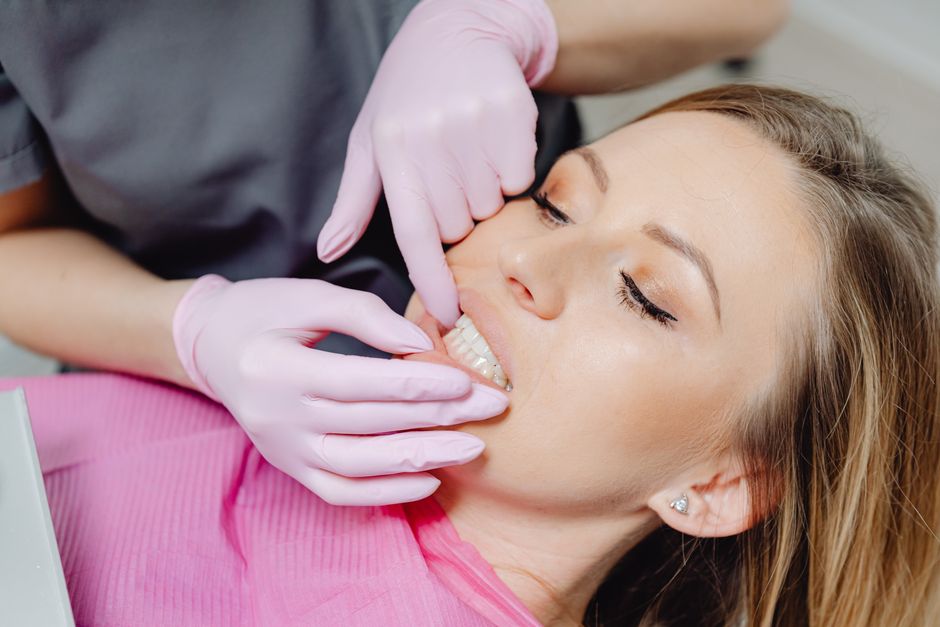
Teeth whitening strips are generally safe for most adults when used as directed. The main risks are temporary tooth sensitivity and gum irritation, both of which usually fade after you stop using them. The bigger safety concerns come from misuse — leaving strips on too long, using them too often, or applying them to unhealthy teeth without a dental check first.
Most over-the-counter strips rely on hydrogen peroxide or carbamide peroxide to break down stain molecules inside the tooth. Those ingredients are well studied. The questions worth asking are about your specific mouth — your gums, your enamel, and whether a whitening product is the right tool for what you are trying to fix.
How Do Whitening Strips Actually Work?
Strips bleach stains; they do not scrub them off. The active ingredient — usually hydrogen peroxide or carbamide peroxide — passes through the porous outer layer of the tooth (enamel) and reaches the dentin underneath. There it breaks apart the long molecules that cause discoloration into smaller ones that reflect less color. That is why whitening changes the actual shade of the tooth rather than just its surface.
Carbamide peroxide breaks down into hydrogen peroxide and urea once it contacts saliva. This is why products list one or the other, and why comparing percentages between the two directly is misleading — the concentrations are not equivalent.
The effect is real but modest. Over-the-counter strips typically lighten teeth by a few shades, and results vary widely between people. Professional in-office whitening uses higher concentrations and produces faster, larger changes — with more sensitivity risk to match.
Are Teeth Whitening Strips Safe for Your Enamel?
Research consistently shows that peroxide whitening at over-the-counter concentrations does not permanently damage enamel when used as directed. This is one of the better-supported points in cosmetic dentistry.
Some studies have observed temporary changes in enamel surface texture or mineral content after whitening. These changes have generally been found to reverse as saliva re-mineralizes the tooth. Saliva is a genuine protective factor here — it constantly bathes teeth in calcium and phosphate that help repair minor surface shifts.
What strips cannot do is fix damage that is already there. If your enamel is worn thin from acid erosion, grinding, or reflux, whitening may make teeth look more yellow, not less — because thinner enamel lets more of the yellowish dentin show through. A dentist can tell you whether that is your situation before you spend money on a product that works against you.
What Are the Most Common Side Effects?
Tooth sensitivity is the most frequently reported side effect, and gum irritation is second. Both are usually mild and temporary.
Sensitivity happens because the peroxide reaches the nerves inside the tooth through tiny channels in the dentin. It typically shows up as a brief sharp twinge with cold drinks or air, and it generally resolves within a few days of stopping. Some people are more prone to it than others, and no reliable way exists to predict who will react strongly.
Gum irritation comes from peroxide contacting soft tissue. Strips are designed to sit on the teeth, but they shift. If the strip overlaps your gums, you may notice whitening or soreness at the gumline. That irritation is usually short-lived, but repeated exposure is worth avoiding.
A less common but more serious issue is swallowing the strips or leaving them on for extended periods. Follow the package directions on timing — this is not a case where longer means better.
Who Should Avoid Whitening Strips?
Some people should skip over-the-counter strips or get a dental evaluation first. The list below reflects situations where whitening is more likely to cause problems or fail to work.
- Children and teens: No clinical guidelines support peroxide whitening for children. Teeth with developing pulp and larger pulp chambers may be more vulnerable to sensitivity. The American Academy of Pediatric Dentistry has generally advised against elective whitening in young children.
- Pregnant or breastfeeding people: No clinical guidelines currently exist for using whitening products during pregnancy or breastfeeding. The amount of peroxide absorbed is thought to be very small, but the evidence is limited. Ask your clinician before using them.
- People with untreated cavities, cracked teeth, or exposed roots: Peroxide can pass through these openings and cause significant pain. Whitening a decayed tooth is not safe.
- People with gum disease or receding gums: Exposed root surfaces are not covered by enamel and are more sensitive to peroxide.
- People allergic to an ingredient in the product: Check the label, and stop if you notice swelling, hives, or a rash.
If you have crowns, veneers, or bonding, strips will not change their color. Only natural tooth structure whitens, which can leave restorations looking mismatched against newly brightened teeth.
Are Whitening Strips Safe If You Follow the Directions?
Yes — for healthy adults, following the label is what separates a low-risk product from a problematic one. The instructions exist because the risks are dose- and time-dependent.
Key practices that reduce risk:
- Use the strips for the time stated on the package, not longer.
- Do not use them more often than directed, even if you want faster results.
- Trim the strip if it overlaps your gums.
- Stop if sensitivity becomes sharp or persistent rather than fading between uses.
- Avoid whitening right after dental work or if you have untreated tooth problems.
One point that gets overlooked: whitening does not prevent stains from coming back. Coffee, tea, red wine, and tobacco will re-stain teeth over time. Strips are a treatment, not a maintenance plan.
Strips vs. Professional Whitening: How Do They Compare?
Both approaches use the same basic chemistry. The difference is concentration, control, and supervision.
| Feature | OTC Whitening Strips | Professional Whitening |
|---|---|---|
| Active ingredient | Hydrogen or carbamide peroxide | Same, at higher concentrations |
| Typical result | Modest lightening over days to weeks | Larger, faster change |
| Sensitivity risk | Common, usually mild | Common, can be stronger |
| Supervision | None | Dentist evaluates teeth and gums first |
| Cost | Lower | Higher |
Neither option is “safer” in absolute terms. Professional whitening carries more sensitivity risk because of the higher concentrations, but it comes with a dental exam that can catch problems strips would miss. For someone with healthy teeth, strips are a reasonable first step. For someone with any doubt about their dental health, the exam is the more important part.
What About DIY and “Natural” Whitening?
Some home whitening methods are ineffective, and a few are actively harmful. This is worth stating plainly because social media promotes them heavily.
Baking soda and lemon juice, a popular homemade paste, is acidic enough to erode enamel over repeated use. Charcoal toothpaste is abrasive and has not been shown to whiten teeth; the American Dental Association has not given its seal of acceptance to charcoal-based whitening products. Oil pulling has no clinical evidence supporting tooth whitening.
No study has confirmed that these methods whiten teeth safely. If a product claims to whiten without peroxide, ask what the active mechanism is. In most cases, there isn’t one that holds up.
Frequently Asked Questions
Can teeth whitening strips damage enamel permanently?
Research consistently shows that over-the-counter peroxide strips do not permanently damage enamel when used as directed. Temporary surface changes have been observed but generally reverse with saliva’s natural re-mineralizing action.
How often is it safe to use whitening strips?
Follow the frequency stated on the product label, which is designed around the concentration in that specific product. Using them more often than directed raises the risk of sensitivity and gum irritation without speeding results much.
Can you use whitening strips with braces or veneers?
Strips will not whiten veneers, crowns, or bonding, and they can leave natural teeth mismatched against restorations. With braces, check with your orthodontist first, since strips may not fit properly around brackets.
What should you do if whitening strips cause pain?
Stop using them and let the sensitivity settle, which usually takes a few days. If pain is sharp, lasts beyond that, or occurs with hot or cold foods afterward, see a dentist to rule out an underlying problem.
