
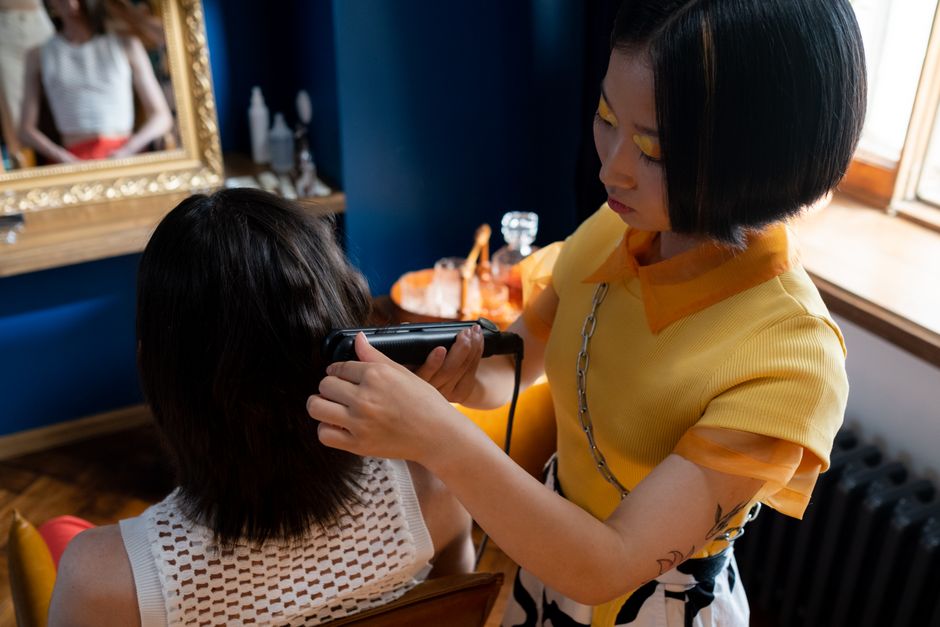
Hair straighteners are not inherently good or bad for your hair — the damage depends entirely on how you use them. Used correctly with proper heat protection and reasonable temperature settings, they can style hair without causing significant harm. Used daily at maximum heat with no protection, they will damage your hair over time. The real answer is that straighteners are a tool, and like any tool, the outcome depends on the user and the technique.
How Do Hair Straighteners Actually Damage Hair?
Hair is made of a protein called keratin. When you apply heat above a certain temperature, the hydrogen bonds in the hair temporarily break, allowing the hair to change shape. This is how straightening works. The problem is that high heat also damages the outer protective layer of the hair, called the cuticle.
When the cuticle is damaged, it lifts up and allows moisture to escape. Hair becomes dry, brittle, and prone to breakage. Repeated heat exposure can also break the disulfide bonds — the stronger chemical bonds that give hair its structure. Once those break, the damage is permanent until new hair grows in.
Research consistently shows that heat styling at temperatures above 350°F (175°C) causes measurable damage to the hair cuticle and cortex. The higher the temperature and the longer the contact time, the more damage occurs.
What Is the Safe Temperature Range for Hair Straighteners?
Most hair straighteners heat between 250°F and 450°F (120°C to 230°C). The safe range depends on your hair type. Fine or damaged hair should never exceed 300°F (150°C). Normal hair can handle 300-350°F (150-175°C). Thick or coarse hair may need 350-400°F (175-200°C).
If you have color-treated hair, the safe maximum is lower — typically around 300°F. The chemical processing has already weakened the hair structure, so adding more heat increases the risk of breakage.
Many people set their straighteners to maximum heat thinking it works faster. It does work faster, but it also causes more damage. Lower temperatures with multiple passes cause less cumulative damage than one pass at maximum heat.
Are Hair Straighteners Good Or Bad For Your Hair Depending on Frequency?
Frequency matters as much as temperature. Occasional use — once a week or less — with proper technique causes minimal damage. Daily use almost always leads to visible damage over weeks and months.
The reason is simple: hair does not fully recover between heat sessions. Each time you straighten, you strip some moisture and weaken the cuticle. Over time, the damage accumulates. Hair becomes dry, develops split ends, and breaks more easily.
Some people report that their hair feels fine after daily straightening for months. That is possible if they use low heat, high-quality heat protectants, and have naturally resilient hair. But this is the exception, not the rule. Most people will see damage with daily use within 3-6 months.





Does Heat Protectant Actually Work?
Yes, but with an important clarification. Heat protectants do not prevent all damage. They reduce it. A good heat protectant forms a thin barrier on the hair that absorbs some of the heat before it reaches the hair shaft. Studies have found that heat protectants can reduce moisture loss by 50-70% compared to using no protection.
Not all heat protectants are equal. Look for products containing silicones, which are effective at creating a heat barrier. Dimethicone and cyclomethicone are common and well-studied ingredients. Some newer formulas use polymers or plant-based ingredients, but the evidence for silicones is strongest.
Apply heat protectant to damp hair before blow-drying, then again before straightening. One application is not enough if you use multiple heat tools. The protectant needs to be present on the hair at the moment the straightener touches it.
What About Ceramic vs. Titanium Plates?
The plate material affects how heat is distributed to your hair. Ceramic plates heat evenly and maintain a consistent temperature. This reduces hot spots that can burn hair. Ceramic is generally recommended for most hair types, especially fine or damaged hair.
Titanium plates heat up faster and can reach higher temperatures. They are better for thick, coarse, or very curly hair that needs more heat to straighten. The trade-off is that titanium can be harder to control and may cause damage if you are not careful with temperature settings.
Tourmaline-infused plates emit negative ions that help seal the cuticle and reduce frizz. This is a real effect, though it is often overstated in marketing. The ion technology does help, but it does not prevent heat damage. It mainly improves the appearance of the finished style.
Can Hair Straighteners Cause Permanent Hair Loss?
No. Hair straighteners do not cause permanent hair loss. Heat damage affects the hair shaft, not the hair follicle where hair grows from. Damaged hair can break off, but the follicle continues to produce new hair.
However, there is a specific scenario where straighteners can cause permanent damage. If the straightener touches the scalp directly at high heat, it can burn the skin and damage the follicle. This can cause a small area of permanent hair loss. This is rare and happens only with direct skin contact, not normal styling.
If you notice thinning or balding, it is almost certainly caused by something other than heat styling. Genetics, hormones, stress, and medical conditions are the common causes. Heat styling can make existing hair look thinner by breaking the ends, but it does not stop new hair from growing.
What Are the Signs Your Hair Is Being Damaged by Heat?
Your hair will tell you if it is being damaged. Look for these signs:
- Dry, rough texture that does not improve with conditioner
- Split ends that appear faster than normal
- Increased breakage when brushing or styling
- Hair that feels brittle or snaps easily
- Loss of shine and natural luster
- Frizz that gets worse over time
If you notice any of these signs, take a break from heat styling for at least 2-4 weeks. Focus on deep conditioning and gentle handling. If the hair improves, heat was the likely cause. If it does not improve, there may be another issue like nutritional deficiency or a medical condition.
How to Minimize Damage If You Must Straighten
If you choose to straighten your hair, you can reduce the damage significantly with these steps:
- Always use a heat protectant — non-negotiable
- Set the temperature to the lowest effective setting for your hair type
- Never straighten wet or damp hair — dry it fully first
- Limit straightening to once a week or less
- Use a straightener with adjustable temperature control
- Replace your straightener if the plates are damaged or uneven
- Deep condition at least once a week
Some people find that using a lower temperature with more passes works better than high heat with fewer passes. This is partly true but has limits. Each pass still causes some damage. The goal is to find the balance between effective styling and minimal heat exposure.
Are There Health Risks Beyond Hair Damage?
Yes, and this is worth paying attention to. Some hair straighteners, especially older models or cheaper ones, can release fumes when heated. These fumes come from the coating on the plates and can contain chemicals that irritate the lungs.
There is also concern about formaldehyde exposure from some keratin-based straightening treatments. This is different from using a standard flat iron. The risk comes from the chemical treatment, not the straightener itself. If you use a keratin treatment followed by heat, make sure the product is formaldehyde-free and the room is well-ventilated.
As of 2026, there is no clinical evidence that standard hair straighteners cause cancer or other serious health problems. The risks are limited to hair damage, occasional burns from improper use, and potential lung irritation from fumes in poorly ventilated spaces.
Frequently Asked Questions
Can hair straighteners cause hair to fall out?
No, hair straighteners do not cause permanent hair loss because they only affect the hair shaft, not the follicle. Breakage from heat damage can make hair look thinner, but new hair will still grow.
What temperature should I set my hair straightener to?
Fine or damaged hair should stay at 300°F (150°C) or below, normal hair at 300-350°F (150-175°C), and thick hair at 350-400°F (175-200°C). Never exceed 400°F unless you have very coarse, resilient hair.
Is ceramic or titanium better for preventing damage?
Ceramic plates are better for preventing damage because they heat evenly and have fewer hot spots. Titanium heats faster and reaches higher temperatures, making it better for thick hair but riskier for fine or damaged hair.
How often can I straighten my hair without causing damage?
Once a week or less with proper heat protection is generally safe for most hair types. Daily straightening almost always causes visible damage within 3-6 months.
