
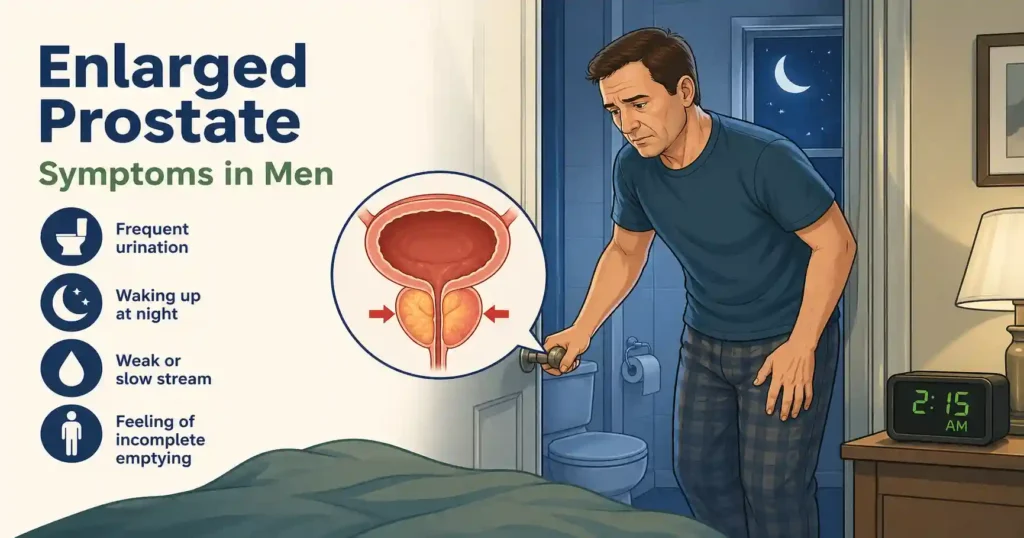
Enlarged prostate symptoms in men are mainly urinary changes caused by pressure on the urethra as the prostate grows. The condition, called benign prostatic hyperplasia (BPH), affects how urine flows and how often you need to go. It becomes more common with age, especially after 50.
Key Takeaways
- Enlarged prostate symptoms start mild but progress over time.
- The most common signs are urinary changes, not pain.
- Night urination is often the first major disruption.
- Back pain is not a typical early symptom.
- BPH, prostatitis, and cancer are not the same condition.
- Ignoring symptoms leads to worse outcomes later.
What Is an Enlarged Prostate?
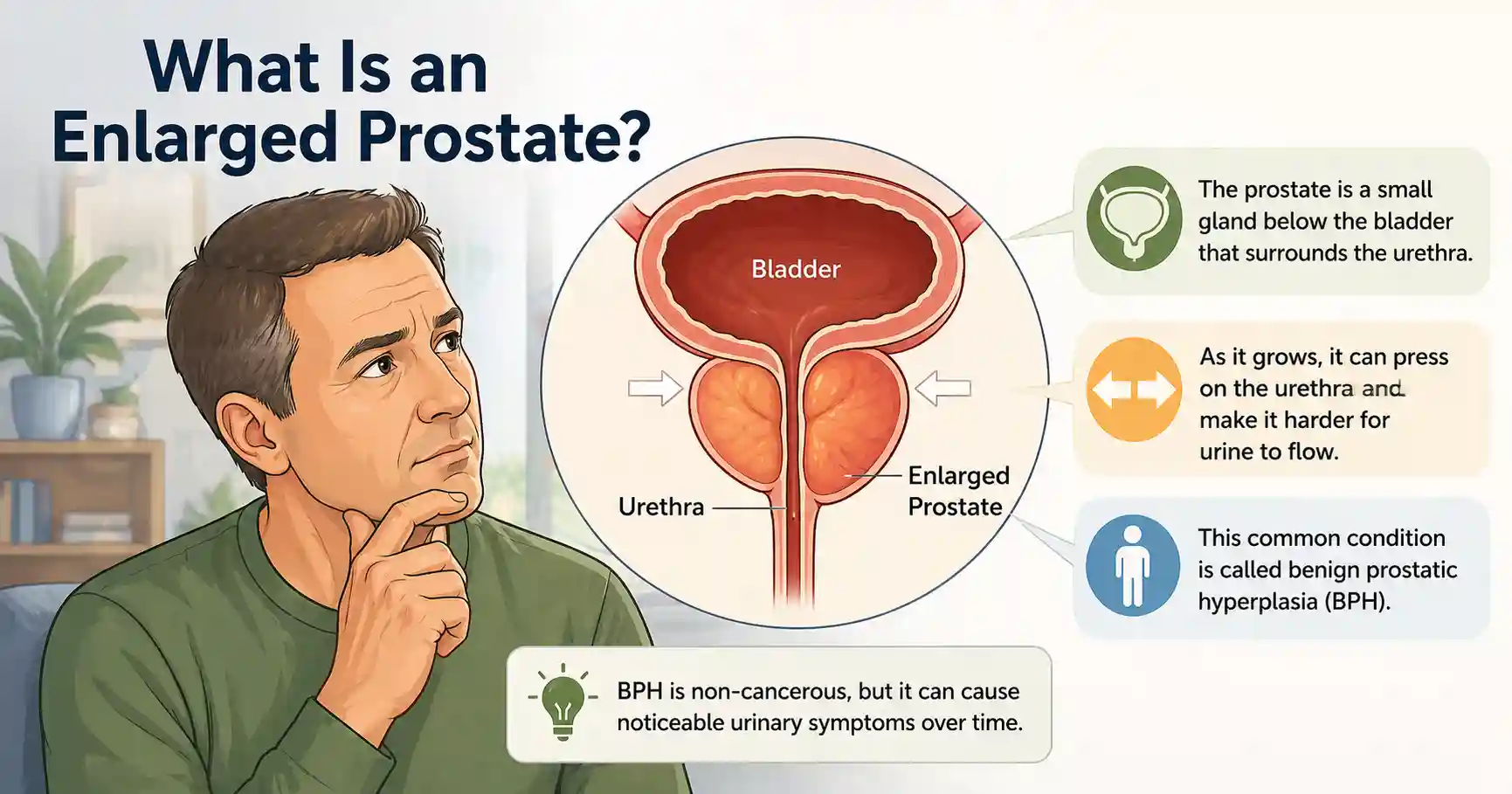
An enlarged prostate (BPH) is a non-cancerous increase in prostate size that happens as men age. The prostate sits just below the bladder and wraps around the urethra. When it grows, it squeezes that tube.
That pressure changes how urine moves. It’s not subtle. It shows up in daily habits first, not lab reports.
Current research suggests that hormonal changes, especially dihydrotestosterone (DHT), play a major role. A 2022 review in Nature Reviews Urology points out that prostate growth continues even when testosterone levels drop with age.
Most men don’t notice the enlargement itself. They notice what it does.
What Are the First Signs of an Enlarged Prostate?
The earliest symptoms of an enlarged prostate are annoying, not painful. That’s why many men ignore them.
Here’s how it usually starts:
- You need to pee more often, especially in the evening
- The stream feels weaker than before
- You hesitate before your urine starts
- You feel like your bladder isn’t fully empty
These don’t hit all at once. They creep in slowly. The mistake people make is assuming it’s “just aging.” That’s partly true. But ignoring early signs often leads to worse symptoms later.
Quick Takeaway: Early BPH symptoms are subtle urinary changes that gradually become more noticeable.
What Are the Main Enlarged Prostate Symptoms Men Experience?
This is where most articles fail—they list symptoms without context. Here’s the reality, grouped by how they actually show up.
1. Storage Symptoms (Bladder Irritation)
- Frequent urination
- Urgency (hard to hold it)
- Waking up multiple times at night (nocturia)
2. Voiding Symptoms (Flow Problems)
- Weak urine stream
- Straining to start
- Stop-start flow
- Dribbling at the end
3. Post-Urination Symptoms
- Feeling like you didn’t empty fully
- Need to go again soon
Now the important part: These symptoms are not random. They reflect two mechanisms:
- Bladder working harder
- Urethra being compressed
Most articles don’t explain that. They should.
A 2021 report from the American Urological Association notes that over 50% of men above 60 experience some degree of these symptoms.
How Do Symptoms Progress Over Time?
This is the part competitors completely ignore.
Symptoms don’t stay the same. They follow a pattern.
| Stage | What Happens | What You Notice |
|---|---|---|
| Early | Mild obstruction | Slight delay, weak stream |
| Moderate | Bladder overcompensation | Frequent urination, urgency |
| Advanced | Bladder fatigue | Incomplete emptying, retention |
At advanced stages, things get serious:
- Urinary retention (can’t pee at all)
- Increased infection risk
- Bladder damage
Here’s the uncomfortable truth: By the time symptoms are “bad,” the bladder is already under stress.
Quick Takeaway: Symptoms worsen gradually from mild inconvenience to functional problems affecting the bladder.
Why Do Enlarged Prostate Symptoms Get Worse at Night?
Night symptoms are not random. They follow biology.
At night:
- Your body shifts fluid back into circulation
- Kidneys produce more urine
- The bladder becomes more sensitive
Now, combine that with a narrowed urethra. You wake up. Repeatedly. This is called nocturia, and it’s often the symptom that pushes men to seek help.
What most people misunderstand: It’s not just the prostate. It’s a bladder + hormone + circulation issue.
That’s why fixing only one factor doesn’t always solve it.
What Causes an Enlarged Prostate?
The honest answer: age and hormones drive it.
Main factors:
- Aging (primary driver)
- Hormonal imbalance (DHT buildup)
- Family history
- Metabolic factors (obesity, insulin resistance)
A 2020 study in The Journal of Clinical Endocrinology & Metabolism linked higher insulin levels with increased prostate growth. That connection is still being studied, but it shows this isn’t just a “local” problem.
What doesn’t cause it:
- Sexual activity
- Masturbation
- Low testosterone alone
There’s a lot of nonsense online about this. Ignore it.
Enlarged Prostate vs Prostatitis vs Cancer: What’s the Difference?
This confusion is everywhere—and it matters.
| Condition | Key Symptoms | Key Difference |
|---|---|---|
| BPH | Urinary issues, slow progression | Non-cancerous growth |
| Prostatitis | Pain, burning, fever | Inflammation or infection |
| Prostate Cancer | Often silent early | May spread silently |
Here’s the blunt truth:
- BPH = annoying
- Prostatitis = painful
- Cancer = often silent early
If you mix these up, you either panic unnecessarily or ignore something serious.
When Should You Worry About Prostate Symptoms?
You don’t need to panic over mild symptoms. But you do need to act at the right time.
Watch for:
- Sudden inability to urinate
- Blood in urine
- Painful urination with fever
- Rapid worsening of symptoms
These are not “wait and see” situations. Also, if symptoms start affecting sleep or daily life, that’s already past the “ignore it” stage.
What Actually Helps (and What Doesn’t)?
Let’s cut through the noise.
Things That Often Help
- Reducing evening fluid intake
- Limiting caffeine and alcohol
- Bladder training (timed urination)
- Medical treatments (alpha-blockers, etc.)
Things That Are Overhyped
- Random herbal supplements with no evidence
- “Detox” claims
- Quick fixes
Some plant-based options, like saw palmetto, have mixed evidence. A 2023 Cochrane review found inconsistent benefits, not strong results.
That’s not what supplement ads tell you.
FAQs
What are the warning signs of prostate problems?
Warning signs include frequent urination, weak urine flow, urgency, and waking at night to urinate. More serious signs include blood in urine, pain, or inability to urinate. These symptoms vary depending on whether the cause is BPH, infection, or cancer.
What causes an enlarged prostate in men?
The main causes are aging and hormonal changes, especially increased dihydrotestosterone levels. Genetics and metabolic factors like obesity may also contribute. It is not caused by sexual activity or lifestyle alone.
Is an enlarged prostate dangerous?
An enlarged prostate itself is not life-threatening, but untreated symptoms can lead to complications like urinary retention, infections, or bladder damage. The condition becomes more serious when it interferes with normal bladder function.
Why is prostatitis worse at night?
Symptoms may feel worse at night due to increased awareness, reduced distractions, and fluid shifts in the body. Inflammation and pressure in the pelvic area can also feel more intense when lying down.
Can an enlarged prostate go away on its own?
No, an enlarged prostate does not shrink naturally. Symptoms may fluctuate, but the condition typically progresses with age. Treatment focuses on managing symptoms and preventing complications rather than reversing the enlargement completely.
Final Thought
Most men don’t act on enlarged prostate symptoms until sleep gets disrupted or daily life becomes inconvenient. That’s late.
If you’re noticing changes—even small ones—you’re already in the early phase. That’s the best time to deal with it, not when it starts controlling your routine.

Recent Posts