

Natural remedies for constipation are food, fluid, and lifestyle changes that help stool move more easily through the colon. They work by increasing stool water, adding bulk, or stimulating bowel movement. The most reliable options are psyllium, kiwifruit, prunes, fluids, and regular bowel habits, not random “detox” fixes.
Key Takeaways
- Psyllium, prunes, and kiwifruit have the strongest evidence
- Water and fiber must work together
- Fast relief and long-term improvement are different
- Gradual changes work better than aggressive ones
- Consistency beats intensity every time
What Are 10 Science-Backed Natural Remedies for Constipation?
The best natural remedies for constipation are the ones with real clinical evidence, not just tradition or popularity. As of 2026, guideline-level research from the Journal of Human Nutrition and Dietetics (2025) supports a short list: psyllium, kiwifruit, prunes, magnesium-based options, high-mineral water, and consistent bowel habits.
Here are the 10 science-backed options that actually help — each working through stool softening, bulk formation, or colon stimulation:
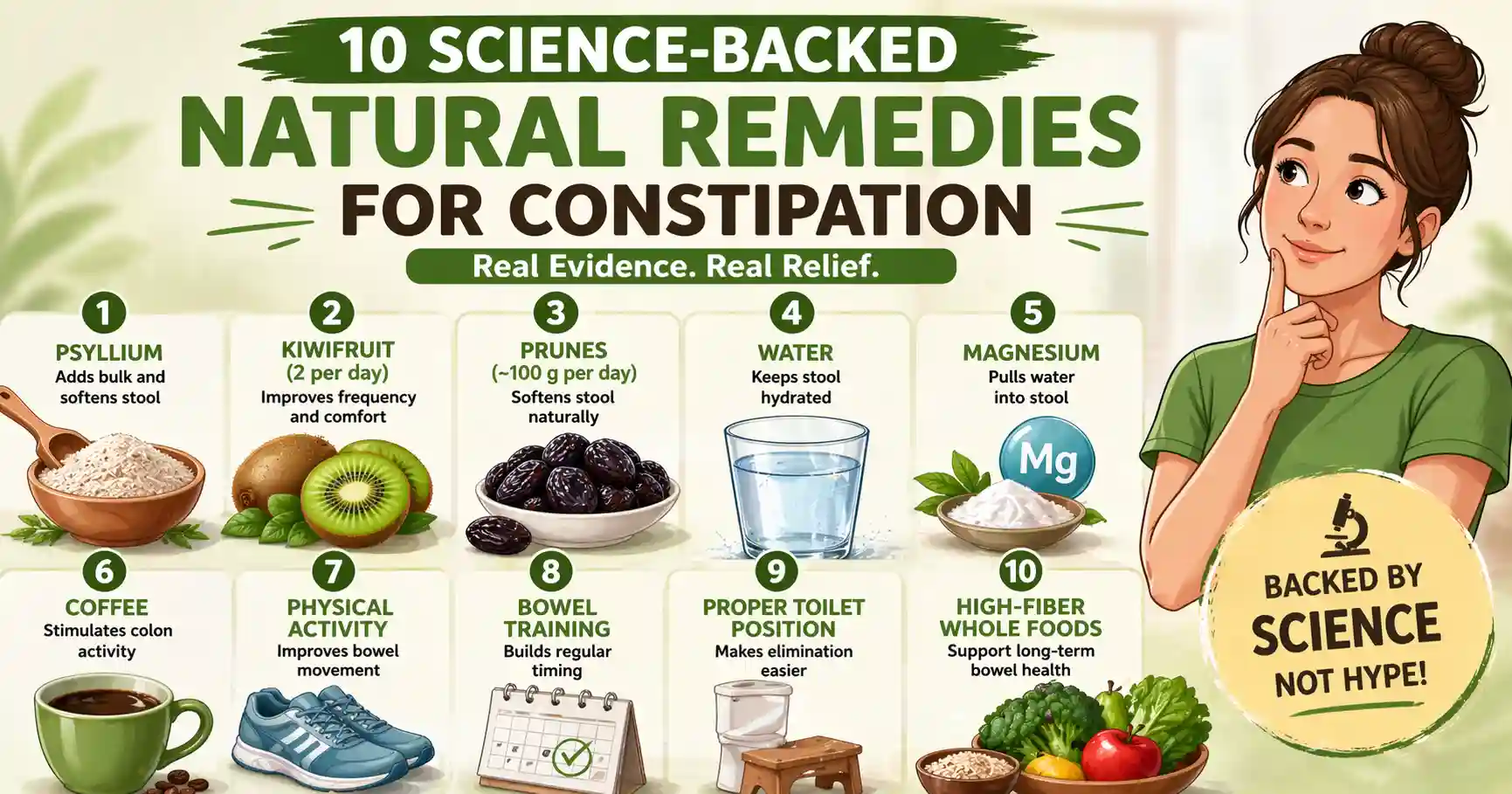
- Psyllium: Adds bulk and softens stool
- Kiwifruit (2 per day): Improves stool frequency and comfort
- Prunes (~100 g per day): Fiber + sorbitol softens stool
- Water: Helps stool stay hydrated
- Magnesium: Pulls water into stool
- Coffee: Stimulates colon contractions
- Physical activity: Improves gut movement
- Bowel training: Builds regular timing
- Proper toilet position: Makes stool easier to pass
- High-fiber whole foods: Support long-term bowel health
| Remedy | What it does | Evidence strength |
|---|---|---|
| Psyllium | Adds bulk and softens stool | Strong (BDA guideline, 2025) |
| Kiwifruit (2/day) | Improves stool frequency and comfort | Strong (AJG trial, 2021) |
| Prunes (~100 g/day) | Fiber + sorbitol softens stool | Strong (AJG, 2022) |
| Water | Helps stool hydration | Moderate (NIDDK guidance) |
| Magnesium oxide | Pulls water into stool | Moderate |
| Exercise | Improves bowel movement | Moderate |
| Coffee | Stimulates colon activity | Moderate |
| Bowel training | Builds regular timing | Strong behavioral evidence |
Here’s the blunt truth: most remedies people try are weak because they are inconsistent or underdosed.
Which Foods Help Most With Constipation?
The best foods are not just “high fiber.” That advice is incomplete and often backfires.
The strongest food-level evidence comes from direct trials:
- Kiwifruit (2 per day)
A 2021 American Journal of Gastroenterology study in 79 adults showed improved bowel movements with fewer side effects than other options.
Why it works: fiber + natural enzymes + better tolerance. - Prunes (~100 g per day)
A 2022 RCT showed improved stool consistency and frequency.
Why it works: fiber plus sorbitol, which pulls water into the stool. - Psyllium (fiber supplement)
One of the most effective fibers.
Why it works: forms a gel that increases stool bulk and softness. - Vegetables, legumes, whole grains
Support baseline fiber intake.
Why they work: slow digestion and increased stool volume.
What most people get wrong: They jump from low fiber to high fiber overnight. That causes bloating and makes them quit.
Gradual increase works. Sudden overload doesn’t.
Which Natural Remedies Work Fastest?
Some remedies work quickly, but that does not mean they are the best long-term solution.
Fast-acting options:
- Coffee → stimulates colon contractions
- Warm fluids → can trigger bowel movement reflex
- Prune juice → softer stool within hours for some people
- Bowel timing (after meals) → uses natural reflex
Cleveland Clinic notes that fiber supplements can take 12 hours to 3 days to work. That delay makes people think they are ineffective, which is wrong.
Key distinction:
- Fast relief = symptom response
- Effective treatment = consistent pattern change
How Long Do Natural Remedies Take to Work?
Constipation does not resolve instantly unless it is very mild.
Real timeline:
- Day 1–3
Water, coffee, and timing may help. - Week 1–2
Fiber starts working. Stool becomes softer. - Week 3–4
Stable improvement if the routine is consistent.
The 2021 kiwifruit/prune/psyllium trial ran for 4 weeks, not a few days. That matters. Most people quit before results stabilize.
What people misunderstand: They expect a fix in 24 hours. That expectation kills consistency.
What Should Adults Over 40 Do First?
Start simple. Do not jump to extreme fixes.
NIDDK recommends 22–34 grams of fiber daily, plus fluids. Most adults fall short.
A practical plan:
- Drink water regularly during the day
- Add one fiber source at a time
- Use kiwifruit or prunes before supplements
- Walk after meals
- Sit on the toilet after breakfast daily
- Use a footstool to improve position
Non-obvious insight: Older adults often need routine more than intensity. Large sudden changes are harder to tolerate and easier to abandon.
When Should You Stop Home Remedies and See a Doctor?
Constipation is not always a simple diet issue.
Get medical help if you have:
- Blood in stool
- Severe abdominal pain
- Vomiting
- Inability to pass gas
- Unexplained weight loss
- Persistent constipation despite changes
NIDDK highlights these as warning signs that need evaluation. Ignoring them and “trying more fiber” is a mistake.
FAQs
Which foods are worst for constipation?
Low-fiber foods are the main issue. Processed foods, fast food, and meat-heavy diets slow bowel movement because they lack fiber and water content. NIDDK recommends limiting these foods and increasing fiber-rich options instead, especially fruits, vegetables, and whole grains.
How quickly do natural remedies work?
Some remedies, like coffee or warm fluids, can work within hours, but most natural approaches take longer. Fiber supplements may take 12 hours to 3 days, while food-based changes such as prunes or kiwifruit usually need several days to weeks for consistent results.
Can diet alone treat constipation?
Diet can help significantly, but it does not fix every case. NIDDK includes diet as one part of treatment, along with physical activity and sometimes medication. If constipation persists despite dietary changes, other causes may need medical evaluation.
What is the best eating pattern for constipation?
The most effective pattern includes steady fiber intake, enough fluids, and regular meals. NIDDK suggests 22–34 grams of fiber per day for adults, combined with water to help stool move more easily. Consistency matters more than occasional high-fiber meals.
Do supplements work better than food for constipation?
Not always. Psyllium is one of the better-supported supplements, but foods like prunes and kiwifruit also have strong evidence. Many people find food-based approaches easier to maintain long-term, which makes them more effective in practice.

Recent Posts