
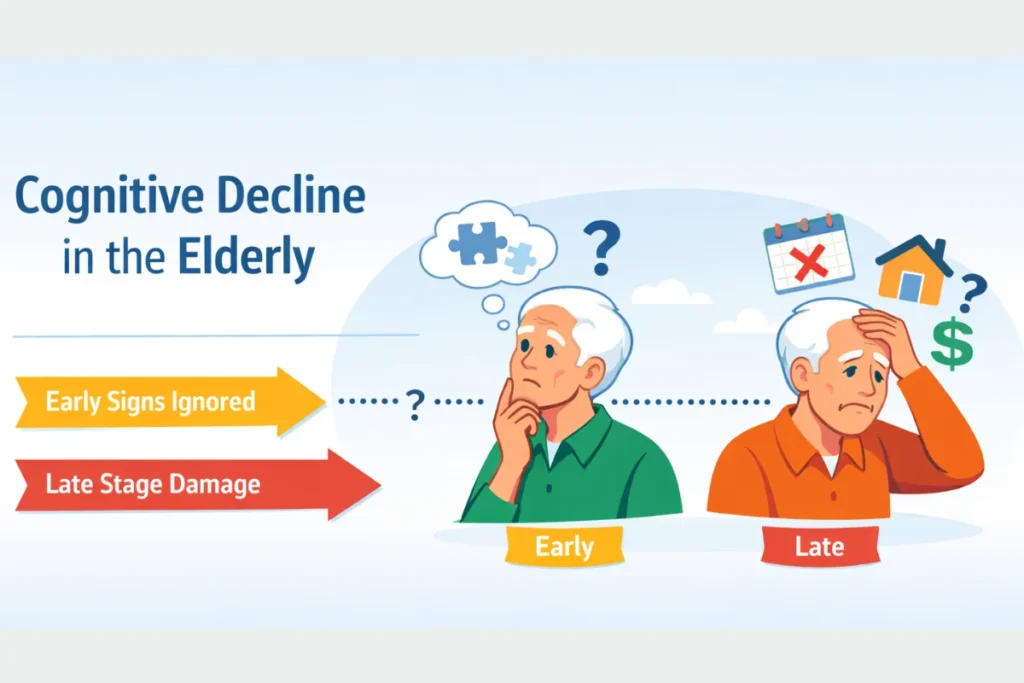
Cognitive decline in the elderly is a measurable reduction in memory, thinking, or reasoning abilities beyond normal aging. It matters because it can affect daily independence and may indicate conditions like mild cognitive impairment or dementia.
Common early signs include memory loss, confusion, and difficulty making decisions.
Key Takeaways
- ✔ Cognitive decline is not the same as normal aging
- ✔ Early symptoms follow a pattern, not isolated events
- ✔ Some causes are reversible if identified early
- ✔ Sudden decline is a medical emergency
- ✔ Lifestyle changes help but don’t guarantee prevention
- ✔ Early evaluation improves outcomes significantly
What Is Cognitive Decline in the Elderly?
Cognitive decline in the elderly refers to a noticeable drop in mental abilities, including memory, attention, and problem-solving. It goes beyond the slower thinking that comes with normal aging.
Most people assume aging equals memory loss. That’s not accurate.
Normal aging might mean:
- taking longer to recall a name
- needing reminders occasionally
But cognitive decline shows up differently:
- Repeated memory failures
- Confusion in familiar situations
- Trouble completing routine tasks
There’s also an in-between stage called mild cognitive impairment (MCI). People with MCI are not fully impaired, but they’re no longer functioning at their previous level either. According to the National Institute on Aging (2026), some people remain stable, but others progress to dementia over time.
One thing that stands out when you read multiple studies, people rarely notice the shift when it begins. It’s gradual, and that’s exactly why it gets missed.
What Are the Symptoms of Cognitive Decline in the Elderly?
Symptoms of cognitive decline in elderly individuals appear as consistent changes in memory, thinking, and behavior.
Cognitive Decline Symptoms by Stage
| Symptom | Early Signs | Progressive / Advanced Signs |
|---|---|---|
| Memory | Frequent memory lapses (recent events) | Severe memory loss, forgetting familiar places or people |
| Repetition | Repeating questions or stories | Repeating constantly without awareness |
| Focus | Difficulty concentrating | Unable to follow conversations or tasks |
| Language | Trouble finding words mid-sentence | Struggling to communicate clearly |
| Awareness | Losing track of time or conversations | Confusion about location, dates, or surroundings |
| Decision-Making | Slight hesitation in decisions | Poor judgment in simple or risky situations |
| Daily Tasks | Mild difficulty organizing tasks | Unable to manage finances or routine activities |
| Social Behavior | Reduced engagement | Withdrawal from social situations completely |
It’s not about having symptoms. It’s about pattern + persistence.
Someone forgetting a name once is normal. Someone forgetting the same conversation three times in a day isn’t. Behavior changes often show up before severe memory loss. That detail gets ignored far too often.
What Causes Cognitive Decline in Older Adults?
Cognitive decline in older adults is caused by a combination of brain aging, disease, and lifestyle factors.
Main causes:
- Brain aging: Gradual loss of neurons. Reduced communication between brain cells
- Neurodegenerative diseases: Alzheimer’s disease. Vascular dementia. Lewy body dementia
- Medical conditions: Stroke, diabetes, high blood pressure, or thyroid problems
- Lifestyle factors: Poor sleep, physical inactivity, social isolation, or chronic stress
- Medications: Certain drugs, especially sedatives, can affect memory and thinking.
What most people misunderstand
Not all cognitive decline is permanent.
Some cases are linked to:
- vitamin B12 deficiency
- depression
- medication side effects
These can improve if treated early. The problem is timing. People assume “this is just aging” and delay evaluation. By the time they act, the condition has progressed.
What Is Sudden Cognitive Decline in the Elderly?
Sudden cognitive decline in elderly individuals is a rapid change in thinking or awareness that develops over hours or days.
This is not typical aging. It’s usually a warning sign.
Common causes include:
- infections (especially urinary tract infections)
- stroke
- medication reactions
- dehydration
This condition is often called delirium.
Unlike dementia:
- It appears quickly
- symptoms fluctuate
- attention is severely affected
This is one area where hesitation causes real damage. If symptoms appear suddenly, it needs immediate medical attention.
Is Cognitive Decline a Normal Part of Aging?
Mild slowing of thinking is normal with age. Significant cognitive decline is not.
Here’s a clearer breakdown:
| Normal Aging | Cognitive Decline |
|---|---|
| Occasional forgetfulness | Frequent memory problems |
| Slower thinking | Confusion and disorientation |
| Needs reminders | Cannot complete familiar tasks |
| Aware of mistakes | Often unaware of issues |
The difference isn’t subtle once you know what to look for. The issue is that most people don’t know what to look for.
What Is the Difference Between Cognitive Decline and Dementia?
Cognitive decline is a broad term for reduced mental ability. Dementia is a diagnosed condition that affects daily life significantly.
The key difference is function.
| Condition | Severity | Daily Impact |
|---|---|---|
| Normal aging | Mild | None |
| Mild Cognitive Impairment | Moderate | Minimal |
| Dementia | Severe | Significant |
In dementia:
- Daily tasks become difficult
- independence decreases
- Safety becomes a concern
Research published in Alzheimer’s & Dementia (2020)12020 Alzheimer’s disease facts and figures, The Journal Of The Alzheimer’s Association. suggests that individuals with MCI have a higher risk of developing dementia, but progression is not guaranteed.
What Treatments Are Available for Cognitive Decline in the Elderly?
Treatment for cognitive decline in elderly individuals focuses on managing symptoms and slowing progression.
Medical approaches:
- medications for Alzheimer’s disease
- treatment of underlying conditions (blood pressure, diabetes)
Lifestyle strategies:
- regular physical activity (linked to slower decline – JAMA Neurology, 2019)
- cognitive stimulation (learning, problem-solving)
- social interaction
Diet:
Diet patterns like the Mediterranean diet have been associated with better brain health (Harvard Health, 2025).
Where common advice fails
You’ll often hear:
- “The brain games prevent dementia.”
That’s not fully accurate.
They may improve function temporarily, but they do not stop disease progression on their own. That distinction matters, but it’s rarely explained clearly.
How to Prevent Cognitive Decline in Aging?
Prevention focuses on reducing risk, not eliminating it.
Effective strategies include:
- staying physically active
- maintaining strong social connections
- managing chronic conditions
- getting consistent sleep
- avoiding smoking
As of 2026, current research suggests that lifestyle changes can delay the onset, but not fully prevent neurodegenerative disease in all cases.
That’s an important distinction. Most content ignores it.
What to Do If an Elderly Parent Shows Cognitive Decline?
If an elderly parent shows signs of cognitive decline, early action matters.
Steps to take:
- Track symptoms over time
- Schedule a medical evaluation
- Review medications
- Check for reversible causes
Most families wait too long. Not intentionally—just because the changes seem small at first.
By the time it’s obvious, the condition is often advanced.
FAQs
What are the early signs of cognitive decline in the elderly?
Early signs include repeated memory lapses, confusion, difficulty concentrating, and trouble finding words. The key factor is consistency. Occasional forgetfulness is normal, but repeated patterns that interfere with daily life suggest cognitive decline.
Can cognitive decline be reversed in the elderly?
Some forms of cognitive decline can improve if caused by vitamin deficiencies, medication effects, or depression. However, conditions like Alzheimer’s disease cannot be reversed, although treatment may help slow progression and manage symptoms.
What causes a sudden cognitive decline in the elderly?
Sudden cognitive decline is often caused by infections, stroke, dehydration, or medication reactions. This rapid change is usually classified as delirium and requires immediate medical evaluation because it is often treatable if addressed quickly.
Is cognitive decline normal in old age?
Mild slowing of thinking is normal with age, but significant memory loss, confusion, or impaired decision-making is not. These symptoms indicate possible cognitive impairment and should be evaluated by a healthcare professional.
Final Thought
Cognitive decline in the elderly is often ignored in its earliest stages and misunderstood once it becomes obvious. Early symptoms are subtle, inconsistent, and easy to dismiss as normal aging. That delay in recognition is where most of the real damage begins.
By the time changes become clear—missed bills, confusion, poor decisions—the underlying process has usually been developing for years. At that point, options become more limited, and progression is harder to slow.
What stands out, after looking across research and real-world patterns, is how often people wait for certainty before acting. They want clear proof that something is wrong. But cognitive decline doesn’t announce itself that way. It builds quietly.
That gap—between when it starts and when people finally act—is not just a delay. It’s the difference between a manageable decline and an irreversible loss of independence.
Scientific References
- 12020 Alzheimer’s disease facts and figures, The Journal Of The Alzheimer’s Association.

Recent Posts