
Use this calculator to estimate your daily step goal based on your body details and weight loss target.
How Many Steps to Lose Weight Calculator
Find your personalized daily step goal for healthy weight loss
How Many Steps Per Day to Lose Weight?
Walking is one of the most accessible and sustainable forms of exercise for weight loss. This steps to lose weight calculator helps you find a personalized daily step goal based on your body metrics and weight loss targets.
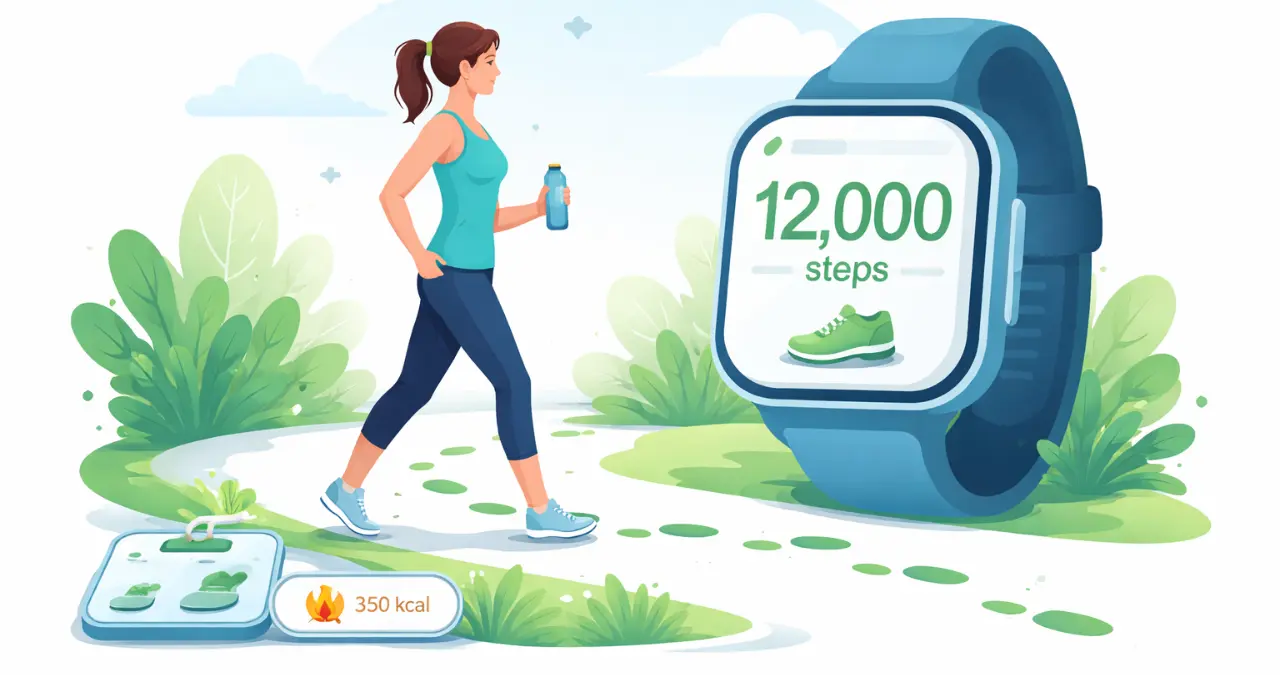
The Science of Walking for Weight Loss:
- Every step burns approximately 0.04–0.05 calories per kg of body weight
- 10,000 steps ≈ 7–8 km of walking distance
- Walking burns about 300–500 calories per 10,000 steps (depending on weight)
- To lose 0.5 kg per week, you need a 500 calorie daily deficit
How This Step Calculator Works
Our walking calorie calculator uses the Mifflin-St Jeor equation to calculate your Basal Metabolic Rate (BMR), then factors in your activity level to determine your Total Daily Energy Expenditure (TDEE). From there, it calculates exactly how many steps you need to create the calorie deficit for your weight loss goal.
| Weight Loss Goal | Weekly Deficit | Daily Deficit Needed |
|---|---|---|
| 0.25 kg/week | ~1,925 calories | ~275 calories/day |
| 0.5 kg/week | ~3,850 calories | ~550 calories/day |
| 0.75 kg/week | ~5,775 calories | ~825 calories/day |
Is 10,000 Steps a Day Enough to Lose Weight?
The popular 10,000 steps per day goal originated from a 1960s Japanese marketing campaign, not scientific research. While it’s a good baseline for general health, the right number for weight loss varies by individual.
What 10,000 Steps Actually Burns
| Body Weight | Calories Burned (10,000 steps) |
|---|---|
| 60 kg (132 lbs) | ~280–320 calories |
| 70 kg (154 lbs) | ~330–380 calories |
| 80 kg (176 lbs) | ~380–430 calories |
| 90 kg (198 lbs) | ~420–480 calories |
| 100 kg (220 lbs) | ~470–530 calories |
Key Insight: For meaningful weight loss, many people need 12,000–15,000 steps per day, especially if they’re not making dietary changes. Use this step calculator for weight loss to find your personalized target.
Walking vs Running for Weight Loss
Both walking and running are effective for burning calories, but they offer different benefits:
| Factor | Walking | Running |
|---|---|---|
| Calories per minute | 3–5 cal/min | 8–12 cal/min |
| Sustainability | High (can do daily) | Moderate (needs rest days) |
| Injury risk | Very low | Moderate to high |
| Duration possible | 60–120+ minutes | 20–45 minutes |
| Best for | Beginners, consistency | Time efficiency |
Bottom Line: The best exercise for weight loss is the one you’ll actually do consistently. Walking wins for most people because it’s sustainable, low-impact, and can be incorporated into daily life.
Tips to Reach Your Daily Step Goal
- Start gradually – Increase steps by 1,000-2,000 per week until you reach your target
- Break it up – Three 10-minute walks are as effective as one 30-minute walk
- Take walking meetings – Turn phone calls into walking opportunities
- Park farther away – Simple habit that adds 500-1,000 steps daily
- Use stairs – Skip the elevator when possible
- Walk after meals – Improves digestion and adds steps naturally
- Track consistently – Use a fitness tracker or smartphone for accountability
⚠️ Medical Disclaimer
This calculator provides estimates for educational purposes only. Individual results vary based on metabolism, diet, body composition, and walking intensity. Consult a healthcare professional before starting any weight loss program, especially if you have health conditions.
Frequently Asked Questions
Our Calculation Methodology & Sources
This steps to lose weight calculator uses peer-reviewed formulas and research-backed data to provide accurate estimates. Here’s the science behind our calculations:
Basal Metabolic Rate (BMR)
We use the Mifflin-St Jeor Equation, recognized as the most accurate BMR formula for adults by the Academy of Nutrition and Dietetics.
- Men: BMR = (10 × weight in kg) + (6.25 × height in cm) − (5 × age) + 5
- Women: BMR = (10 × weight in kg) + (6.25 × height in cm) − (5 × age) − 161
→ View Study: Comparison of predictive equations (PubMed)
Activity Multipliers (TDEE)
Total Daily Energy Expenditure is calculated by multiplying BMR by standardized Physical Activity Level (PAL) factors established by the World Health Organization and validated in metabolic research.
→ FAO/WHO Technical Report on Human Energy Requirements
Walking Calorie Expenditure
Calories burned per step are calculated using body weight and stride length, based on research from the American College of Sports Medicine (ACSM) and studies on walking energy expenditure.
- Average calorie burn: 0.04–0.06 kcal per step (varies by weight)
- Step length approximation: ~41.5% of height
→ Energy Expenditure of Walking (Medicine & Science in Sports)
Weight Loss Energy Balance
Our calorie deficit calculations are based on the established principle that 1 kg of body fat ≈ 7,700 calories (3,500 calories per pound), a figure consistently used in clinical nutrition guidelines.
→ Quantifying the Energy of Weight Loss (International Journal of Obesity)
10,000 Steps Research
While 10,000 steps is a popular target, research shows optimal health benefits may require individualized goals. Recent studies suggest 7,000–10,000 steps significantly reduce mortality risk.
→ Steps per Day and Mortality (JAMA Network Open, 2021)
Why Trust Our Calculator?
- Based on peer-reviewed scientific research
- Uses the same formulas trusted by dietitians and fitness professionals
- Regularly updated to reflect current nutritional science
- Transparent methodology with cited sources
Published by Healthy Beginning Magazine