
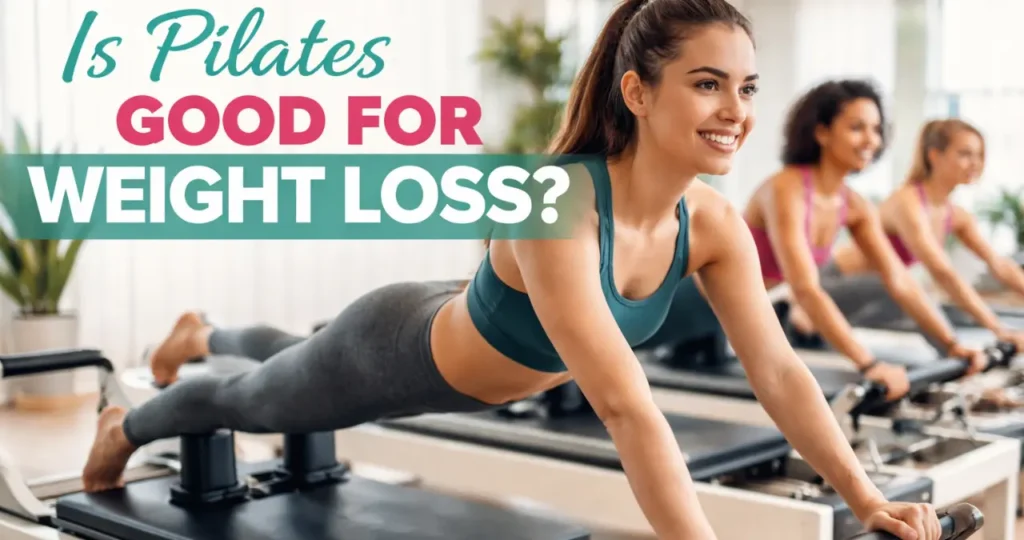
Weight Loss is a problem that’s usually reduced to just calories, but that doesn’t cut it for many people. Plenty of adults in the US are cutting back on food, working hard, and still not seeing any results. What’s getting left out of the equation is how the body responds to exercise – how it adapts, holds on to its muscle, and what gets lost when you lose weight.
People often get the impression that Pilates is a “low-impact” exercise, which makes them wonder whether it will really help with weight loss. There are loads of search data and clinical discussions around this exact question: “Is Pilates actually good for weight loss, or is it just a bunch of flexibility and posture benefits?”
This guide tries to get to the bottom of that question, relying on what we know from medical science and some real-world proof. No hype about getting fit overnight, just looking at Pilates as a long-term strategy for changing the way your body is put together.
What Pilates is Really All About
Pilates is a form of exercise that’s designed to be low-impact, with a focus on controlled movements, core power, breathing, and building muscle endurance. It’s not about getting you to burn as many calories as possible per session – it was actually designed to improve the connection between your brain and muscles.
From a medical perspective, Pilates is considered a form of moderate-intensity mind-body exercise – it works the muscles hard enough that they stay under tension, but doesn’t put too much stress on the joints. Because Pilates doesn’t rely on just speed, but on precision, it gets a bad rap for not being a ‘proper’ workout.
Why Weight Gain Happens (Beyond Calories)
We like to think that weight gain is just about overeating, but that’s not usually the whole story. In adults (especially after 30), it’s more likely that weight gain is being driven by:
- A loss of lean muscle mass – your resting metabolism drops, and you start storing more fat
- Less sensitivity to insulin
- Chronic stress and sky-high cortisol levels
- Being stuck in a slouchy posture or having weak stabilizing muscles in your body
- Doing things in life that make your body work less efficiently
As your muscle mass goes down, so does your resting metabolic rate – you burn fewer calories, even when you’re not doing anything. And that makes it easier for fat to build up, even if you’re eating ‘normally’.
And that’s where Pilates for weight loss comes in – because it’s about building muscle and changing the way your body works.n and neuromuscular efficiency is directly targeted.
According to metabolic studies referenced by the NIH and Harvard Health, resistance-based movement plays a central role in long-term fat reduction and metabolic stability.
How Pilates Supports Weight Loss (The Real Mechanisms)
Pilates may not lead to rapid scale drops in the first few weeks – and that’s not something to just brush aside. But what it does do over time is pretty interesting.
1. Keeping Lean Mass Strong
Pilates keeps on exerting a gentle but sustained pressure on your deeper muscles – in your core, hips, and back, especially. As a result, your lean muscle mass is protected, and your resting metabolism stays supported.
2. Improving Your Body’s Ability to Use Glucose
When you contract your muscles in a controlled way, glucose gets drawn into your muscle tissue. That helps you manage your blood sugar levels better, which in turn reduces the signals that tell your body to start storing fat.
3. Reducing Stress & Cortisol Levels
Pilates is all about focusing on your breathing and getting your nervous system in line. That means your cortisol levels – which are linked to stomach fat storage – tend to come down over time.
4. Moving More Efficiently
Bad movement patterns can limit your activity levels and set you up for injuries. Pilates helps you get your posture right and your joints in line, making other kinds of exercise easier to stick to.
The way this works is – your weight loss isn’t directly linked to how many calories you burn in each session. Instead, Pilates supports you indirectly but consistently.
Calories Burned vs. Fat Loss: A Common Misconception
You might be thinking – “Okay, one Pilates session is going to burn way more calories than a Pilates session.” And that’s true enough – but what really matters when it comes to weight loss isn’t how many calories you burn in one session. What really matters is whether you’ll keep coming back for more and whether you can keep it up over time.
In fact, Pilates has some pretty high adherence rates – especially among people over 35 who have joint pain or people who tend to avoid high-impact exercise.
So what really drives sustainable weight loss is consistency – not how intense the session is.
Who Benefits Most From Pilates For Weight Loss
Pilates isn’t the right choice for everyone – especially if you’re looking for something to lose weight fast. But it works particularly well for:
- People in their 30s and 40s who are finding their metabolism slowing down
- Folks who are dealing with back pain or can’t take high-impact exercise
- Beginners who are just starting and don’t want to put their joints under too much stress
- Women who are dealing with hormonal weight gain
- People who are under a lot of stress and need a way to manage it
If you’re a young athlete looking to lose a lot of weight quickly, Pilates might not be enough on its own. But for most adults, it’s a pretty solid choice – especially if you can stick with it.
What Happens If Weight Gain Is Ignored
If you just keep on gaining weight without doing anything about it, your medical risks are going to start creeping up. You’re looking at a higher chance of:
- Insulin resistance and a diagnosis of type 2 diabetes
- Heart disease is taking hold
- Your joints are wearing out
- Chronic inflammation and your overall health declining
- Reduced mobility as you get older
Exercise that preserves joint health while supporting metabolic function is strongly recommended by the CDC and Mayo Clinic.
Evidence-Based Comparison: Pilates vs Other Exercise Types
| Exercise Type | Muscle Preservation | Joint Stress | Adherence Rate | Weight Loss Support |
|---|---|---|---|---|
| Pilates | High | Low | High | Moderate–High (long-term) |
| Running | Low–Moderate | High | Low–Moderate | High (short-term) |
| HIIT | Moderate | High | Low | High (short-term) |
| Walking | Low | Low | High | Low–Moderate |
This table reflects long-term sustainability rather than short-term calorie burn.
Diet and Lifestyle Factors That Matter With Pilates
Pilates for weight loss works best when the diet supports muscle preservation. Severe calorie restriction works against it.
Recommended principles include:
- Adequate protein intake
- Stable meal timing
- Reduced ultra-processed foods
- Proper hydration
- Sleep consistency
Extreme dieting combined with Pilates often leads to muscle loss and stalled results.
Common Mistakes and Misconceptions
Several errors reduce results:
- Expecting rapid scale weight loss
- Treating Pilates as “too easy.”
- Skipping progression and resistance
- Ignoring diet quality
- Avoiding complementary cardio
Pilates should not be isolated forever. It should be used as a foundation.
What Actually Works Long-Term
For lasting results, Pilates is best used as part of a combined strategy:
- Pilates 3–4 times per week
- Light to moderate cardio 2–3 times per week
- Protein-supported nutrition
- Stress management
- This approach aligns with guidance from Harvard Medical School and NHS recommendations on sustainable weight management.
Frequently Asked Questions
Is Pilates enough for weight loss on its own?
Weight loss can occur, but results are slower without dietary support or additional activity.
How long before results are seen?
Body composition changes are often noticed within 6–8 weeks.
Is Pilates good for belly fat?
Core fat reduction occurs indirectly through improved insulin sensitivity and stress control.
Can beginners lose weight with Pilates?
Yes, especially when previous activity levels were low.
Is Pilates safe for overweight individuals?
Pilates is considered low-risk and joint-friendly when properly guided.

Recent Posts