
Creatine isn’t just a thing for gym rats anymore. By 2026, researchers are going to be looking at it in a whole new way – specifically, creatine for brain health.
To cut to the chase – it’s not magic, but it’s more helpful than most folks think.
What is creatine for brain health all about, really?
Creatine is something your body naturally produces. You also get a bit of it from red meat or fish.
In a nutshell, its main job is to help your cells produce energy. That energy comes in the form of ATP – the fuel your brain runs on all day long.
When ATP levels drop, you quickly feel the effects – brain fog starts to kick in, thinking gets a whole lot slower, and you just feel fatigued in general.
Does creatine actually do anything for your brain?
The quick answer is yeah, but only in specific situations.
Not everyone is going to feel a huge difference. But here’s the part where it actually matters.
How creatine affects your brain’s energy supply.
Your brain is a major energy hog. It only makes up 2% of your body weight, but it uses up a whopping 20% of your energy – that’s a pretty big gap.
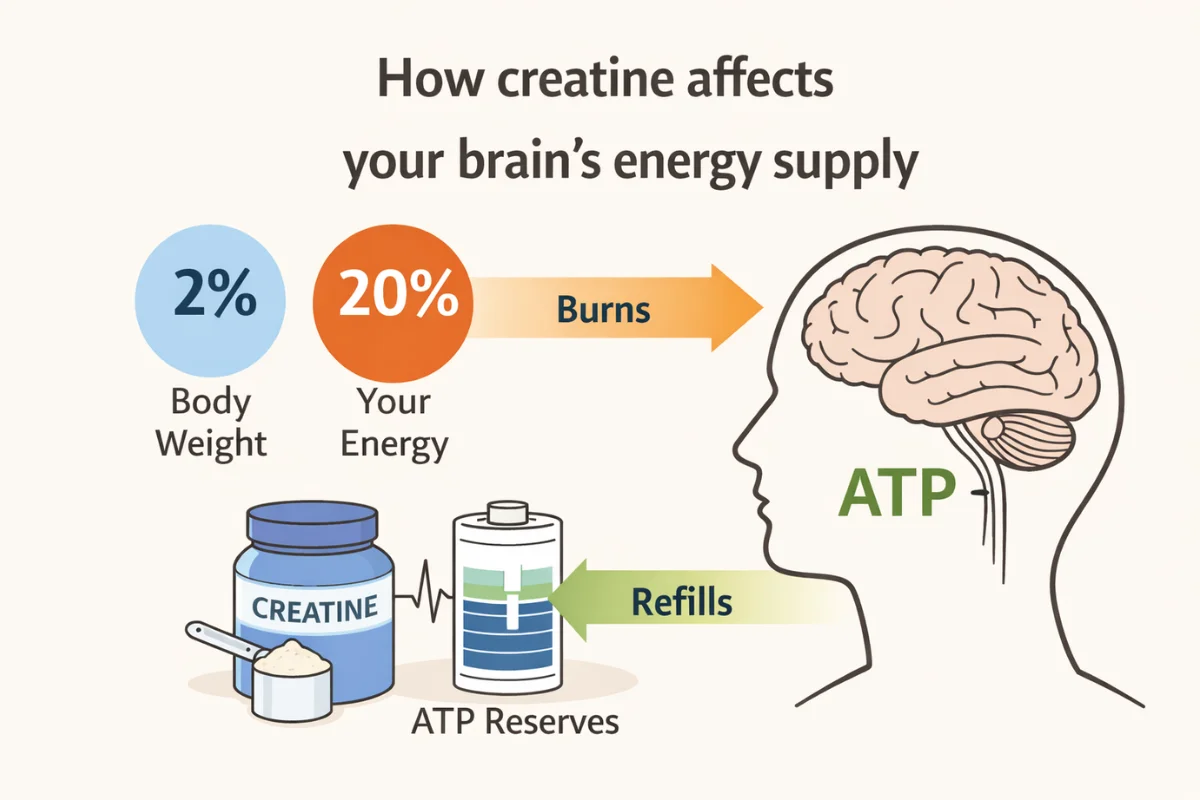
When you’re deep in thought, working on tricky problems, or stuck in a long meeting, ATP gets burned up fast. Creatine can help top it back up a bit quicker; that’s really the main benefit. No special science or anything.
What happens when your brain’s energy levels start to flag?
You know this feeling all too well.
You’re sharp and focused at the crack of dawn, but by 3 p.m., suddenly everything feels like a whole lot harder.
That’s not just plain old tiredness – it’s a case of your energy supply starting to flag. Creatine might help slow down that drop a bit.
A review published in Nutrients (2022) found that creatine supplements can help give your brain a bit more energy to play with, especially when you’re under stress or tired.
Creatine and being sleep-deprived
Now this is where things get a bit more interesting. Some studies show creatine can be a bit of a lifesaver when you’re running on zero sleep.
One small study published in Proceedings of the Royal Society B (2003) found that people who were given creatine and then kept up all night did a bit better cognitively than folks who didn’t take it.
But don’t go thinking that creatine is some kind of magic pill that can make up for not getting any sleep. It just helps you function a bit better when you are running on empty.
Can Creatine Really Improve Memory or Focus?
Possibly, but just think about how often this gets blown out of proportion.
Some bits of research suggest small gains in:
- Short-term memory – though we’re not talking huge leaps here.
- Tackling reasoning-style tasks a bit quicker.
- Lasting longer without mental exhaustion.
Take a study from Psychopharmacology (2003); it found that vegetarians on creatine scored better on working memory and intelligence tests.
But why vegetarians? Because they tend to start with lower levels of creatine in the first place. So the impact is a bit more pronounced because the starting point is lower to begin with.
If you are a meat-eater, the benefits might be smaller and not as noticeable.
What About Brain Protection and Aging?
Now we get to some pretty early stages of research here. A few studies think creatine might help keep brain cells safe by giving a boost to those tiny energy factories we call mitochondria.
Which is a big deal because – when those energy factories go pop, brain function does suffer. But let’s keep things in perspective. This is still the super early days, and there’s no huge pile of proof from long-term human studies to back it up yet.
The Inflammation Claim – Fact or Fad?
You’ll see all these claims about creatine reducing brain inflammation.
Now that’s not entirely a load of rubbish – but it’s a claim that still needs some real proof before we start getting all excited.
Most of the evidence that shows this sort of thing comes from lab or animal tests – not the sort of studies that most people really care about.
So don’t get caught up in the hype on this one just yet.
The Big Mistake We Make With Creatine
We keep expecting it to give us some sort of caffeine kick. It just doesn’t. No instant focus, no “boost.”
The real effect is much more gradual.
More like:
- A bit more mental stamina – taking on more without flagging
- Less of a crash after pushing yourself for ages
- A bit more clarity when things start getting stressful
If you’re waiting around for some sort of “kick,” you’ll probably end up thinking it’s useless.
Does creatine actually work better for some people?
Yeah, it does. And that’s worth thinking about.
You’ll probably get better results if:
- You’re regularly running on no sleep
- You’re dealing with heavy mental pressure
- You eat a mostly plant-based diet (vegan or vegetarian)
- You’re putting in those long, intense work hours
If none of those sound like you, the impact might be pretty small.
How much creatine do you need for brain benefits?
Most studies use a pretty standard amount of:
3 to 5 grams of creatine a day, that’s it. No fancy loading phases or anything. And let’s get one thing straight, more isn’t necessarily better.
Is creatine safe to take?
For most people, yes. It’s been one of the most well-studied supplements out there. A big review in the Journal of the International Society of Sports Nutrition (2017) found that creatine is safe for long-term use in healthy adults.
But you should still talk to a doctor if you have kidney issues or anything like that.
What creatine actually does – and what it doesn’t
Let’s cut to the chase. What creatine can’t do:
- Make you a genius overnight.
- Replace a good night’s sleep.
- Fix a bad diet.
- Cure brain problems like Alzheimer’s.
- Give you instant focus.
If someone is selling that kind of hype, be pretty sure they’re just trying to sell you something.
So, is creatine worth it for brain health?
The truth is. If you’re constantly crashing under work and stress, then creatine might help you keep your head clear a bit longer.
Not like dramatically longer. But noticeably. If you’ve already got your life together, then the benefit is smaller.
Still worth it, just don’t expect a miracle.
The one thing we still don’t really know about creatine
The long-term effects on brain health. We’ve got some research on short-term memory and the like. And lots of theories about how it works. But we still need some solid, long-term human trials to figure out if it can actually help prevent brain decline.
That’s still an open question.
My final take on creatine for brain health
So – creatine for brain health – not over-hyped, but not a totally life-changing thing either. It just helps your brain manage its energy better.
And in a world where we’re all tired, distracted, and overworked, that small edge is actually pretty valuable.

Recent Posts