
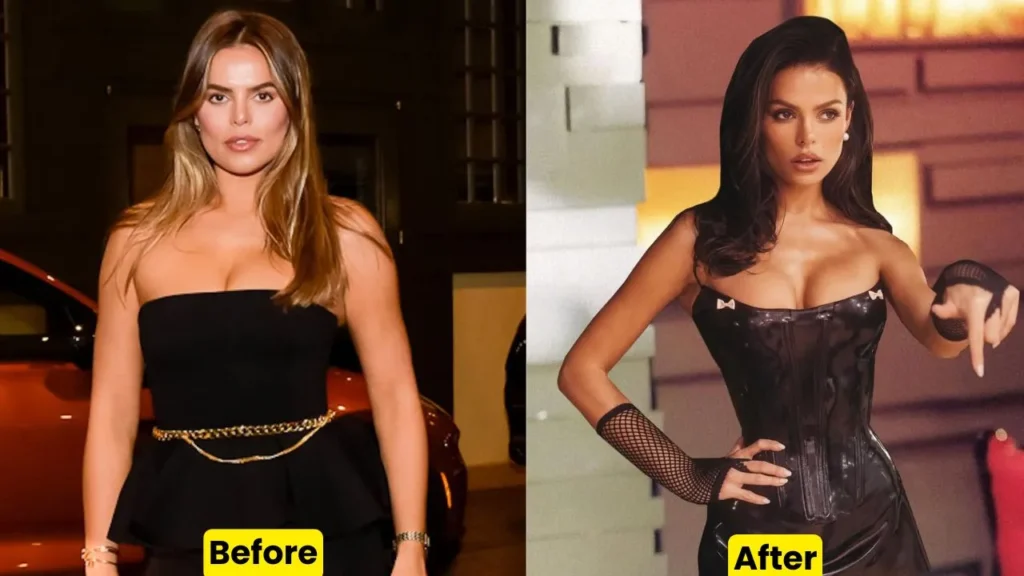
Brooks Nader is currently getting a lot of attention, and it’s not just because of her “glow up”. This time, though, it’s not just about how great she looks – it’s about the fact that she’s been open about how her physical transformation has been fueled by weight-loss meds & cosmetic procedures, not to mention the pressure to be marketable in the modeling world.
She’s been quite honest about using those weight loss methods and also let slip that her career really took off once she lost some weight, which has got a lot of people talking about how the fashion industry essentially rewards extreme body changes.
Now, she’s also talked quite openly about the various cosmetic procedures she’s had, like a rhinoplasty and some facial enhancements – pretty much all of this info came from her own mouth rather than just through speculation. The fact that she’s been so honest about this is part of why this story is getting so much heat.
This article isn’t about swooning over Brooks or judging her harshly – it’s simply going to lay out exactly what went down, based on her own words and timeline. We will explore a few points of her amazing transformation journey, such as:
No beating around the bush, no “motivational” mumbo jumbo… just straight up the facts, her timeline, and the harsh reality of how it all works in the cutthroat fashion world of today.
Who Is Brooks Nader? Her Background & Quick Facts
Brooks Nader is a US fashion model who you might know from her work in Sports Illustrated Swimsuit. She grew up in Baton Rouge, Louisiana, in a really close-knit family. There’s a lot of interest online in her ethnicity, and Brooks herself says she’s American with a mixed European background. Given that her parents really emphasised education, she didn’t get into modeling right out of high school like some people do.
She went to Tulane University and studied finance – not exactly the usual route into modeling. While she did take on some local modeling gigs while she was at college, she wasn’t seriously thinking of making a living from it at the time. After uni, she made the big move to New York City in the hope of finding more opportunities. That’s a pretty big risk, especially since she didn’t have a contract with a major agency or a big brand deal lined up.
But then her big break came when she won a spot in the Sports Illustrated Swimsuit Model Search. That got her (and her figure) in front of even more people, and opened up all sorts of new opportunities in the industry, including partnerships, runway work, and big brand collaborations.
Brooks Nader Family & Sisters
Brooks Nader grew up with 3 sisters. Her sisters are Grace Nader, Sarah Jane Nader, and Mary Holland Nader. The sisters are close in age and grew up with a strong family routine in Louisiana. Their parents taught them to stay grounded, and that family structure is something Brooks still mentions in interviews.

The sisters have appeared with her in campaigns, red carpet events, and social content. They aren’t in the modeling industry at the same level as Brooks, but they have public profiles because of her. They act more like her support system than entourage.
Brooks Nader Weight Loss: What Actually Happened
Brooks Nader’s weight loss didn’t happen overnight. Her physical change began when she entered the higher levels of professional modeling. She said once she started booking more shoots, she felt pressure to be smaller to stay competitive. This is a common expectation in the industry, and she didn’t sugarcoat it.
Her transformation became visible when she started using GLP-1 for weight management. These meds are known to reduce appetite and regulate blood sugar. She said she lost 30 pounds, and that lined up with the time her career started to take off. She said clearly that the change in her body helped her get more work done. That’s the part that gets attention—she connected the transformation to her professional opportunities.

Here’s the basic timeline based on her own statements and public appearance history:
There’s no magic to the transformation. She lost weight because she thought it would help her career—and she later confirmed it did. That’s where the conversation shifts from personal choice to industry expectations because the results show how much value the modeling world puts on body size.
Did Brooks Nader Use Ozempic / GLP-1?
Yes, Brooks Nader has said she used a GLP-1 weight management injection. In interviews, she said she started using it when she felt pressure to lose weight for work. She didn’t try to hide it or spin it as a natural transformation. She said the medication helped her lose weight, and she linked that to getting more modeling jobs.
What are GLP-1 meds?
Ozempic, Wegovy, and Mounjaro were originally developed for people with Type 2 diabetes. They control blood sugar and reduce appetite. Now, many non-diabetic people are taking them strictly for weight loss because these reduce hunger and cause fast, noticeable weight loss.
Brooks also talked about the side effects she experienced. She mentioned nausea, low energy, and fainting during workouts. Her sisters noticed these signs and stepped in to talk to her about how far things were going. That’s why the topic went public – this wasn’t hidden and wasn’t presented as a healthy, effortless process.
Many people in modeling and entertainment are turning to such practices because the industry still rewards a very thin body. These meds offer a quick way to get to that body type. When one model in a competitive environment uses them and books more jobs, others feel pressure to do the same to keep up. It’s a cycle.
Brooks Nader’s story is a clear example of how weight, beauty standards, and career opportunities are still tied together in fashion and media today.
Brooks Nader Before & After Weight Loss
Brooks Nader was always more athletic and curvy earlier in her career. She had more curves in her waist and hips, and more muscle tone. After her weight loss, her frame is leaner with more definition in her arms, shoulders, and jawline. The change is visible in photos from runway shows and Sports Illustrated shoots over the years, but it’s not exaggerated – it’s a reduction in overall body mass, not a dramatic change in structure.
The weight loss changed the kind of work she booked. Before the transformation, most of her work was lifestyle, commercial, and swimwear with a more natural look. After she lost the weight, she started getting more high-fashion, editorial, and brand campaign work. She’s said directly that her bookings increased once her size fit the sample measurements more closely. This is a common pattern in modeling: bodies that fit the sample sizes get more runway and designer work because they require fewer alterations.
Public reaction was mixed. Some praised her for her discipline and the results. Others criticized the industry for promoting a narrow standard and said linking weight loss to career success is unhealthy. There was also criticism around the use of prescription medication for cosmetic purposes. The conversation was less about her personal choices and more about what her transformation revealed about the industry.
The before and after are clear, but the real story is how the change affected her career momentum. Her career moved faster when her body fit the fashion industry’s preferred size. This isn’t good or bad – it’s just how it is.
Brooks Nader and Plastic Surgery
Brooks Nader has been pretty upfront about the cosmetic procedures she’s tried out. She hasn’t tried to spin them as unconfirmed rumors or speculation. Instead, she’s gone out of her way to list them out in interviews herself.
She has indeed had a rhinoplasty, which is what she went in for, and did it to basically refine the bridge of her nose and get a more balanced look overall. It’s a procedure she only had to do the once – no going back for more.
She also has vieners – which are basically covers for her teeth that help them look even and white. They really come in handy in the modeling business because they look super good on camera and mean you don’t have to have as much done in editing afterwards. Once you get them fitted, they tend to stay in place for a pretty long time.

For keeping her face looking good in the long term, Brooks has been using Botox in the neck and jaw area, coupled with jawline contouring fillers. Botox sorts out the muscles in your jaw that tend to pull your face downwards, which can give your jaw a more defined, smoother look. Fillers add a bit of structure and shape to the area – but these treatments aren’t permanent – you’ll need to get ’em done again now and then to keep the effect.
And then there was that “salmon sperm facial” she mentioned – sounds like some pretty out there stuff, right? But actually, it’s just some more advanced skincare treatment that uses polynucleotides derived from fish DNA to sort out the texture and elasticity of your skin. This one is basically just some extra TLC for your skin, and the effects don’t last too long in the grand scheme.
In a nutshell:
- Permanent things: rhinoplasty, veneers
- Things she has to keep going back for: Botox and jawline fillers
- The one that’s a temporary treat for her skin: that “salmon sperm” facial – aka the polynucleotide facial treatment
She’s been pretty open about all this because, let’s be honest, these are all just part of her getting ready for shoots and whatnot as a model. It’s not about looking like someone entirely different – it’s just about keeping up with the look the industry expects you to have.
Brooks Nader Before Plastic Surgery
In the early days of her photoshoots, Brooks Nader’s features looked softer. Her nose was a bit more rounded, the tip a bit less pointed, and her jawline not as chiseled. The difference wasn’t in the shape of her bones – that’s always been strong. No, the changes were just a matter of subtly shaping and contouring her face.
Old red carpet vids, retro Sports Illustrated spreads, and her college days on social media all show these subtle differences pretty clearly. She’s still got the same spark in her eyes and the same natural proportions, but her nose looks a bit fuller and the lower half of her face a bit less defined. That’s all changed since she got her nose job and started doing regular Botox on her neck and filler on her jaw. Now she looks all the more chiseled, and her angles really pop on camera.
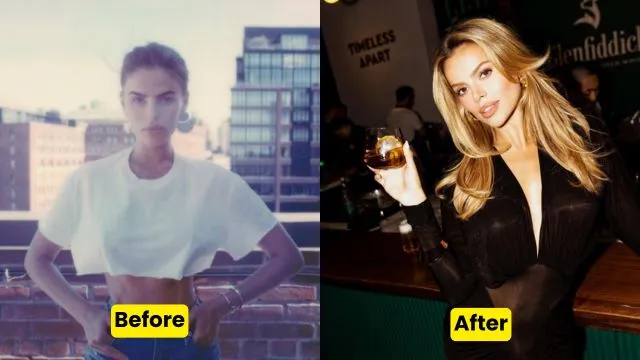
The pros in the industry have been saying that the modeling world tends to love faces with clean, defined lines – especially when it’s lit up bright or you’re beamed into high-res. By taming her nose and just a little bit enhancing her jawline, she’s basically become the kind of face they want to put in a magazine. Note that none of this changed who she really is; she just brought her skin and features more in line with what gets you attention in the high-visibility world of modeling.
The takeaway here is that Brooks didn’t become an entirely different person. She just tweaked her face so it fit in with the look they want in the industry she’s in. What we’re seeing in the before-and-after pics is basically the difference between how she looks in real life and how she looks when she’s camera-ready.
Did Weight Loss or Surgery Influence Her Career More?
Brooks Nader has said her weight loss had the biggest impact on her career. When she became smaller, she started fitting the standard sample sizes used in modeling. That shift placed her in direct competition for jobs that only a certain body type can access. More fittings are lined up. More agencies showed interest. Bookings increased.
The cosmetic procedures played a supporting role. Refining her nose and shaping her jawline made her features stronger on camera. These changes helped her look more defined in high-resolution photos and editorial lighting. They didn’t change her identity, but they made her more camera-ready in a market where small visual details matter.
The reality is not complicated. The modeling industry rewards bodies and faces that match the current preferred look. When Brooks aligned with that standard—through weight loss and refined appearance—her opportunities expanded. The transformation is what the industry responded to, not “natural beauty” alone.
Health & Ethical Implications
Using GLP-1 medication for weight loss when you’re not diabetic is risky. These meds can reduce appetite to the point where eating normally becomes hard. Some users experience nausea, dehydration, low blood sugar, and fatigue. Brooks Nader said she fainted during workouts and felt a noticeable drop in daily energy. These side effects happen when the medication is used without medical need or close supervision.
And then there’s the mental side of the transformation. When weight loss means more work and public approval, it’s easy to link “success” to being smaller. That can create a cycle of dependency where the focus shifts from health to constant self-adjustment. That can turn into a psychological pattern of “optimization” where the goal stops being wellness and becomes staying marketable.
This is part of a bigger industry pattern. The modeling and entertainment world follows a loop:
High demand for a certain look → Pressure to match the look → Body or facial enhancement → More work and praise → Even more pressure to maintain it
Brooks Nader’s experience reflects that loop clearly. Her transformation boosted her visibility, but it also exposed the cost of keeping up with what the industry rewards.
Our End Thoughts
Brooks Nader’s rise came from a mix of talent, consistent work, and visible physical changes. She used weight-loss medication, refined her features with surgery and injectables, and aligned her look with the standards the modeling industry rewards. None of this happened by luck. It was a response to a system where appearance strongly influences opportunity.
The reality here is straightforward: beauty standards are created, shaped, and enforced—not naturally discovered. When a transformation leads to more career success, it shows how the industry values a specific look, not the idea of “natural beauty.” Ignoring that truth only misleads people.

Recent Posts