
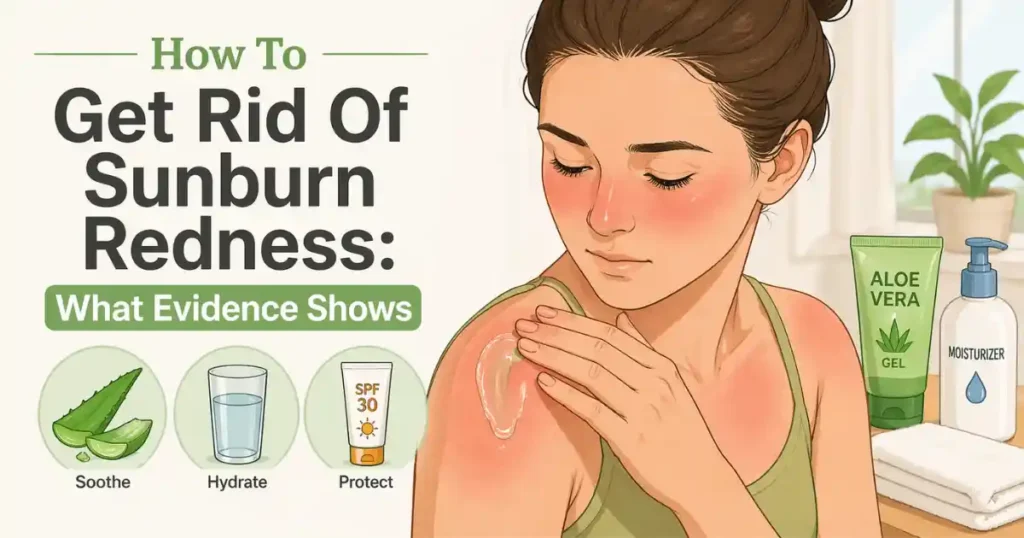
To get rid of sunburn redness, take ibuprofen early, apply a cool compress, and moisturize on damp skin. The redness is not the burn itself — it is your body sending extra blood to the damaged area. That process peaks around 12 to 24 hours after sun exposure.
A mild sunburn usually clears up in three to five days. You cannot make it disappear overnight, no matter what you put on it.
Key Takeaways
- Sunburn redness is your body opening blood vessels after skin damage. The red color comes from increased blood flow, not the burn itself.
- Ibuprofen or naproxen taken early can help reduce redness by blocking the chemical trigger at the source.
- Aloe vera helps soothe the skin, but strong evidence for reducing redness is limited.
- Cool water, moisturizing damp skin, and staying hydrated support recovery.
- A mild sunburn usually heals in 3–7 days. Older adults may take longer. No treatment removes redness overnight.
- Blisters, fever, or feeling unwell with a sunburn means you should see a doctor the same day.
Sunburn Redness: What Is Actually Happening in Your Skin
Most people think the red color is just burned skin. It is not quite that simple.
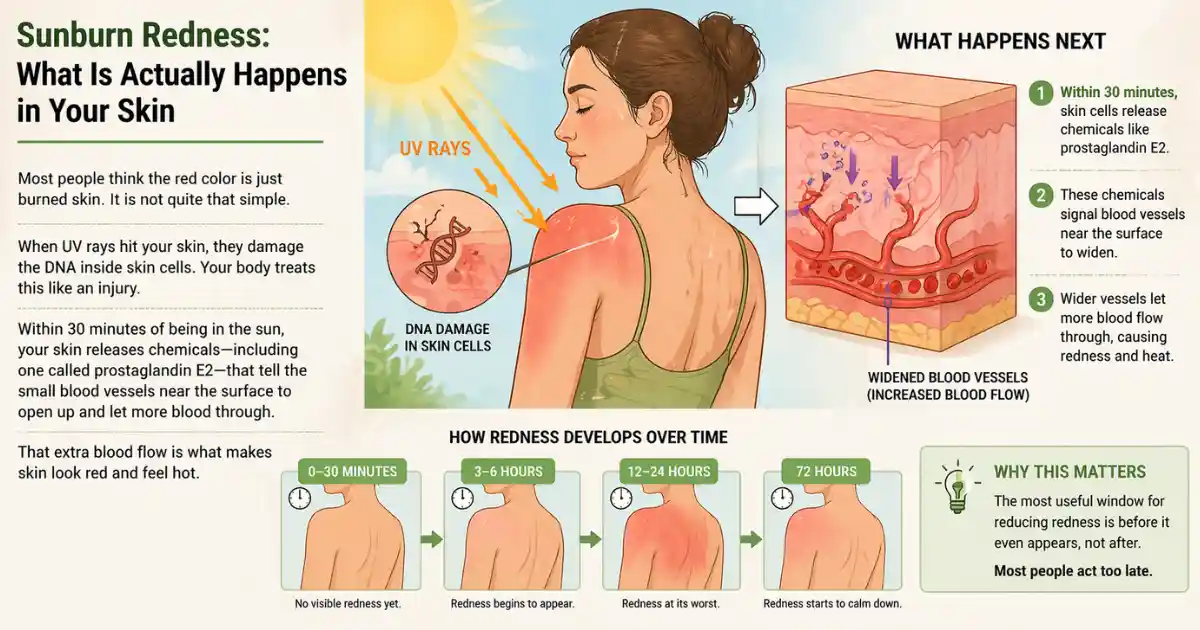
When UV rays hit your skin, they damage the DNA inside skin cells. Your body treats this like an injury. Within 30 minutes of being in the sun, your skin releases chemicals — including one called prostaglandin E2 — that tell the small blood vessels near the surface to open up and let more blood through. That extra blood flow is what makes skin look red and feel hot (StatPearls / NIH, 2023).
The redness shows up three to six hours after exposure. It hits its worst point around 12 to 24 hours. By 72 hours, it usually starts to calm down — even without treatment.
This matters because it changes what you should do first. The most useful window for reducing redness is before it even appears, not after. Most people act too late.
What Actually Works for Sunburn Redness: Evidence-Based Options Ranked
These are your real options, ranked by how well the evidence supports them.
| Treatment | How Well It Works | Best Time to Use It | What It Does |
|---|---|---|---|
| Ibuprofen or naproxen | Strong evidence | Within 0–6 hours of sun exposure | Blocks the chemical process that causes blood vessels to dilate; directly reduces redness at the source |
| Cool water (bath or compress) | Strong, well-supported | Any time | Narrows blood vessels temporarily; brings surface temperature down |
| Aloe vera gel | Weak-to-moderate for redness | Any time | Mild soothing and anti-inflammatory effect; it does not stop the blood vessel response |
| Moisturizer with soy or ceramides | Moderate | Applied while the skin is still damp | Locks in moisture; protects the skin barrier while it heals |
| 1% hydrocortisone cream | Moderate | First 24–48 hours | Reduces local swelling and irritation; use briefly, not for days |
| Colloidal oatmeal bath | Moderate for itch | Days 2–4 | Calms irritation and itching; does not speed up redness going away |
One thing most articles skip: Ibuprofen and naproxen work by blocking the enzyme (called COX-2) that makes the chemicals causing your blood vessels to open up. If you take one of them within the first few hours — before the redness is even visible — you can limit how bad it gets.
Waiting until you already look red still helps with pain, but you have missed the best window. The American Academy of Dermatology recommends ibuprofen or aspirin for sunburn, but does not spell this out.
On aloe vera: it is the most recommended sunburn product in existence, and the evidence behind it is thinner than most people realize. A 2022 review in the International Journal of Dermatology (Balkrishna et al., DOI: 10.1111/ijd.16231) found that plant-based treatments for sun-induced redness have biological logic behind them, but real human trial data are limited.
Aloe is a decent moisturizer. It is not going to make the redness go away faster.
How to Get Rid of Sunburn Redness Overnight: Step by Step
You will not wake up with clear skin. The body’s peak inflammation is at 12–24 hours — that is just how it works. What you can do is keep it from getting as bad, and shorten how long it sticks around.
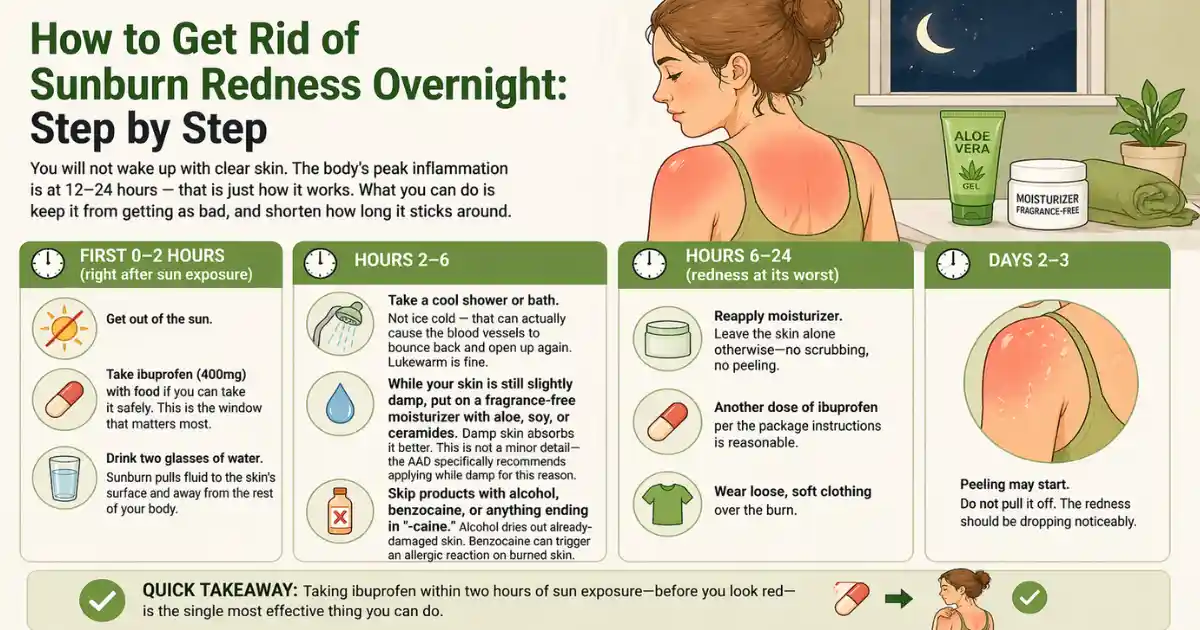
First 0–2 hours (right after sun exposure):
- Get out of the sun.
- Take ibuprofen (400mg) with food if you can take it safely. This is the window that matters most.
- Drink two glasses of water. Sunburn pulls fluid to the skin’s surface and away from the rest of your body.
Hours 2–6:
- Take a cool shower or bath. Not ice cold — that can actually cause the blood vessels to bounce back and open up again. Lukewarm is fine.
- While your skin is still slightly damp, put on a fragrance-free moisturizer with aloe, soy, or ceramides. Damp skin absorbs it better. This is not a minor detail — the AAD specifically recommends applying while damp for this reason.
- Skip products with alcohol, benzocaine, or anything ending in “-caine.” Alcohol dries out already-damaged skin. Benzocaine can trigger an allergic reaction on burned skin.
Hours 6–24 (redness at its worst):
- Reapply moisturizer. Leave the skin alone otherwise — no scrubbing, no peeling.
- Another dose of ibuprofen per the package instructions is reasonable.
- Wear loose, soft clothing over the burn.
Days 2–3: Peeling may start. Do not pull it off. The redness should be dropping noticeably.
Quick Takeaway: Taking ibuprofen within two hours of sun exposure — before you look red — is the single most effective thing you can do.
Popular Sunburn Redness Remedies That Do Not Work
Here is the thing people believe most strongly: aloe vera heals sunburn redness. You see it recommended everywhere, in every article, by every wellness brand.
What studies actually show is that aloe soothes pain and dryness. There is no human trial that proves it makes redness clear up faster than a plain moisturizer.
Most of the research behind its reputation was done in labs or on animals, not on people. If aloe makes your skin feel better, keep using it — it is not harmful. Just do not expect it to shorten the red phase.
Other things people try that range from unhelpful to actively bad:
- Butter or cooking oil — traps heat in the skin and raises the risk of infection.
- Toothpaste — causes irritation, no evidence behind it at all.
- Apple cider vinegar — its acidity can damage skin that is already compromised.
- Benzocaine sprays — risk of allergic reaction on burned skin; the AAD warns against any product ending in “-caine.”
- Hot shower — makes the blood vessels open up more and increases pain. Avoid.
How Long Does Sunburn Redness Take to Resolve? A Realistic Timeline
| Time | What to Expect |
|---|---|
| Hours 3–6 | Redness first becomes visible; skin feels warm |
| Hours 12–24 | Redness at its worst; may feel tight or swollen |
| Days 2–3 | Red starts to fade; peeling may begin |
| Days 3–5 | Mild burns are mostly gone; moderate burns are still visible |
| Days 5–7 | Most first-degree burns fully healed (Skin Cancer Foundation) |
| Week 2 and beyond | Severe or blistering burns; see a doctor |
If you are over 40, expect the longer end of these ranges. Skin renews itself more slowly as you age — the natural turnover cycle that takes about three weeks in younger adults can stretch to four weeks or more in older skin. The same burn may stay red and peel longer in older skin, and it needs more consistent moisturizing throughout the whole recovery.
As of 2026, current research does not support any treatment that cuts healing time significantly below these ranges.
When to See a Doctor Instead of Treating It Yourself
Most sunburns are first-degree burns — they only affect the outer skin layer and heal on their own. Second-degree burns go deeper and look different.
Go to a doctor the same day if you have:
- Blisters on the burned skin (second-degree burn)
- A fever above 102°F alongside the burn
- Chills, nausea, or a bad headache with the burn
- Any sunburn on a baby under one year old is always a medical situation
- A burn that gets worse, not better, after 48 hours
Fever combined with sunburn is a specific warning sign. It can point to heat illness or a whole-body inflammatory response, not just a local skin reaction. That combination needs a doctor, not more aloe.
Frequently Asked Questions
How long does it take to get rid of sunburn redness?
Mild sunburn redness usually fades over three to five days. Most first-degree burns are fully gone within a week. Redness is worst at 12 to 24 hours after sun exposure, then gradually improves. If you are older, healing often takes a few days longer than it would in younger skin. Moderate or blistering burns need more time.
Is it safe to treat sunburn redness at home?
Yes, for most first-degree burns. Cool water, ibuprofen, moisturizer, and extra water to drink are enough for a mild sunburn. Do not treat at home if there are blisters, if the burn covers a large area, or if you have a fever, chills, or nausea with it. Infants under one and people on photosensitizing medications should always see a doctor.
What makes sunburn redness worse?
Going back in the sun is the biggest one — burned skin is far more sensitive to UV than normal skin. Hot showers increase blood flow to the area and make things worse. Products with alcohol, fragrance, or benzocaine irritate already-damaged skin. Not drinking enough water prolongs the response. Some medications, including certain antibiotics and diuretics, also make the skin burn and redden more easily.
When should I see a doctor for sunburn redness?
See a doctor the same day if blisters form, if you have a fever over 102°F with the burn, or if you feel chills, nausea, or a bad headache. Any sunburn on a baby under one year old always needs medical attention. A burn that keeps getting worse after 48 hours instead of improving should also be checked.
Does sunburn redness go away on its own?
Yes. Sunburn is a self-limiting process — your body will clear it up without treatment. The redness, pain, and peeling are all part of a repair process that runs its course over several days. Treatment reduces discomfort and may take the edge off severity, but does not dramatically shorten how long it takes. The DNA damage inside skin cells, though, is permanent and adds up with each burn over time.

Recent Posts