
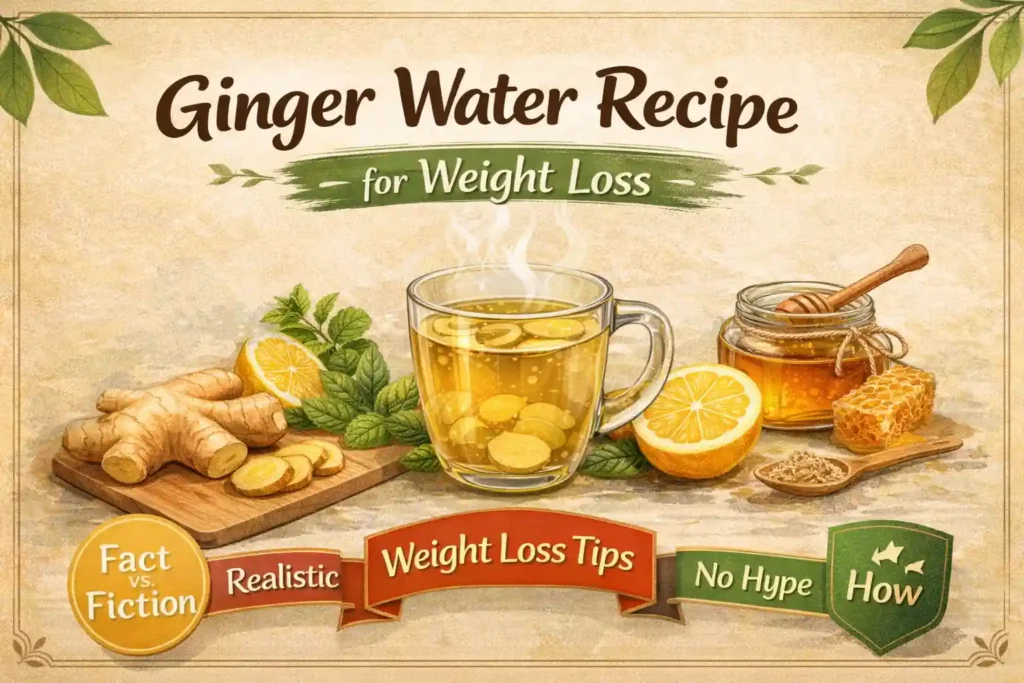
I’ll be blunt. Most of the content on this topic, “Ginger Water Recipe for Weight Loss,” is lazy. It takes one small finding, stretches it, and suddenly, ginger water is “melting fat.” That’s not how human biology works, and it’s honestly irritating how often that claim gets recycled.
Ginger water is not a fat-loss tool. That part is clear. Fat loss still comes down to energy balance—eat less than you burn, over time. That hasn’t changed. What ginger may do is help around the edges of that process. Small shifts. Slight appetite control. Maybe better digestion. That’s the real conversation.
Ginger Water & Weight Loss!
The active compounds in ginger—mainly gingerol and shogaol—have been studied for metabolic effects. There is some evidence that they can slightly increase thermogenesis and influence blood sugar response after meals. But “slightly” is doing a lot of work here.
These are not strong levers. They’re background adjustments, not drivers. One study that keeps getting cited is from Metabolism (2012). It tested a hot ginger beverage in just 10 overweight men. Small sample, already a limitation.
But the interesting part is this: the increase in fullness showed up specifically with the hot ginger drink, not just ginger itself. That detail gets ignored in most articles, which tells you how carefully they actually read the study.
Then you have the broader view. A meta-analysis in Critical Reviews in Food Science and Nutrition (2019) looked at multiple randomized controlled trials.
The result? Ginger intake was linked to modest reductions in body weight and waist-to-hip ratio, along with some improvement in fasting glucose. Not nothing. But not impressive either—and definitely not fast.
What Our Research Team Found
We noticed while going through this research that the benefits show up more clearly in people who already have some metabolic issues, like higher body fat or poor blood sugar control. In relatively healthy individuals, the effect shrinks.
That nuance almost never gets mentioned, even though it matters if you’re trying to set realistic expectations.
So where does that leave ginger water?
It’s a support habit. Not useless. Not powerful. Somewhere in the middle.
If your diet is messy, it won’t save you. If your diet is structured, it might make things slightly easier to stick to—especially if it helps you feel a bit fuller or reduces that constant urge to snack. And that’s not exciting, which is probably why no one leads with it, but it’s the part that’s actually true.
Before you even get into the ginger water recipe for weight loss, you need that frame locked in. Otherwise, you’re just repeating the same bad advice that’s already everywhere.
Ginger Water Recipe for Weight Loss. How To Make?
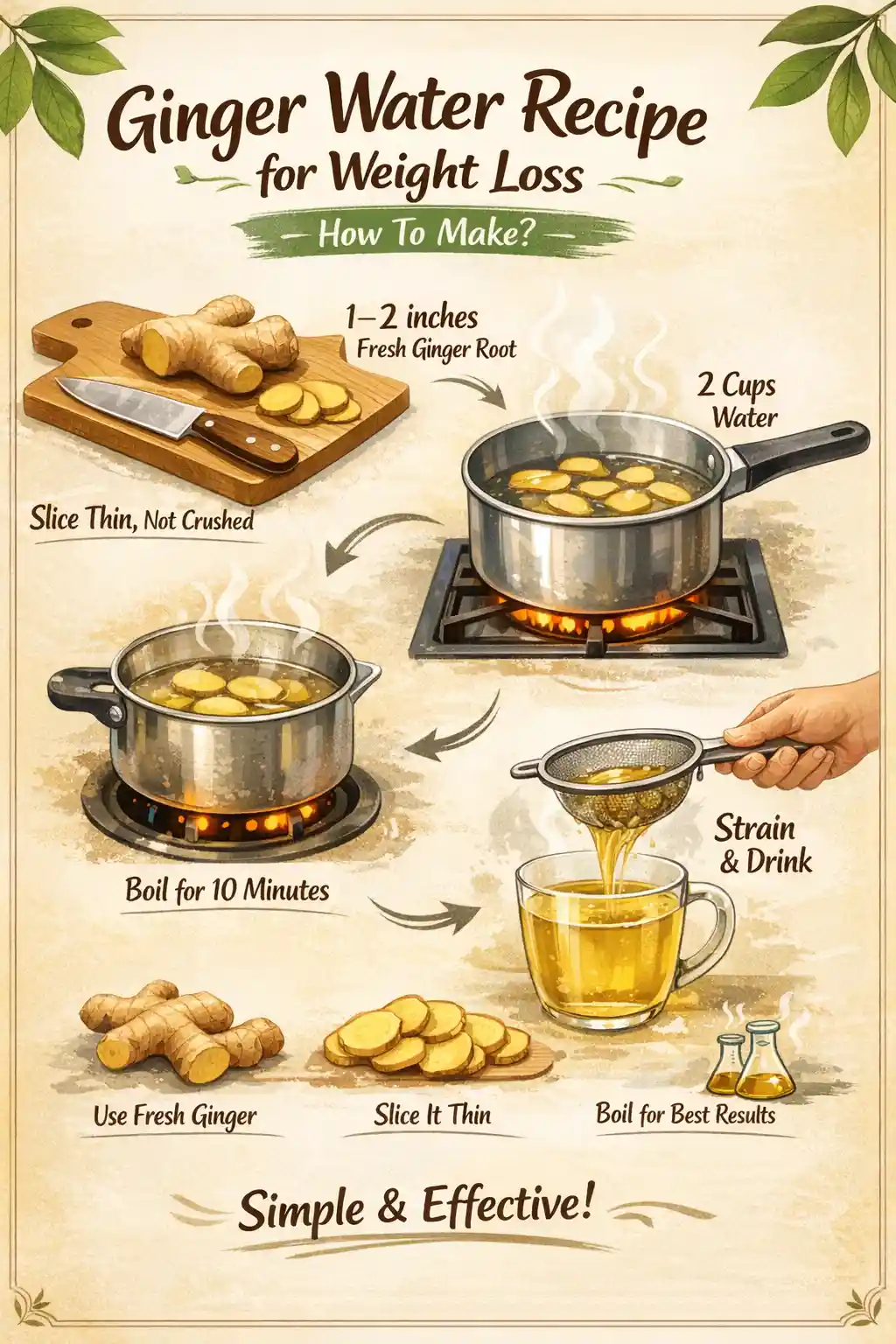
The recipe itself is simple. Almost boring. Which is probably why people keep trying to “improve” it with extra ingredients that don’t really change much.
Here’s the base version:
- 1–2 inches fresh ginger root
- 2 cups water
- Boil for 10 minutes
- Strain and drink
That’s it.
But the way you prepare it actually changes what you get out of it, and this is where most articles just gloss over everything, like it doesn’t matter.
Start with fresh ginger. Not powder. Powder loses some volatile compounds during processing, especially the ones linked to aroma and possibly some metabolic effects. It still works, but it’s weaker.
Slice it thin. Don’t crush it into paste unless you want it overly harsh and hard to drink daily. Thin slices increase surface area without making it aggressive. And yes, that affects compliance—if it tastes bad, you won’t stick to it, and then none of this matters anyway.
Boiling vs. Steeping Ginger Water
Now boiling vs steeping—that part actually matters more than people admit.
Boiling extracts more compounds like gingerol into the water. Stronger effect, sharper taste. Steeping (just pouring hot water over ginger and letting it sit) gives a milder drink. Easier to tolerate, but slightly less potent.
There isn’t a clean “better” option here. It depends on whether you’re optimizing for consistency or strength. And if we had to pick, consistency wins—because a perfect recipe you don’t follow is useless.
One small detail that stood out while digging into preparation methods: heat changes gingerol into shogaol, a more stable compound that may have stronger anti-inflammatory effects. That transformation only happens with sufficient heat, which is another reason boiling isn’t just a random step—it actually changes the chemistry of what you’re drinking.
And yet, most content reduces this entire process to “add ginger to water.”
That’s the level of depth you’re usually dealing with.
So keep it simple, but don’t treat it like it’s interchangeable. How you prepare it affects how strong it is, how it tastes, and whether you’ll actually keep drinking it long enough to see any benefit from this ginger water recipe for weight loss.
Ginger Water Recipe for Weight Loss With Lemon and Honey
This is the version everyone recommends. Ginger + lemon + honey. Sounds clean. Sounds effective. But most people never stop to ask what each part is actually doing.
Let’s break it down without pretending it’s more powerful than it is.
Why Add Lemonto Ginger Water?
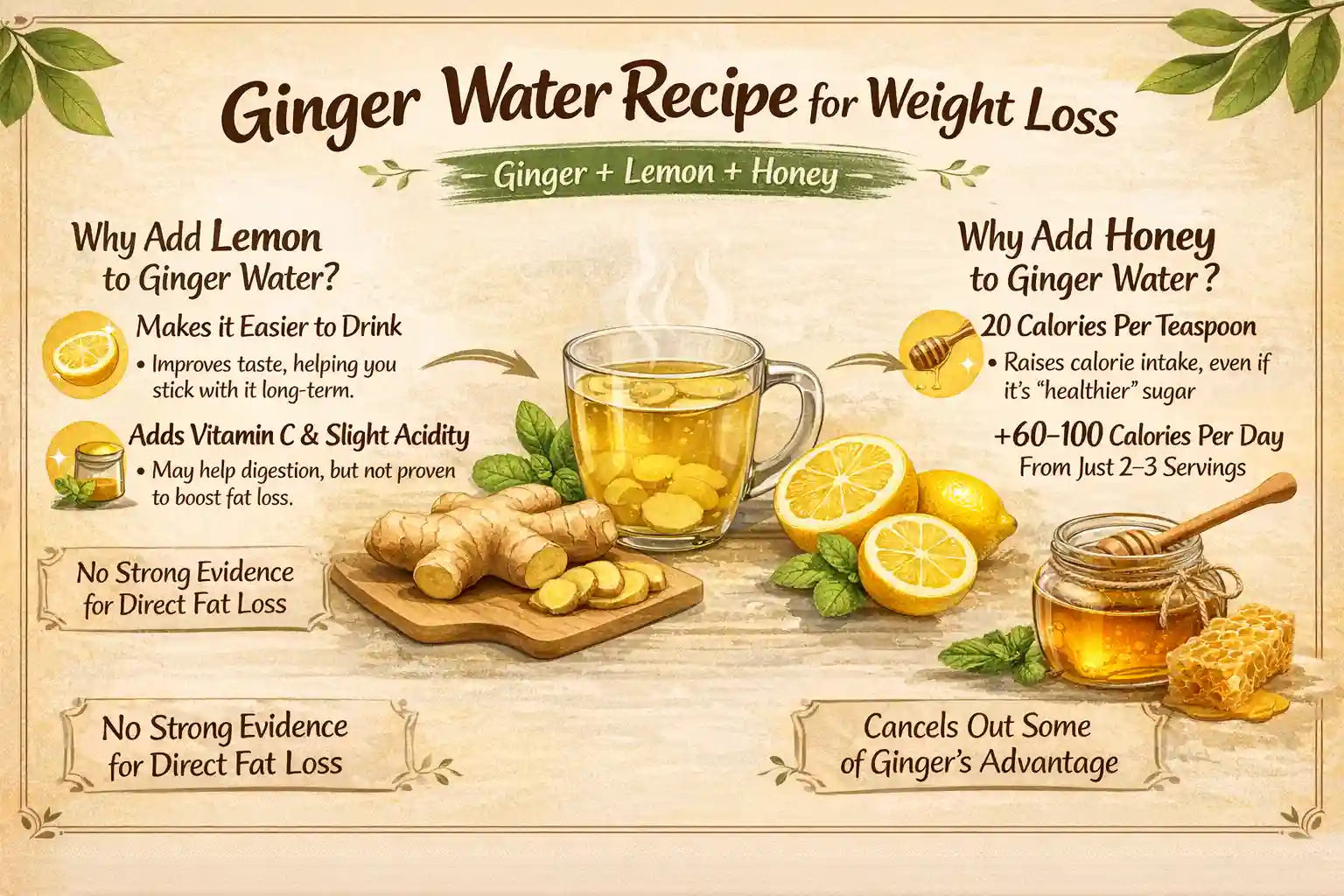
Adding lemon does two things. First, it makes the drink easier to tolerate. That alone matters more than people think, because adherence is where most “healthy habits” fail.
Second, lemon adds a small amount of vitamin C and acidity, which may help with digestion slightly—but there’s no strong evidence it directly affects fat loss.
Why Add Honey to Ginger Water?
Now honey. This is where things get messy.
Honey is often framed as a “healthier sugar,” which is technically true in terms of micronutrients and antioxidants. But from a fat-loss perspective, your body still sees it as calories.
About 20 calories per teaspoon. Add two or three servings a day, and suddenly your “weight loss drink” is quietly adding 60–100 calories.
That’s not a disaster. But it does cancel out part of the small advantage ginger might be giving you. And almost no article points that out clearly, which is frustrating because it’s basic math.
What You Should Add?
There’s also no solid research showing that combining ginger with lemon or honey creates a stronger weight loss effect. Most studies isolate ginger alone. Once you start stacking ingredients, you’re mostly changing taste and compliance—not metabolic impact.
That doesn’t mean this version is useless. It just means you should use it for the right reason.
If adding lemon and a small amount of honey helps you drink this consistently every day, then it’s a net positive. If you’re adding honey because you think it speeds up fat loss, that’s just wrong.
One thing we’ve noticed going through recipes and user habits: people who stick with ginger water long-term almost always modify the taste slightly. Not dramatically, just enough to make it tolerable. The ones trying to drink it “pure” for maximum benefit usually quit within a week.
So if you’re going to use this version, keep it controlled:
- Add lemon for taste and hydration support
- Use honey sparingly, or skip it entirely
- Focus on consistency, not stacking ingredients
Because again, nothing in this drink overrides your overall diet. It either fits into a calorie deficit—or it quietly works against it, even if it looks healthy on the surface.
Ginger Water for Belly Fat — Does It Actually Work?
This is where most articles go off the rails.
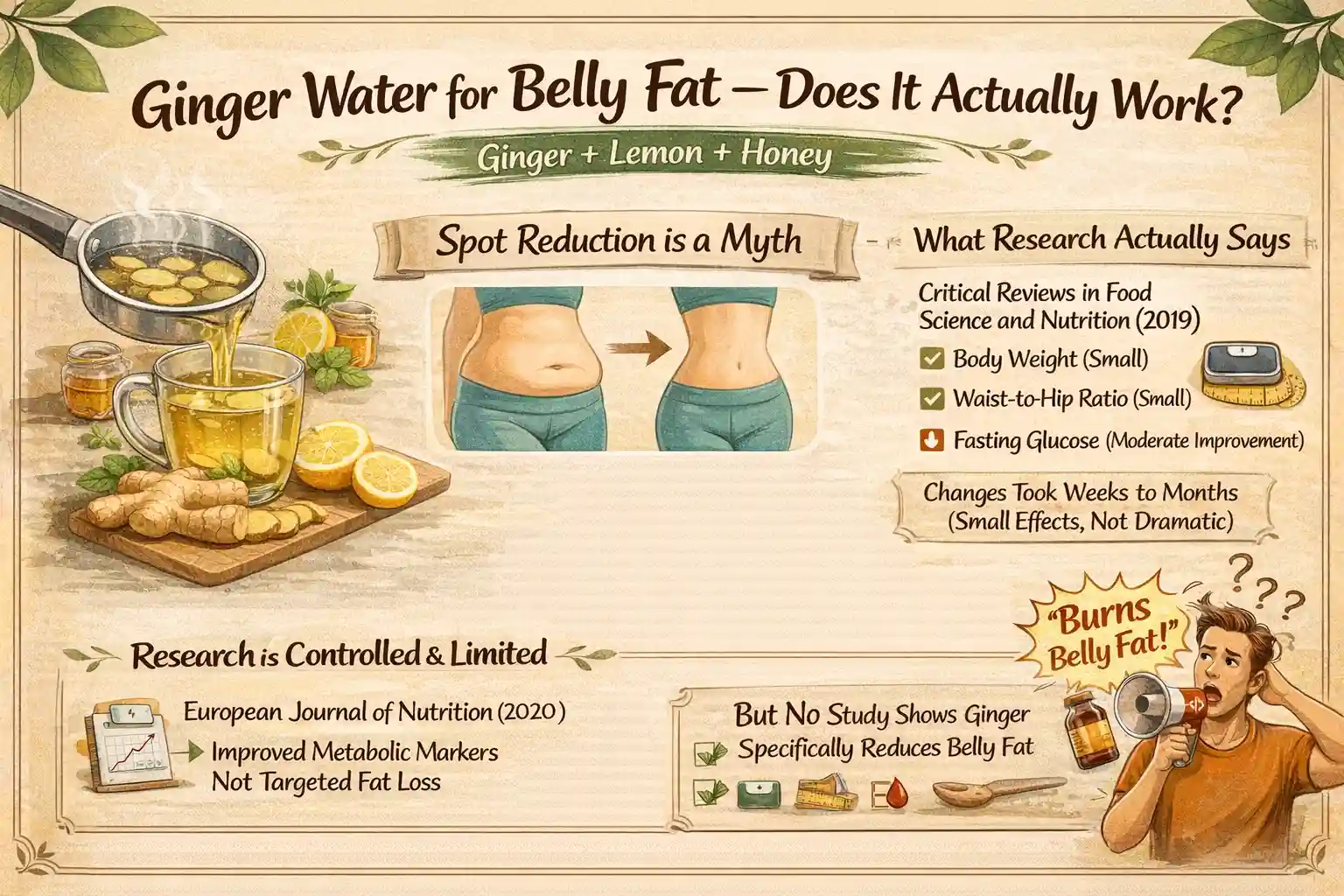
They jump from “ginger helps metabolism” to “ginger burns belly fat.” That leap sounds small, but it’s completely unsupported. Your body does not lose fat from one specific area because of a drink. That’s been tested for decades. It doesn’t work that way.
What Research Actually Says
Ginger has been studied for weight-related markers. Some results are positive—but controlled and limited.
The Critical Reviews in Food Science and Nutrition (2019) meta-analysis looked at multiple human trials. It found reductions in:
- Body weight (small)
- Waist-to-hip ratio (small)
- Fasting glucose (moderate improvement)
But here’s the part people skip: these changes happened over weeks to months, not days. And the magnitude wasn’t dramatic.
Another review in the European Journal of Nutrition (2020) pointed toward improved metabolic health markers, not targeted fat loss. No study shows ginger specifically reduces abdominal fat.
So if someone says “belly fat burner,” they’re either oversimplifying or just making it up.
Why People Think It Targets Belly Fat
This is actually interesting.
A lot of people report a “flatter stomach” after a few days. That part is real—but it’s misunderstood.
What’s happening is:
- Reduced bloating
- Better digestion
- Less gas retention
That changes how your stomach looks. But it’s not fat loss.
We kept noticing this pattern in user reviews and anecdotal reports. People confuse visual change with fat loss, especially in the first week. And once that idea sticks, everything else gets exaggerated.
The Role of Inflammation and Water Retention
There’s one indirect pathway worth mentioning.
Ginger has anti-inflammatory properties. Chronic low-grade inflammation is linked to fat storage, especially around the abdominal area. So in theory, reducing inflammation may support better fat regulation over time.
But this is slow. Subtle. And dependent on your overall lifestyle.
It’s not like drinking ginger water suddenly “unlocks” fat burning in your stomach area. That’s the kind of language that should make you skeptical immediately.
So, What Should You Expect?
If you use ginger water consistently:
- You may feel less bloated within a few days
- Your stomach may look slightly flatter
- Actual fat loss will depend on your diet
That’s the honest version.
Ginger water doesn’t target belly fat. It may support conditions that make fat loss easier—but only if the fundamentals are already in place.
Best Time to Drink Ginger Water for Weight Loss
Timing isn’t magic. But it’s not irrelevant either.
You’ll see claims like “drink this at night to burn fat while you sleep.” That sounds good. It’s also not backed by anything meaningful. Ginger doesn’t suddenly switch into fat-burning mode because the clock hits 10 PM.
What timing can influence is appetite and digestion. That’s where the real effect sits.
Morning (Before Breakfast)
This is the most practical window.
Drinking ginger water in the morning may slightly reduce hunger signals. Not dramatically—but enough that some people eat a bit less at breakfast without forcing it.
The Metabolism (2012) study we’ve mentioned earlier used a hot ginger drink and saw increased fullness. Again, a small study, just 10 men, but the effect showed up early in the day after consumption.
That lines up with how appetite hormones behave in the morning. You’re more responsive to small signals than.
Before Meals (Most Useful Timing)
If there’s one timing that actually makes sense, it’s this.
Drink it 15–20 minutes before meals.
Why?
Because if ginger helps even slightly with satiety, this is where it can influence how much you eat. You’re not relying on willpower as much. You’re just a bit less hungry going in.
This is subtle. But over weeks, subtle matters.
We didn’t see many articles emphasize this properly, which is strange because it’s the only timing strategy that directly connects to calorie intake.
After Meals (Digestive Support)
This one isn’t about weight loss.
Drinking ginger water after meals may help with:
- Bloating
- Heaviness
- Slow digestion
According to the European Journal of Gastroenterology & Hepatology (2008), ginger supports gastric emptying. That means food moves through your stomach more efficiently.
You feel lighter. That’s useful—but it’s not fat loss.
Night (Overhyped)
Let’s clear this up. Drinking ginger water at night does not increase fat loss.
There’s no strong evidence showing better overnight fat metabolism from ginger intake. What it might do is help digestion after dinner and reduce discomfort before sleep.
That’s it.
The whole “night fat-burning drink” idea is mostly marketing.
So, What Timing Actually Makes Sense?
If you want a simple, realistic approach:
- Morning → helps set appetite tone
- Before meals → best chance to influence intake
- After meals → helps digestion
- Night → optional, not important
Don’t overthink this.
Timing won’t override your diet. But used correctly, it can support it in small, practical ways, which is pretty much the theme of everything related to the ginger water recipe for weight loss.
How to Consume Ginger Water for Weight Loss (What Actually Makes a Difference)
This is the part most articles skip or oversimplify. They give you a recipe, maybe a “best time,” and stop there. But how you use it across the day and over weeks is what decides whether it does anything at all.
And this is also where people quietly mess it up.
How Much Ginger Per Day?
There’s a usable range here. Not unlimited.
Most human studies use around 1 to 2 grams of ginger per day. That’s roughly:
- 1–2 inches of fresh ginger.
- Or about ½ to 1 teaspoon of powder.
Go far beyond that, and you don’t get better results. You just increase the chance of side effects like heartburn.
This isn’t one of those “more is better” situations.
How Many Times Per Day?
Once is fine. Twice is more practical.
- 1 cup → basic habit
- 2 cups → more consistent exposure
- 3+ cups → usually unnecessary
I’ve noticed a pattern here. People either drink it once randomly and expect results, or they overdo it for a week and quit. Neither works.
Consistency beats intensity. Every time.
How Long Before You See Any Effect?
This is where expectations go wrong.
You’re not going to “feel fat loss” in a few days. That’s not how physiology works. What you might notice early is less bloating or slightly reduced hunger.
Actual weight-related changes take longer.
The 2019 meta-analysis we talked about included trials running 8 to 12 weeks. That’s where small but measurable changes showed up.
Not 7 days. Not a weekend detox.
And honestly, this is where most people drop off—they expect something visible too quickly.
Should You Drink It Daily?
Yes, if you’re using it at all. Ginger doesn’t build up like a drug in your system, but its effects are tied to repeated exposure. Irregular use won’t do much.
Think of it like brushing your teeth. Skipping randomly defeats the purpose.
With Food or Without?
Both work, but they do different things.
- Before meals → appetite control
- With/after meals → digestion support
This isn’t about right vs wrong. It’s about what you’re trying to get out of it.
One Small Detail Most People Miss
This stood out to me when going through both studies and user patterns. People who benefit from ginger water usually change something else at the same time—even if they don’t realize it. They snack less. They eat more slowly. They drink more fluids.
Then ginger gets all the credit. That doesn’t make ginger useless. But it does mean its effect is often blended with behavior changes, which makes it look stronger than it is.
What This Means in Practice
If you want to use ginger water properly:
- Stick to 1–2 cups daily
- Use around 1–2 grams of ginger
- Time it before meals if appetite is your issue
- Keep it going for at least 6–8 weeks
And most importantly, don’t expect it to carry your weight loss. It supports the process. It doesn’t drive it.
Ginger Water Benefits (What Actually Holds Up)
Most lists online are inflated. You’ll see “detox,” “fat burning,” “cleansing.” None of that is clearly defined, and most of it isn’t backed by strong human data.
There are real benefits. But they’re narrower and more specific than people make them sound.
Appetite Control (Small, But Real)
This is one of the more consistent findings.
The Metabolism (2012) study—again, small, just 10 overweight men—found that a hot ginger drink increased feelings of fullness and reduced hunger after eating. Not a massive effect, but noticeable.
What matters here is behavior. If you feel even slightly less hungry, you may eat less without forcing it. That’s where the benefit comes from.
Not from “burning fat,” but from eating a bit less over time.
Digestion and Gut Comfort
This one is well-established. Ginger helps speed up gastric emptying—basically, how fast food leaves your stomach. Slower emptying can lead to bloating, discomfort, and that heavy feeling after meals.
According to Johns Hopkins Medicine (2023), ginger has been shown to support digestion and reduce nausea. That’s why it’s often used for motion sickness and pregnancy-related nausea.
For weight loss? Indirect benefit. If your digestion feels better, you’re less likely to overeat or snack just to “settle” your stomach.
Bloating Reduction (Often Misread as Fat Loss)
This one shows up fast. Within a few days, some people notice their stomach feels flatter. That’s usually reduced gas and water retention—not fat loss.
We kept seeing this pattern repeated in user reports and forums. The early “results” people talk about are almost always digestive changes, not actual fat reduction. That doesn’t make it useless. It just means you need to interpret it correctly.
Anti-Inflammatory Effects
Ginger contains compounds like gingerol and shogaol, which have anti-inflammatory properties.
Chronic low-grade inflammation is linked to weight gain and metabolic issues. So reducing it may support better metabolic function over time.
But this is not immediate. And it’s not strong enough on its own to change body composition in a big way. Think of it as background support—not a primary tool.
Blood Sugar and Metabolic Effects
There’s some evidence here, but it’s mixed. The 2019 meta-analysis found improvements in fasting glucose levels in some participants. That suggests ginger may help with blood sugar regulation.
This matters because better blood sugar control can reduce cravings and energy crashes. But again, the effect size is modest. And not every study shows the same result.
Where Most Articles Go Wrong
They take all these small effects and stack them into one big promise.
Better digestion + less bloating + slight appetite control = “Rapid fat loss.”
That’s the leap. When you separate each benefit and look at it honestly, the picture is more grounded—and actually more useful.
What You Can Realistically Expect
If you use ginger water consistently:
- You may feel slightly less hungry
- Your digestion may improve
- Bloating may reduce within days
- Long-term metabolic markers may improve slightly
That’s the real list. Not dramatic. Not instant. But not useless either—and that middle ground is exactly where most honest health tools sit, including any ginger water recipe for weight loss.
Ginger Water for Bloating
If there’s one area where ginger water consistently helps, it’s this.
Not fat loss. Not metabolism. Bloating.
And the difference matters, because a lot of people confuse the two and end up thinking something “burned belly fat” when it really just reduces gas and water retention.
What Causes Bloating in the First Place?
Bloating usually comes from three things:
- Slow stomach emptying
- Gas buildup in the intestines
- Sensitivity to certain foods
When food sits longer in your stomach, fermentation increases. That leads to gas. That leads to pressure. That’s the uncomfortable, tight feeling people describe. This isn’t fat. It’s temporary.
How Ginger Actually Helps
Ginger works on gut motility—basically, how fast things move through your digestive system.
A clinical study in the European Journal of Gastroenterology & Hepatology (2011) tested ginger on people with digestive issues and found it accelerated gastric emptying compared to a placebo. That’s a direct mechanism, not a vague claim.
- Faster movement = less time for gas buildup.
- Less gas = less bloating.
Simple chain.
There’s also some evidence that ginger can relax the intestinal tract slightly, which may reduce cramping and pressure. That part is less consistent across studies, but it shows up enough to be worth mentioning.
Why the “Flat Stomach” Happens So Fast
This is the part people misread all the time. You drink ginger water for 2–3 days. Your stomach looks flatter. You assume: “It’s working for fat loss.”
What’s actually happening:
- Less gas
- Less water retention
- Better digestion
So visually, your stomach changes quickly.
We kept noticing this exact pattern in user feedback. The “wow” moment always happens early—and it’s almost always tied to bloating, not fat. But once people label it as fat loss, the expectation gets distorted.
When It Works Best
Ginger water helps most when bloating is tied to digestion.
For example:
- After heavy meals
- When eating late at night
- When your diet includes gas-producing foods
It’s less useful if bloating is caused by medical conditions like IBS or food intolerances. In those cases, ginger may help slightly—but it won’t fix the root issue.
How to Use It for Bloating
Keep it simple:
- Drink 1 cup after meals
- Use warm ginger water, not cold
- Stay consistent for a few days
Warm liquids tend to support digestion better. Not dramatically, but enough that it’s noticeable for some people.
What It Will NOT Do
Let’s be clear about the limits.
- It won’t reduce body fat
- It won’t permanently flatten your stomach
- It won’t fix poor eating habits
It manages symptoms. It doesn’t change body composition.
The Useful Way to Think About It
Ginger water is a digestive aid, not a fat-loss tool. If bloating is your main issue, it’s actually worth trying. If fat loss is your main goal, this is just a side benefit.
And honestly, this is one of the few areas where ginger water lives up to the hype—just not in the way most people think when they search for a ginger water recipe for weight loss.
Ginger Water Side Effects (Short, But You Shouldn’t Ignore This)
Most people tolerate ginger well. But “natural” doesn’t mean risk-free. That assumption causes problems.
Common Side Effects
- Heartburn — especially if you already get acid reflux
- Stomach irritation — more likely with strong or frequent doses
- Mild diarrhea — rare, but shows up with higher intake
These usually happen when people overdo it. More is not better here.
Blood Thinning Effect (Important)
Ginger can slightly thin the blood.
That’s not a big deal for healthy individuals.
But if you’re on medications like anticoagulants, it can become a problem.
This interaction is noted in sources like Johns Hopkins Medicine (2023).
Who Should Be Careful
- People with acid reflux (GERD)
- Those taking blood thinners
- Anyone planning surgery (ginger may affect clotting)
The Practical Limit
Stick to:
- Around 1–2 grams per day
- 1–2 cups of ginger water
Once you go beyond that, side effects increase without added benefit.
Bottom Line
Ginger water is generally safe in moderate amounts. Problems show up when people treat it like a “more is better” solution—which it isn’t, especially if you’re using a ginger water recipe for weight loss.
Final Verdict
Ginger water is not a fat-loss shortcut.
- It may help you feel less hungry.
- It may reduce bloating.
- It may support digestion.
That’s it. If your diet is not under control, it won’t do anything meaningful. If your diet is structured, it can give a small edge over time. Use it as a habit. Not a solution. That’s the honest take on a ginger water recipe for weight loss.

Recent Posts