
Weight Loss Doesn’t Begin with Supplements or Fad Diets, It’s About Eating More Food Whilst Keeping Calorie Intake Under Control. In this article, we’ll discuss the list of 11 best vegetables for weight loss.
It all starts with the volume and calorie control of your food, along with a healthy approach to dealing with hunger. Vegetables are a particularly key part of the picture because they let you chow down on big portions without the calories ever really adding up. This has been supported by numerous nutrition studies that have been ongoing for decades.
Vegetables are low in energy density, a nice phrase for saying they’re low in calories but high in bulk. When your stomach’s full, you don’t feel as hungry, and you end up eating fewer calories as a result.
This principle has been demonstrated to be effective repeatedly in various human studies published in top journals, including The American Journal of Clinical Nutrition, Appetite, and Nutrition Reviews.
Why Vegetables Really Do Help With Weight Loss
You see, the key to losing weight is to make sure that you’re using more calories than you’re taking in, and that gets a whole lot easier when you’re not constantly feeling hungry. And the good news is that vegetables are a big help in this regard. They’re full of:
- Loads of water
- Piles of fibre
- Virtually no calories
The fibre slows down digestion, the water adds to the volume, and before you know it, your stomach is stretched, and you’re sending fullness signals to your brain.
It may sound a bit far-fetched, but the science has actually been done, and it’s been shown to work in all sorts of controlled feeding trials; diets that are built around vegetables consistently lead to lower calorie intake without all the side effects of feeling ravenous all the time.
List Of Best Vegetables For Weight Loss
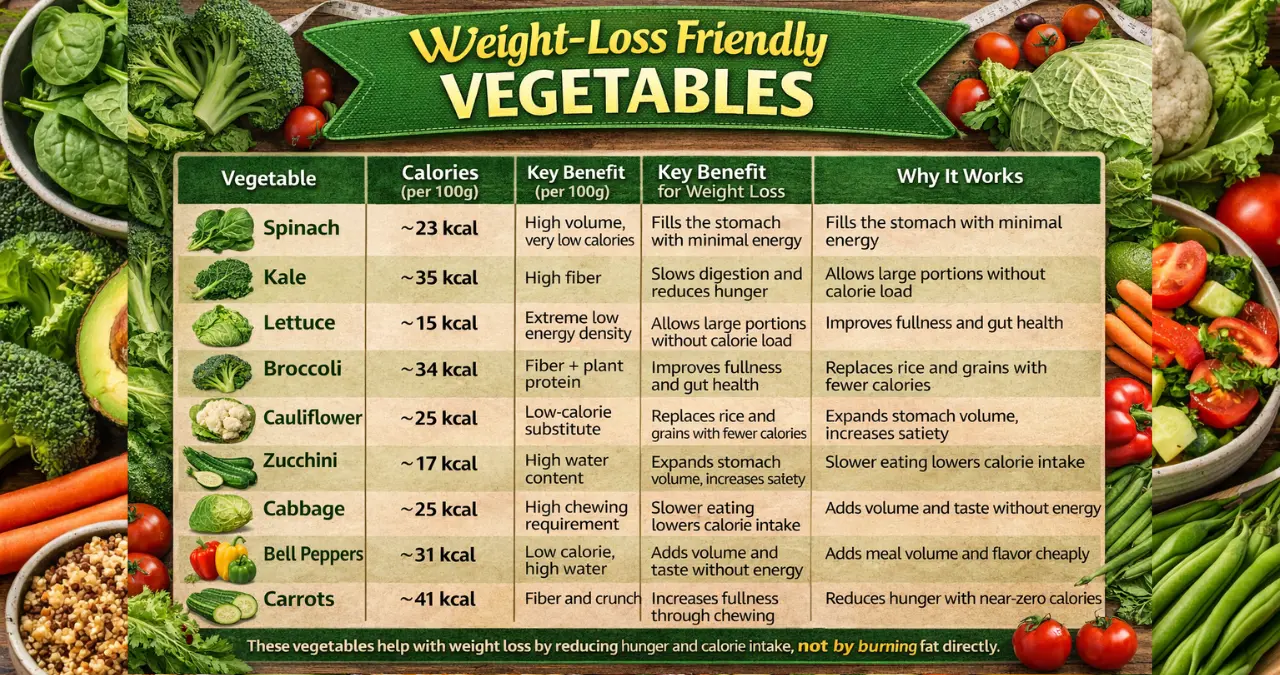
| Vegetable | Calories (per 100g) | Key Benefit for Weight Loss | Why It Works |
|---|---|---|---|
| Spinach | ~23 kcal | High volume, very low calories | Fills the stomach with minimal energy |
| Kale | ~35 kcal | High fiber | Slows digestion and reduces hunger |
| Lettuce | ~15 kcal | Extreme low energy density | Allows large portions without calorie load |
| Broccoli | ~34 kcal | Fiber + plant protein | Improves fullness and gut health |
| Cauliflower | ~25 kcal | Low-calorie substitute | Replaces rice and grains with fewer calories |
| Zucchini | ~17 kcal | High water content | Expands stomach volume, increases satiety |
| Cabbage | ~25 kcal | High chewing requirement | Slower eating lowers calorie intake |
| Bell Peppers | ~31 kcal | Low calorie, high water | Adds volume and taste without energy |
| Carrots | ~41 kcal | Fiber and crunch | Increases fullness through chewing |
| Cucumber | ~16 kcal | Mostly water | Reduces hunger with near-zero calories |
| Tomatoes | ~18 kcal | High water content | Adds meal volume and flavor cheaply |
1)- Spinach
Spinach is basically one of the lowest-calorie vegetables you can find – and a big bowl of the stuff is just a few calories at most, but it’ll fill you up in no time.
It’s full of things like fibre, water, and all sorts of micronutrients that support your metabolism, and research published in Appetite showed that throwing in some leafy greens can actually help you feel fuller and eat fewer calories later on in the day.
You can have it raw, cooked, or a bit of both, really – it’s great in salads, soups, and all sorts of cooked meals.
2)- Kale
Kale is another dense green that’s full of fibre and very low in calories. It takes a bit longer to chew, which slows you down and eats away at your calorie intake – and we all know that eating slower is linked to eating fewer calories in all the studies.
It also has all sorts of compounds in it that support your blood sugar levels, which in turn reduces cravings and overeating – and we’ve got some studies in Nutrition Research to thank for that bit of information.
Best to have it lightly cooked or chucked into a soup to get the best out of it.
3)- Lettuce
Lettuce is water and fibre, so the calorie content is virtually non-existent. You can chuck a huge salad together without impacting your calorie intake.
All sorts of studies have shown that adding in some low-energy-density foods like lettuce before meals can help lower your total calorie intake for the day – and that’s something that’s been reported in The Journal of the American Dietetic Association.
Lettuce is great for when you want to have a big meal but keep calorie intake under control – volume eating and meal size control are the key phrases here.
4)- Broccoli
Broccoli has a whole load of good stuff – fiber, protein, and water. And the calorie content? Pretty low, while the nutrient level is sky high.
All those studies published in The Lancet that looked at fibre intake and body weight found a clear link – people who ate more fibre tended to be leaner. And broccoli is a great way to hit your daily fibre targets without piling on the calories.
It also does your gut a world of good, which in turn can help with weight control.
5)- Cauliflower
People often use cauliflower as a low-calorie substitute for rice and all those high-carb flour-based foods. And the best bit? You can eat a whole lot of it without worrying about the calories piling on.
Cauliflower’s got fibre and water in it, which means it’s filling – and replacing those refined grains with cauliflower has been shown to cut the overall calorie intake in studies where they actually monitored what people ate.
You can steam it, roast it, mash it – whatever you like. And it won’t add a single calorie.
6)- Zucchini
Zucchini’s got almost zero calories and is basically just water, which means it takes up loads of room in the stomach and keeps you feeling full.
It’s a great one to use as a pasta substitute – zucchini noodles can be a real game-changer for people trying to cut their calorie intake. And the studies on this are pretty clear – if you swap out those high-carb pasta dishes for veggie-based ones, you’ll do better with your calorie control.
It’s also super easy to digest and fits into most diets with no problem.
7)- Cabbage
Cabbage is a filling, fibrous, and low-calorie veg. What’s more, it takes a while to chew, which – and this is the important bit – makes you eat slower. Slower eating has been linked to lower calorie intake in loads of studies, actually.
And cabbage is good for your gut too – all that fibre will do your good bacteria a world of good.
Raw or cooked, cabbage is a great addition to any weight control diet.
8)- Bell Peppers
Bell peppers are water, fibre, and a few calories. They also have a sweet taste that’s not at all sugary.
People who swap out high-calorie snacks for bell peppers have been shown to knock out some of their daily calorie intake in studies published in Public Health Nutrition. And they taste bloomin’ great too!
You get loads of volume and flavour with virtually no extra energy.
9)- Carrots
Carrots are fibre and water, and they’re not too sweet either – which means they’ll cut the cravings for those processed foods.
The crunch of a fresh carrot has been shown to increase the feeling of fullness in loads of studies – and it slows down digestion too (all that fibre gets in the way). It’s a guaranteed winner.
Raw carrots are especially good at filling you up.
10)- Cucumbers
Cucumbers are just a load of water, which makes them basically calorie-free – and you can eat a whole lot of them without worrying about piling on the pounds.
Water-rich foods like cucumbers make your stomach feel full and reduce hunger, which is why loads of weight-loss studies have looked at them in Obesity Reviews.
They’re dead easy to add to your meals and snacks.
11)- Tomatoes
Tomatoes are basically calorie-free and are about 90% water. They add loads of flavour and bulk to your meals without adding any extra energy.
Studies have shown that adding tomatoes to meals makes you feel fuller and also gets you to eat fewer calories from other foods. This has been seen in loads of dietary intervention research.
And they’re a great way to stay hydrated while you’re on a calorie-cutting diet.
How to Use Vegetables for Weight Loss
The thing that really gets the weight loss ball rolling with veggies is when they supplant high-calorie foods in your diet. Just tossing some extra veggies into the mix without nixing those rich calorie items is gonna do squat for your fat loss goals.
Some research-backed strategies that actually work include:
- Filling up half your plate with vegetables
- Tucking into a veggie snack before your main meal
- Using veggies as a replacement for grains
This approach knocks down your calorie intake without making you feel like you’re starving – and that’s the beauty of it.
The Bottom Line
Here’s the thing: veggies don’t actually burn fat on their own. What they do is help with fat loss by keeping you from getting too hungry, curbing your calorie intake, and just generally making meals feel more substantial. This has been a well-established part of the science of nutrition for ages.
What really matters is showing up to the table with veggies every day – not necessarily trying to cram in some elaborate salad once a week. The simple, consistent crap tends to produce better results than some fancy-schmancy plan that you’re only gonna stick to for a week or two.
Weight loss isn’t about deprivation – it’s about making better food choices on the regular.

Recent Posts