
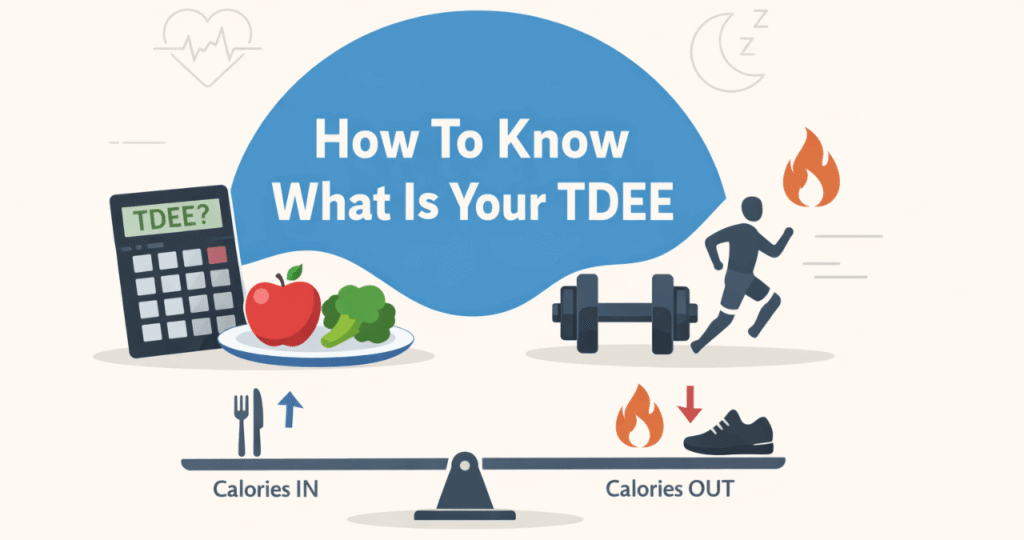
TDEE is a key health metric. It is used to control body weight. It is also used to plan daily calories.
Many people struggle with fat loss. Many also struggle with weight gain. In most cases, calorie needs are misunderstood.
TDEE helps remove confusion. It shows how many calories are burned in one day. Once this number is known, better decisions are made.
This guide explains TDEE in clear terms. Each section gives a direct explanation.
What Is TDEE?
TDEE stands for Total Daily Energy Expenditure. It means the total calories burned in a full day.
Calories are burned even without exercise. They are burned during breathing and circulation. They are also burned during movement. All calorie-burning processes are added together. The final total is called TDEE.
This number represents daily energy use. It does not represent food intake.
Why Is TDEE Important?
Body weight is controlled by energy balance. This is a basic biological rule.
- When calorie intake is lower than TDEE, weight is lost.
- When calorie intake is higher than TDEE, weight is gained.
- When intake matches TDEE, weight stays stable.
Without TDEE, calorie targets are guessed. Guessing leads to slow or failed results. TDEE gives structure. It allows calories to be adjusted with logic.
What Makes Up Your TDEE?
TDEE is not one single process. It is made from four components.
Each component burns calories differently. Some parts are controllable. Others are automatic.
Understanding these parts improves accuracy.
Basal Metabolic Rate (BMR)
BMR is the largest part of TDEE. It usually accounts for 60–70% of calories burned. BMR is the energy used at rest. No movement is required.
Calories are burned to keep organs working. Heart function is supported. Breathing is supported. Body temperature is maintained. BMR depends on body size. Age also plays a role. Muscle mass increases BMR.
This part cannot be avoided. It runs all day and night.
Physical Activity
Calories are burned through movement. This includes planned exercise. Walking, running, and gym workouts are counted.
Sports and physical labor are included. The more intense the activity, the more calories are burned. Duration also matters. This part of TDEE can be controlled. Increasing activity raises calorie needs.
However, exercise is often overestimated. This mistake leads to inaccurate TDEE values.
Thermic Effect of Food (TEF)
Calories are burned during digestion. This is called the Thermic Effect of Food. Energy is used to break down nutrients. Absorption also requires energy.
- Protein requires the most energy to digest.
- Carbs require less.
- Fats require the least.
TEF usually accounts for about 10% of TDEE. It is smaller but consistent. This process happens automatically. No effort is needed.
Non-Exercise Activity Thermogenesis (NEAT)
NEAT includes small daily movements. Exercise is not included here.
- Standing, walking, and cleaning are counted.
- Posture changes are included.
- Fidgeting is also counted.
NEAT varies greatly between people. Some people move more naturally. Others remain still for most of the day.
This difference can change TDEE by hundreds of calories. NEAT is often ignored, but very important.
How To Calculate Your TDEE
TDEE is estimated using math formulas. Exact numbers are not possible. The standard method uses two steps. This method is widely accepted.
Step 1: Calculate Your BMR
The Mifflin-St Jeor formula is commonly used. It is considered reliable. Weight, height, and age are used. Gender is also considered.
For Men
BMR is calculated as:
10 × weight (kg)
- 6.25 × height (cm)
− 5 × age - 5
For Women
10 × weight (kg)
- 6.25 × height (cm)
− 5 × age
− 161
This number shows calories burned at rest only. Movement is not included.
Step 2: Apply Activity Level
BMR is multiplied by activity level. This accounts for movement. Activity level must be chosen honestly. Overestimation causes errors.
Common Activity Levels
- Sedentary includes desk jobs.
- Lightly active includes light exercise.
- Moderately active includes regular workouts.
- Very active includes intense training.
- Extremely active includes physical labor.
Each level increases calorie needs. The multiplier reflects this increase.
Example TDEE Calculation
An example helps clarify the process.
A person has a BMR of 1,700 calories. They exercise three to four times per week. Moderate activity is chosen. The multiplier used is 1.55.
1,700 × 1.55 = 2,635 calories
This is the estimated TDEE. This is the daily calorie burn.
Using TDEE For Weight Loss
Fat loss requires a calorie deficit. This means eating less than TDEE. A moderate deficit works best. A reduction of 300–500 calories is common.
Extreme deficits are not advised. Muscle loss may occur. Energy levels may drop. Slow and steady loss is safer.
TDEE helps guide this process.
Using TDEE For Weight Gain
Weight gain requires a surplus. Calories must exceed TDEE. A small surplus is recommended. 300–500 extra calories are usually enough. Large surpluses increase fat gain. They do not speed muscle growth.
TDEE helps control the surplus size. Progress becomes predictable.
Is TDEE Always Accurate?
TDEE is an estimate. It is not a perfect number.
Metabolism varies between people. Hormones affect energy use. Sleep and stress also matter. Tracking weight helps improve accuracy. If weight changes too fast, calories are adjusted.
TDEE should be treated as a starting point.
Common Mistakes With TDEE
Several mistakes are often seen.
- Activity levels are overstated.
- Calories eaten are underreported.
- Daily fluctuations cause panic.
Short-term changes are misleading. Weekly trends matter more. Consistency improves results more than precision.
How Often Should TDEE Be Updated?
TDEE changes with body weight. It also changes with activity level. Rechecking every 2–4 weeks is reasonable. Adjustments should be small.
Large changes are rarely needed.
Final Thoughts
TDEE is a practical tool. It brings logic to dieting. Calories are not emotional. They are measurable energy. When TDEE is understood, control improves. Guessing is reduced. Results become predictable.
Discipline becomes easier.
Knowledge stays more powerful than motivation.

Recent Posts