
Use this free TDEE calculator to estimate how many calories your body needs each day based on age, weight, height, and activity level.
TDEE Calculator
Calculate your Total Daily Energy Expenditure
What is TDEE?
Total Daily Energy Expenditure (TDEE) is the total number of calories your body burns in a day. Understanding your TDEE is essential for achieving any weight-related goal.
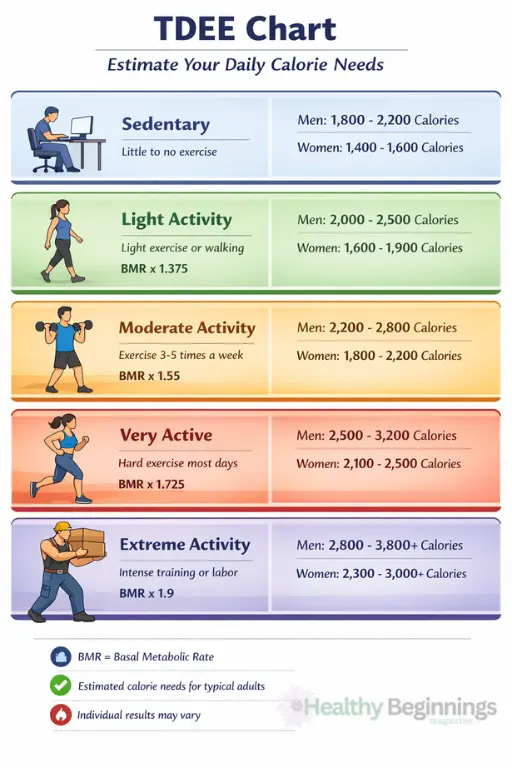
TDEE consists of four components:
- BMR (60–75%): Calories burned at rest
- Physical Activity (15–30%): Exercise and movement
- TEF (≈10%): Thermic Effect of Food (digestion)
- NEAT (5–15%): Non-exercise activity like walking or fidgeting
The Mifflin-St Jeor Equation
This calculator uses the Mifflin-St Jeor equation, widely considered the most accurate method for estimating basal metabolic rate (BMR) in adults.
| Gender | BMR Formula |
|---|---|
| Men | (10 × weight kg) + (6.25 × height cm) − (5 × age) + 5 |
| Women | (10 × weight kg) + (6.25 × height cm) − (5 × age) − 161 |
Your final TDEE is calculated by multiplying your BMR by an activity factor that reflects your daily movement and exercise level.
How to Use Your TDEE
For Weight Loss
Create a calorie deficit of 300-500 calories below your TDEE. This results in approximately 0.5-1 lb (0.25-0.5 kg) of weight loss per week, which is sustainable and helps preserve muscle mass.
For Weight Maintenance
Eat at or near your TDEE to maintain your current weight. This is ideal when you’re satisfied with your body composition and want to focus on performance or health.
For Muscle Gain
Eat 200-300 calories above your TDEE while following a resistance training program. This provides enough energy for muscle growth while minimizing fat gain.
Pro Tip: Regardless of your goal, prioritize protein intake (1.6-2.2g per kg body weight) to support muscle maintenance and satiety.
Activity Level Guide
| Level | Description | Multiplier |
|---|---|---|
| Sedentary | Desk job, little or no exercise | 1.2 |
| Lightly Active | Light exercise 1-3 days/week | 1.375 |
| Moderately Active | Moderate exercise 3-5 days/week | 1.55 |
| Very Active | Hard exercise 6-7 days/week | 1.725 |
| Extremely Active | Athlete or physical labor job | 1.9 |
Tip: Most people overestimate their activity level. If unsure, start with a lower level and adjust based on results after 2-3 weeks.
Tips for Accurate Tracking
- Weigh yourself weekly at the same time (morning, after bathroom) and track the average
- Be honest about activity level – most people are less active than they think
- Give it 2-4 weeks before adjusting calories based on results
- Account for water fluctuations – weight can vary 2-5 lbs daily
- Recalculate every 10-15 lbs of weight change
⚠️ Medical Disclaimer
This calculator provides estimates for educational purposes. Individual metabolic rates vary based on genetics, body composition, and health conditions. Consult a healthcare professional or registered dietitian for personalized nutrition advice.
Frequently Asked Questions
Published by Healthy Beginning Magazine